On this page
- Define the seven-stage RIGHTS model
- Current MarketPulse workflow
- Choose a response-based service promise
- Assign distribution and handoff owners
- Evaluate the supported distribution chain
- Compare build, resell, refer and avoid
- Price media and accepted delivery
- Preserve response and outcome evidence
- Choose clients with follow-up capacity
- Keep research, response and identity separate
- Control source and delivery risks
- Maintain the recurring syndication package
- Validate acceptance before buying reach
- A file-link click is not proof that someone read the asset
- Worked example: raw responses and accepted delivery have different costs
- Frequently asked questions
Direct answer: Productize intent-based content syndication only when the agency can connect an approved audience, relevant content, documented distribution rights, lead validation, and a client-owned follow-up process. Promise governed delivery of accepted, context-rich responses. Do not promise that a content interaction identifies a decision maker or creates pipeline.
Current MarketPulse offer: intent-data plans start at $500/mo. See the product, demo, and current plans. Updated October 3, 2026.
The recurring value is not merely placing an asset. It is maintaining the topic-to-content map, qualification rules, suppression, delivery evidence, and learning loop that make each program more usable.
Who this is for: B2B agencies considering a managed syndication offer tied to intent signals, content consumption, lead acceptance, and sales handoff.
Define the seven-stage RIGHTS model
- Rights: confirm content ownership, distribution permission, audience source, and permitted use.
- Intent: define topic evidence and keep research signals separate from content response.
- Gate: apply account, role, geography, duplicate, permission, and suppression rules.
- Humanize: review context and assign a useful next action rather than an automatic pitch.
- Transfer: deliver accepted fields, source, timestamps, and qualification evidence.
- Score: record acceptance, response quality, activation, and downstream association.
- Tune: change topics, assets, sources, or rules through documented approval.
This operational framework doubles as an intent based content syndication services implementation guide and checklist. It makes rights and acceptance part of delivery instead of treating them as afterthoughts.
Current MarketPulse workflow
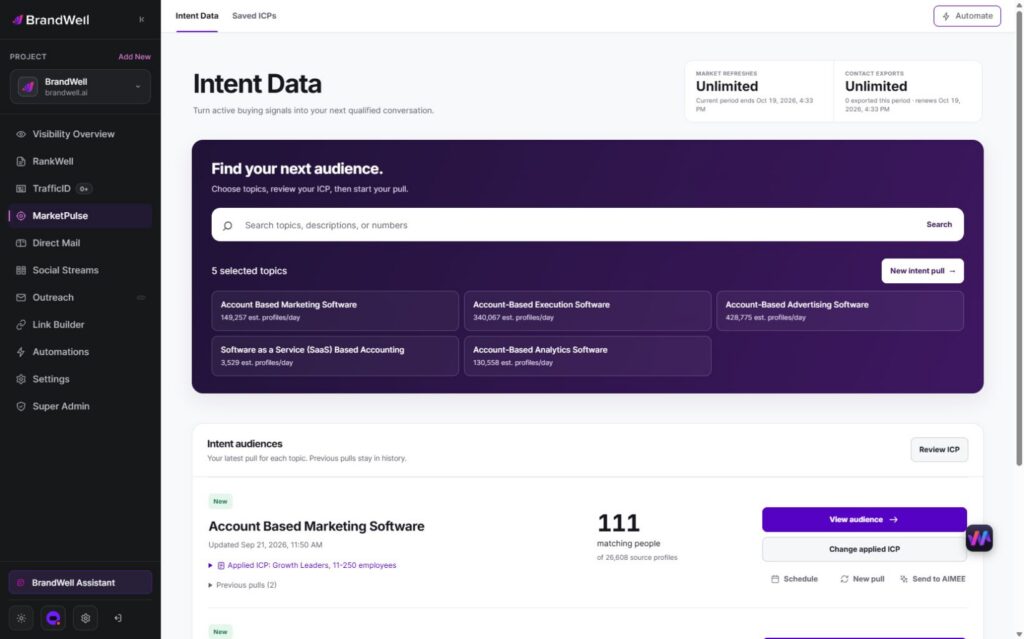
BrandWell MarketPulse: intent data starting at $500/mo. Find people researching topics relevant to what you sell, apply saved ICP filters, and review available contact details before taking action.
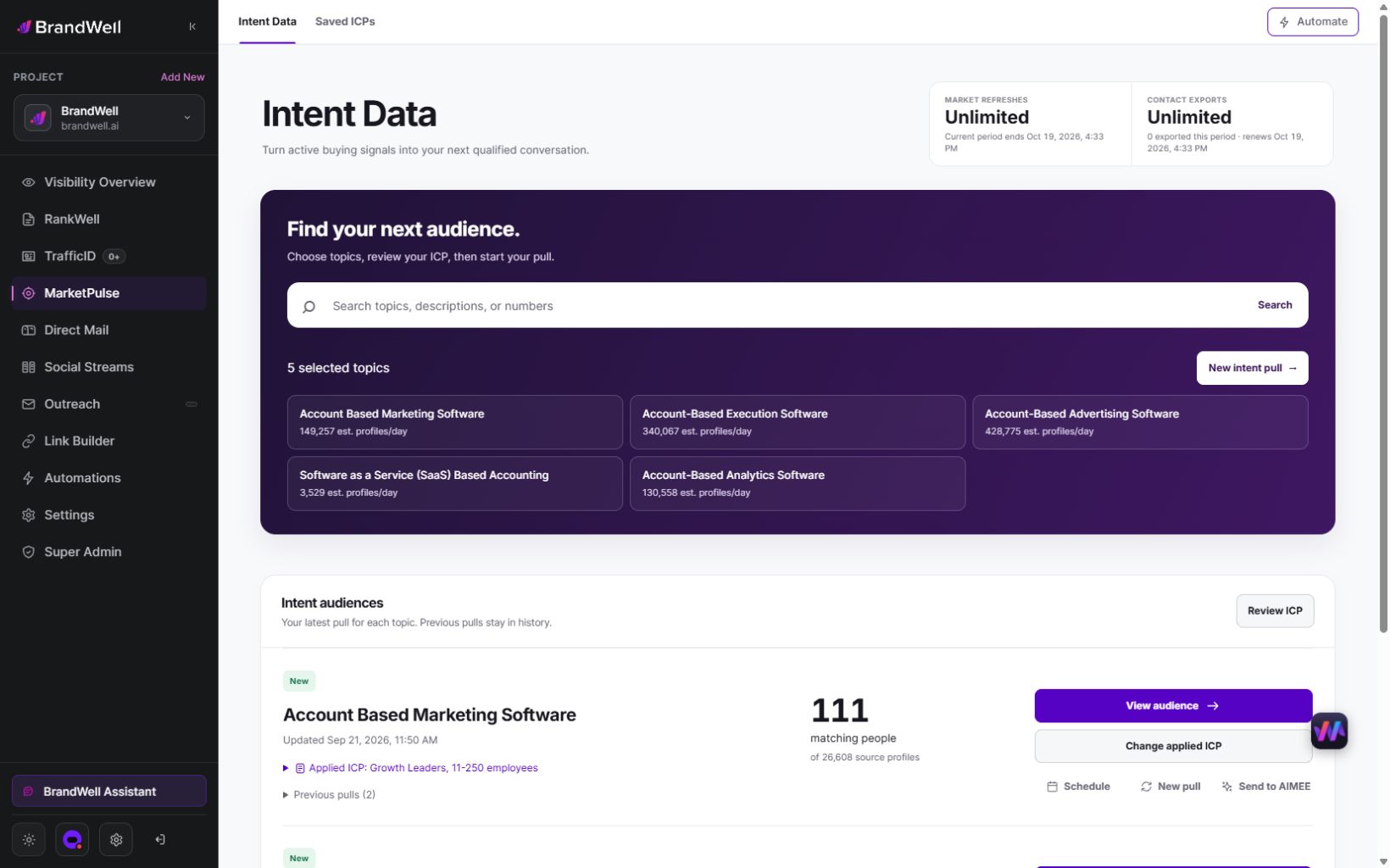
MarketPulse plans are starting at $500/mo. Verify current package scope and offers on the product page.
| Plan | Topics and refreshes | Monthly exports |
|---|---|---|
| Starter | 1 topic, weekly | 25,000 contacts |
| Growth | 3 topics, daily | 100,000 contacts |
| Scale | 10 topics, daily | Unlimited contacts |
Swipe the table to see all columns.
A pull retrieves available data from the previous 24 hours for one topic. Daily use across all included topics provides 90 Growth pulls or 300 Scale pulls in a 30-day month. Weekly Starter pulls vary by calendar month. Available audience size and contact fields vary, and audiences may overlap. Refreshes stop at the plan limit without overage charges.
- Find and qualify: search the topic catalog, save your ICP, and review the people and companies that match.
- Act on the research: export qualified contacts or prepare an Outreach or Direct Mail workflow. Connected products, channel usage, and fulfillment may cost extra.
- Get help from AIMEE: Growth and Scale include AIMEE for the initial user to research accounts and prepare the next step through connected tools.
Agencies and other service businesses can build client deliverables around their available Intent Scans and exports. Keep each client’s scope, permissions, and service fees clear. A subscription is not a promise of a white-label platform or exclusive access to a market.
Explore MarketPulse and watch the demo or compare plans starting at $500/mo. Any early-access discount is a separate, time-limited offer shown to an eligible recipient.
Choose a response-based service promise
Offer the service to clients that own useful content, know their target accounts or qualification criteria, and can follow up on accepted responses. The honest client outcome is a repeatable process that distributes approved assets to a defined audience, validates returned responses against written rules, and supplies enough context for a client decision. The service can improve prioritization and learning, but consumption alone does not prove authority, budget, readiness, or pipeline.
A good strategy starts with one business question: which approved content should reach which audience after which signal, and what action should the client take if the response meets the acceptance rule? If no one owns that action, more delivery simply creates a larger queue. Intent-based content syndication services for agencies deciding what to sell next should be evaluated as an operating system, not as purchased lead volume.
Do not offer the service when content rights are uncertain, the client demands undisclosed lead sources, no suppression process exists, or sales rejects the format. A standard content campaign, a first-party nurture program, or a one-off distribution project may be the better alternative. The service promise must stay narrower than the client’s commercial ambition.
Assign distribution and handoff owners
The agency strategist owns the audience and content map. A media or distribution operator manages approved sources and delivery. A data-quality reviewer validates identity fields, duplicates, suppression, and acceptance rules. The client marketing owner approves content and audience. The client sales or revenue-operations owner accepts the handoff definition and records action. Privacy or legal reviewers decide fact-specific rights and marketing requirements.
- Approve content rights, source terms, target profile, exclusions, and destinations.
- Select and maintain topics with clear inclusion and negative terms.
- Map each topic and audience state to an approved asset and response path.
- Receive publisher or partner delivery with source and event context intact.
- Deduplicate, validate required fields, apply suppression, and flag conflicts.
- Route accepted responses to the client owner; quarantine incomplete or disputed records.
- Record client acceptance, action, feedback, and any downstream association.
Set SLAs for content approval, source intake, validation, accepted delivery, exception response, and correction. Exclude delays caused by missing assets, pending client approvals, or unavailable destination access. The handoff should include source, asset, interaction type, topic context, permission state, identity confidence, qualification rule, rejection reason, and next owner. Use BrandWell’s guide to choosing and maintaining intent topics to make the topic layer explicit.
Evaluate the supported distribution chain
Choose by capability rather than by an undated vendor ranking. The required stack includes topic governance, content asset management, distribution or publisher operations, form and permission capture, identity and company validation, duplicate and suppression checks, client-branded delivery, CRM routing, and evidence reporting. A provider that generates responses but cannot preserve source and consent context creates a difficult service to defend.
Apply identical evaluation criteria to any build, managed platform, publisher network, or white-label option: audience origin, distribution rights, content rights, field definitions, permission evidence, source transparency, duplicate policy, validation method, acceptance remedy, exports, security, integration, support, and quote-backed total cost. Pricing and volume facts are unavailable unless verified in current written terms.
AIMEE can help research a reviewed account and prepare drafts through configured connected tools. Preserve source, asset, rights, response type and the human approval boundary. This does not establish a native publisher network or autonomous distribution capability.
Compare build, resell, refer and avoid
| Path | Best fit | Watch closely |
|---|---|---|
| Build | A narrow owned audience, first-party content, and an experienced operations team. | Distribution reach, permission capture, fraud controls, and maintenance. |
| Resell | A contracted source can meet evidence, branding, acceptance, and support requirements. | Opaque sourcing, duplicate definitions, and obligations that remain with the agency. |
| Refer | The client needs publisher scale or specialist media buying beyond agency capability. | Client experience, evidence access, and economics may sit outside the agency. |
| Avoid | The client requires guaranteed volume or hides how responses will be used. | No operational design can repair an unsafe or misleading promise. |
Swipe the table to see all columns.
This comparison should include the status quo. A client with strong first-party distribution and nurture may not need a separate recurring service. A one-off syndication project can test content and handoff. Referral may preserve trust when a specialist is required. The decision guide should weigh control, learning, rights, client capacity, and recurring economics, not just apparent cost per record.
Price media and accepted delivery
Price the complete service, not only media. Separate setup work such as audience definition, topic selection, content mapping, source review, qualification design, integration, and acceptance testing. Recurring intent based content syndication services cost includes contracted distribution or media, data and validation, labor, rejected or replaced delivery administration, client reporting, support, governance, and overhead.
Copyable syndication economics model
Accepted delivery cost = eligible media and source cost + validation labor + rejected-delivery handling + reporting and support
Monthly contribution = collected client fee - direct recurring delivery cost
Defined contribution percentage = monthly contribution / collected client fee
Sensitivity inputs = acceptance rate, duplicate rate, replacement policy, source mix, asset count, destinations, client review time
A realistic gross margin is unavailable until those inputs are observed under the actual contract. Model scenarios and state assumptions. Do not use an external benchmark whose definition of lead, acceptance, or included media differs from yours. Reprice when audience, asset, source, SLA, or qualification rules change.
Preserve response and outcome evidence
Start with delivery evidence: approved asset, distribution source, response event, validation status, duplicate check, suppression result, acceptance outcome, destination receipt, and client owner. Then measure use: review completion, accepted response, assigned action, response disposition, and content or topic feedback. Only after that should the agency report opportunity or revenue associations recorded under the client’s attribution rules.
Useful KPIs include eligible deliveries, accepted responses, rejection reasons, duplicate rate, completion and engagement context, destination acceptance, time to client review, activation rate, and downstream disposition. Cost per accepted response can be useful if every included cost and the acceptance definition are explicit. Intent based content syndication services ROI must show the exact numerator, denominator, evaluation population, and attribution limit.
Use a holdout or staged comparison when feasible, but never represent a small operational test as universal proof. Content consumption may be meaningful engagement without proving a buying event. BrandWell’s intent-data pipeline attribution guide can help separate delivery, influence, association, and unavailable evidence.
Choose clients with follow-up capacity
Best-fit clients have a defined B2B audience, relevant owned content, an agreed acceptance rule, adequate follow-up capacity, and a system that can record disposition. Strong use cases include distributing a technical guide to approved account segments, testing content relevance across topic clusters, or feeding qualified responses into a human-reviewed account program.
Exclude clients with weak or outdated assets, no owner for rejected leads, indiscriminate outreach plans, undefined permission standards, or an expectation that every downloader will become an opportunity. Also exclude sensitive audiences or uses that require controls the agency and client cannot support. A smaller client may be better served by improving first-party conversion and nurture before buying distribution.
A practical fit checklist covers content rights, target definition, topic specificity, source transparency, permission, suppression, duplicate handling, acceptance, destination, follow-up capacity, and attribution. If the client cannot answer who may receive which record and why, the program is not ready.
Keep research, response and identity separate
Keep four evidence streams separate. Topic research signals indicate that a company may be researching a subject. Content response shows a particular interaction under the source’s terms. Identity evidence connects permitted fields to a company or person with a stated confidence. Qualification evidence tests the response against client rules. None should silently substitute for the others.
An activation record should include source, asset, event type, timestamp, topic context, entity level, validation result, permission or lawful-use status, suppression outcome, qualification state, destination, owner, and action. The client can then decide whether to research the account, add the person to an approved nurture, request human outreach, or take no action.
The destination should preserve the same distinctions. Do not place a content response directly into a sales-ready stage because a file arrived. Define the accepted field mapping, owner, action menu, rejection reason, and correction route using the client CRM and marketing-stack integration guide. This makes the handoff reproducible across sources.
For implementation examples, use a decision path rather than a claim: company topic activity plus an accepted content response may justify human account review. It does not prove purchase authority. A response missing required permission or identity evidence remains quarantined. These activation workflows protect signal quality and measurement.
Control source and delivery risks
Common mistakes include accepting opaque sources, ignoring duplicate definitions, losing content rights evidence, treating form completion as authority, failing to apply suppression, and allowing the client to contact every returned record automatically. Delivery risk also includes late files, schema changes, invalid fields, mismatched assets, and disputes over replacement.
Keep source rights, content ownership, allowed audience use, suppression, validation and approval evidence in the campaign record. Applicable marketing requirements depend on the channel, jurisdiction and facts. Authorized client and legal reviewers must approve the actual program; this operating checklist is not a compliance finding.
Qualified counsel and authorized client reviewers must decide applicable requirements, source rights, and contact permission. If any required fact is unavailable, mark it unavailable and stop the affected activation.
Maintain the recurring syndication package
The package should define target segments, topics, approved assets, source classes, rights, acceptance rules, duplicate and suppression logic, delivery cadence, replacement terms, destinations, owners, service levels, evidence reporting, and change control. Label standard, configurable, custom, and out-of-scope work. Include a content-to-topic template, accepted-response sample, rejection taxonomy, and monthly learning brief.
The agency chooses retail pricing, manages client billing, and records the client action tied to each accepted response. Those commercial and operational responsibilities do not transfer to a publisher or platform. Write them into the responsibility matrix so the client knows who approves, who acts, who reports, and who resolves an exception.
MarketPulse supplies topic audiences and saved ICP filtering starting at $500/mo. RankWell can help develop reviewed content, while configured Outreach and AIMEE workflows can help prepare an approved next step. Publisher distribution, qualification services and agency delivery need their own verified implementation and fees.
Use the first reporting cycle to reconcile every accepted and rejected response with the client’s owner. Show asset, source, permission, qualification, destination, action, and limitation. That review provides more information than a headline lead count and helps the agency decide whether to adjust the topic map, content, source, acceptance rule, or client follow-up capacity.
Copyable agent-ready syndication QA workflow
Use Claude, ChatGPT, or AIMEE with only approved content, source terms, audience rules, and a minimized response sample.

1. Map each topic and audience state to an approved asset and allowed response path.
2. Check content rights, source, permission evidence, duplicate key, suppression, identity state, and acceptance fields.
3. Flag missing context, conflicting fields, rejected records, and any automatic outreach rule.
4. Draft a client handoff with evidence, limitation, owner, and permitted next action.
5. Produce a change proposal for human review. Preserve the original record.

STOP CONDITIONS:
- Do not infer authority, budget, readiness, permission, identity, or a commercial outcome.
- Do not invent a source, right, acceptance result, benchmark, price, or attribution fact.
- Do not distribute content, change a campaign, export data, or contact anyone.

HUMAN APPROVAL REQUIRED:
The content owner approves assets and rights. Authorized privacy or legal reviewers approve applicable uses. The client revenue owner accepts routing and action rules. The agency owner approves scope, source contracts, and price. A human approves every activation.
The agent produces drafts and exception lists, not autonomous marketing. Human approval preserves context when rights, audiences, or client capacity change.
Validate acceptance before buying reach
Run a bounded program with one audience, one topic cluster, one approved asset, and one handoff. Fix rejection, permission, or follow-up problems before adding sources or volume.
A file-link click is not proof that someone read the asset
Google Analytics enhanced measurement documentation defines file_download around clicks on links to supported file types. Treat this as the configured interaction event, not proof of completed reading, purchase authority or buying intent.
For a partner-distributed asset, request the partner’s actual event definition rather than assuming it equals your site’s event. Keep raw events, unique permitted respondents, accepted records and client actions separate. Reconcile an event ID or documented duplicate key; do not silently equate repeated clicks with additional people.
Worked example: raw responses and accepted delivery have different costs
Suppose a fictional campaign returns 200 response rows. Thirty are repeat rows under the written deduplication rule, leaving 170 distinct respondents. Fifty fail required client acceptance checks, leaving 120 accepted responses. Acceptance is 120 / 170 = 70.6% of distinct respondents, or 120 / 200 = 60% of delivered rows. State which denominator you use.
Suppose media costs $1,500, validation costs $600, reporting costs $300 and the allocated research subscription costs $500. Defined recurring cost is $2,900: $14.50 per raw row, $17.06 per distinct respondent or $24.17 per accepted response. A $4,000 client fee leaves $1,100, or 27.5%, before acquisition, setup recovery, general overhead, financing and tax. Ten extra review hours at $75 reduce that remainder to $350, or 8.75%. These are invented planning inputs, not provider quotes or typical outcomes.
If 60 of the 120 accepted respondents receive a recorded client follow-up and six become recorded opportunities, report 50% activation among accepted respondents, 10% opportunity association among activated respondents and 5% among all accepted respondents. Those rates describe this cohort; they do not prove that syndication caused the opportunities.
Build useful content and review the next step in BrandWell
Use MarketPulse to review topic audiences against a saved client ICP, preserving each pull’s actual preceding-24-hour window. Use RankWell to develop an original brief and draft, then verify facts, links and assets before publishing through a supported connection. Prepare permitted follow-up through configured Outreach or AIMEE tools. BrandWell’s topic data is not evidence that a person downloaded or read that specific asset; preserve the separately recorded response.
Frequently asked questions
Does MarketPulse distribute content through a publisher network?
The current product supplies topic research audiences. A publisher distribution service needs its own verified scope.
Is a file-download event a qualified lead?
No. Preserve the event definition, then apply the client’s explicit acceptance and use rules.
Which cost-per-response denominator should we use?
Label raw rows, unique respondents and accepted responses separately and include the stated program costs.
Do opportunities after the campaign prove incremental pipeline?
No. Preserve the cohort, follow-up record, attribution method and alternative explanations.
Start with the research and content workflow: explore MarketPulse and review RankWell for content planning and production.
Reviewed and updated October 3, 2026.

Written by