On this page
- Current MarketPulse workflow
- Standardize the core and bound client overlays
- Assign admission and handoff owners
- Evaluate the supported multi-client stack
- Compare manual, automated and branded delivery
- Model setup and exception capacity
- Measure quality and tail performance
- Match delivery to client readiness
- Keep research and identity states separate
- Control shared workflow changes
- Maintain the recurring client service
- Measure resource consumption rather than client count alone
- Worked example: exception hours determine the admission limit
- Frequently asked questions
Direct answer: Scale an intent-data service across many agency clients by treating it as a governed multi-tenant operating system. Standardize the core service, isolate every client’s data and configuration, automate only stable handoffs, price exceptions, and admit new clients only when capacity and quality gates pass. The first useful outcome is not a large record count. It is a delivery the client accepts, understands, and can act on without the agency breaking its controls.
Current MarketPulse offer: intent-data plans start at $500/mo. See the product, demo, and current plans. Updated October 3, 2026.
Adding accounts to a shared spreadsheet is not scale. A scalable service can show which tenant owns every signal, rule, user, destination, retention period, correction, and outcome record. It also makes custom work visible before that work erodes delivery capacity.
This guide is for agency owners and operators building a separately scoped client service around supported MarketPulse research. Use saved ICP filtering and the selected plan allowances; verify client permissions and configured connections. Agency portals, branded interfaces, tenant provisioning and custom integrations are separate implementation work.
Current MarketPulse workflow
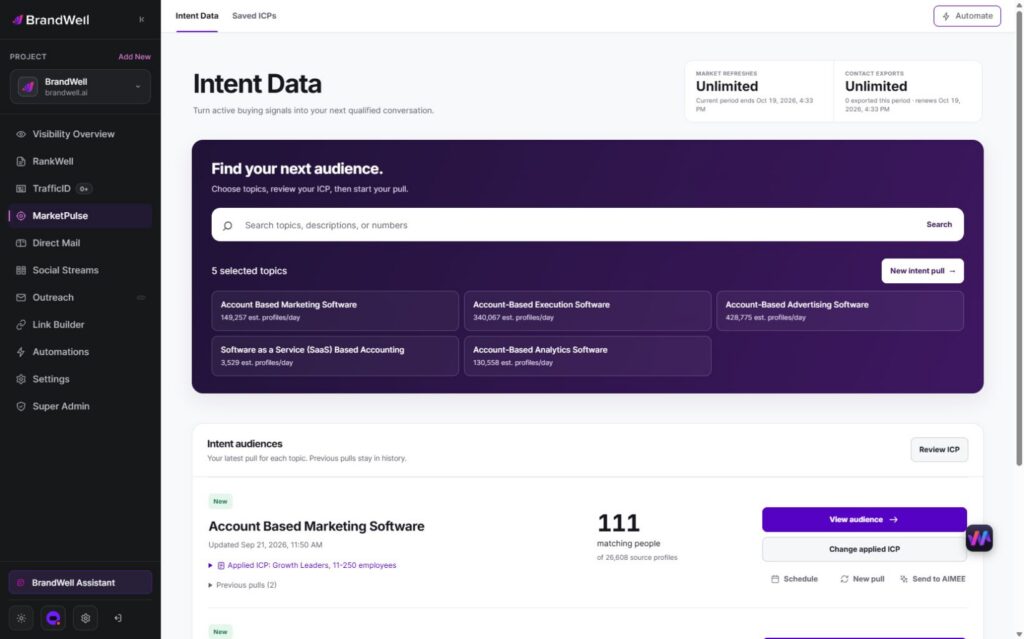
BrandWell MarketPulse: intent data starting at $500/mo. Find people researching topics relevant to what you sell, apply saved ICP filters, and review available contact details before taking action.
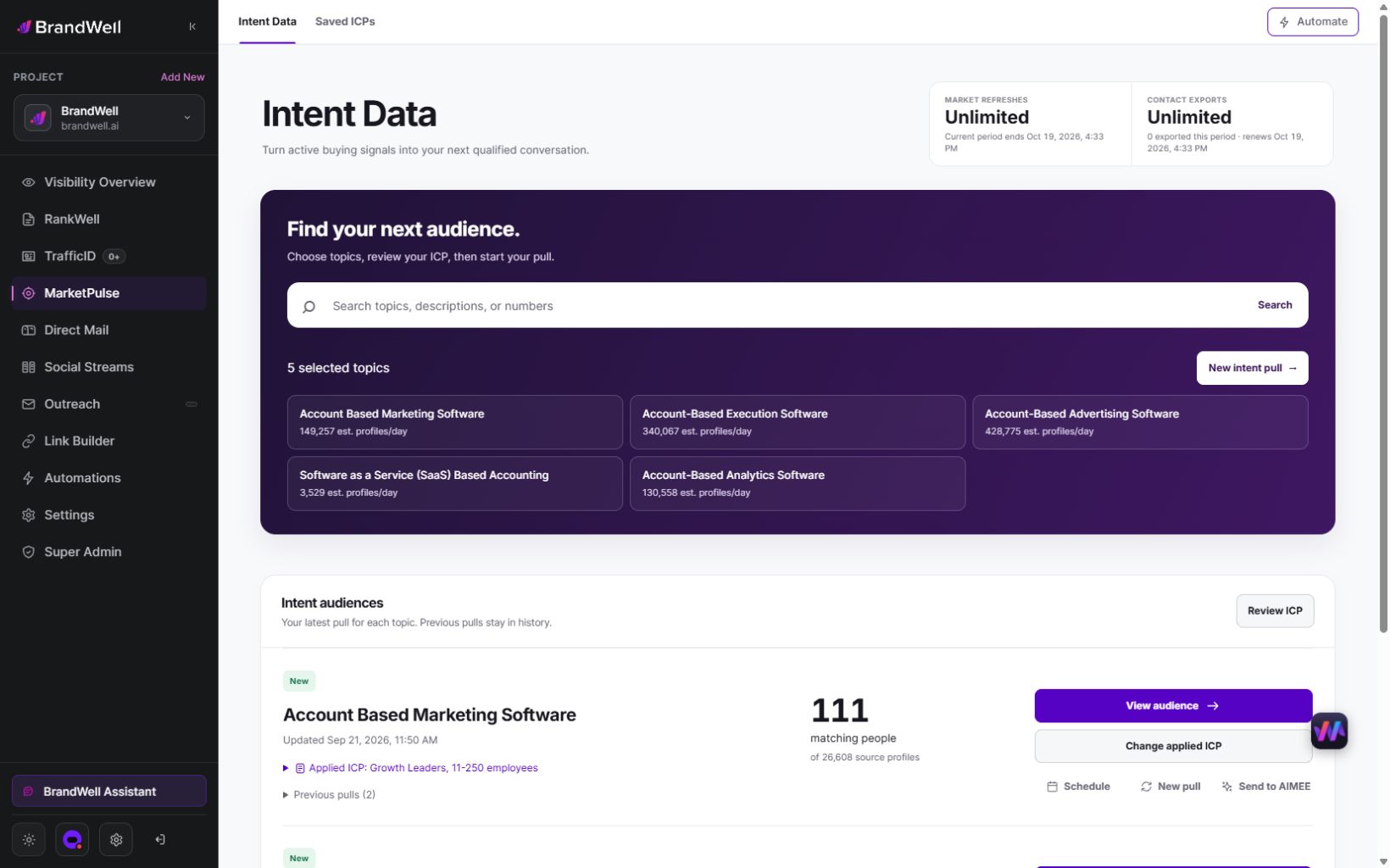
MarketPulse plans are starting at $500/mo. Verify current package scope and offers on the product page.
| Plan | Topics and refreshes | Monthly exports |
|---|---|---|
| Starter | 1 topic, weekly | 25,000 contacts |
| Growth | 3 topics, daily | 100,000 contacts |
| Scale | 10 topics, daily | Unlimited contacts |
Swipe the table to see all columns.
A pull retrieves available data from the previous 24 hours for one topic. Daily use across all included topics provides 90 Growth pulls or 300 Scale pulls in a 30-day month. Weekly Starter pulls vary by calendar month. Available audience size and contact fields vary, and audiences may overlap. Refreshes stop at the plan limit without overage charges.
- Find and qualify: search the topic catalog, save your ICP, and review the people and companies that match.
- Act on the research: export qualified contacts or prepare an Outreach or Direct Mail workflow. Connected products, channel usage, and fulfillment may cost extra.
- Get help from AIMEE: Growth and Scale include AIMEE for the initial user to research accounts and prepare the next step through connected tools.
Agencies and other service businesses can build client deliverables around their available Intent Scans and exports. Keep each client’s scope, permissions, and service fees clear. A subscription is not a promise of a white-label platform or exclusive access to a market.
Explore MarketPulse and watch the demo or compare plans starting at $500/mo. Any early-access discount is a separate, time-limited offer shown to an eligible recipient.
Standardize the core and bound client overlays
Design around a fixed service spine and isolated client overlays. The spine contains the intake schema, signal states, identity states, QA method, delivery receipts, reporting logic, and incident process. Each client overlay contains that client’s purpose, topics, exclusions, users, permissions, destinations, service level, retention, and approved actions. This gives the agency one operating method without pretending every client is identical.
Define time to value as the interval from an approved configuration to the first accepted, usable delivery. Do not define it as the time to a sale or revenue event. Those outcomes depend on the client’s offer, follow-up, sales cycle, and market conditions. A practical scale strategy therefore improves the steps the agency controls: configuration accuracy, delivery latency, acceptance, adoption, and correction speed.
Create an admission gate before promising a start date. Confirm the use case is supported, the client has an action owner, the destination is ready, the data-use purpose is documented, and expected exception work fits available capacity. When any condition fails, offer a smaller report-based package or delay onboarding. Fast value comes from a narrow service that works, not a wide scope that creates hidden queues.
Assign admission and handoff owners
Use one control model for every client, then record the client-specific decision at each gate. Assign an accountable owner, input, output, evidence field, and stop condition. The workflow should sit inside a documented intent-data delivery SOP, while the service agreement separately defines the SLA clock, exclusions, escalation, and remedy.
Seven-gate multi-client scale control model
- Qualify: confirm fit, purpose, action owner, data destination, prohibited uses, and commercial scope.
- Isolate: create the tenant record for topics, permissions, users, retention, suppression, and client branding.
- Define: document signal types, company and person identity states, confidence rules, validation, and accepted-record criteria.
- Provision: configure integrations from a controlled template and test authentication, field mapping, routing, and rollback.
- Inspect: sample outputs, test exclusions, reconcile counts, and route exceptions to a tenant-specific queue.
- Deliver: release through the agreed cadence, record the receipt, and capture acceptance or correction.
- Review capacity: compare recurring minutes, exception minutes, SLA load, failure rate, and contribution estimate before adding another client.
The SLA should measure a controllable service event, such as time from an eligible signal entering the approved queue to delivery or review. It should not promise a response, meeting, opportunity, or sale. Use a separate SLA design process to specify business hours, client dependencies, severity, paused states, maintenance, and evidence. A handoff is complete only when the destination acknowledges the record or a named owner accepts the report.
Version every shared template. A change request should name the tenant, requester, reason, affected rules, test evidence, approver, deployment time, and rollback. Never patch a shared workflow for one client without checking the other tenant paths. This small discipline keeps customization visible and prevents yesterday’s exception from becoming tomorrow’s undocumented default.
Evaluate the supported multi-client stack
The best stack is the smallest one that enforces tenant boundaries and makes exceptions observable. Evaluate capability classes rather than chasing a universal platform ranking. You need a tenant registry, entitlement control, signal and identity layer, workflow orchestration, QA queue, agency-branded delivery surface, reporting layer, and audit trail. Some systems may cover several classes, but the responsibilities still need separate tests.
- Tenant registry: one authoritative client identifier linked to purpose, contract, users, topics, destinations, and lifecycle status.
- Entitlement layer: roles and permissions for view, export, configure, approve, and administer actions.
- Data layer: explicit signal source, entity type, confidence, freshness, validation, and suppression fields.
- Orchestration: idempotent jobs, retries, dead-letter or exception handling, versioned rules, and rollback.
- Portal and reporting: client branding, scoped views, evidence receipts, corrections, and usage visibility.
Test each tool with two synthetic tenants and deliberately similar identifiers. Attempt an unauthorized export, a stale token, a failed destination, a configuration rollback, and an offboarding request. If an evaluator cannot prove who changed a rule or prevent one tenant from reaching another tenant’s object, the tool does not pass the operating test. Any named product capability must be checked on its current primary documentation before publication.
Compare manual, automated and branded delivery
Manual delivery is strongest during discovery and unstable workflows. Automation is strongest after inputs, rules, exceptions, and outputs are understood. A white-label approach is useful when the agency needs branded repeatability without building the entire data and portal layer. A hybrid can combine human qualification and exception review with verified deterministic routing. A branded delivery interface is useful only when its controls and recurring costs fit the client decision.
| Approach | Best fit | Main cost | Switch trigger |
|---|---|---|---|
| Manual | First client, changing offer, complex judgment | Labor and inconsistency | Stable steps repeat and queues become predictable |
| Automated | High-repeatability routing and validation | Design, monitoring, and failure recovery | Exceptions or client variation exceed the rules |
| White-label | Agency-branded modules and portal delivery | Wholesale, usage, configuration, and vendor dependency | Required controls or economics no longer fit |
| Hybrid | Most mature recurring services | Clear ownership across people and systems | One path can pass all controls with less complexity |
Swipe the table to see all columns.
Do not compare the choices on headcount alone. Compare time to configure, cost to change, exception minutes, tenant isolation, evidence quality, client experience, and exit effort. Adding a person can be the safer choice when rules are still moving. Automating a bad rule merely distributes the error faster.
Model setup and exception capacity
Model setup and delivery from the work, usage, and risk the scope creates. Setup includes discovery, purpose and topic design, tenant provisioning, integrations, field mapping, QA, client training, and acceptance. Recurring cost includes platform and usage, analyst review, exception handling, support, reporting, security administration, and account management. Add a reserve for rework when the client changes a destination or qualification rule.
Copyable capacity and cost worksheet
For each client, record: contracted modules; one-time setup hours; recurring base minutes; exception minutes; expected run frequency; usage unit and rate; SLA load; support minutes; error or correction rate; direct delivery cost; agency retail revenue; and contribution before shared overhead. Review the same fields by service package and across the total portfolio.
Set a setup fee from scoped work and risk, not from a copied market number. Set the recurring retail price from the package’s client value and delivery burden. Then stress-test what happens if exception minutes double, usage rises, or an integration fails. There is no defensible universal setup fee or gross-margin benchmark for this service. The agency controls its client retail pricing and billing.
Measure quality and tail performance
Use a measurement ladder. First measure service integrity: provisioning time, eligible-to-delivered time, SLA attainment, successful destination receipts, and open exceptions. Then measure quality: accepted-record rate, verified-field rate, duplicate rate, false-match corrections, and suppression compliance. Next measure adoption: client logins are weak evidence by themselves, so also track assigned actions, accepted reports, resolved records, and outcome feedback returned.
Outcome measurement should remain associated, not automatically attributed. Record the opportunity or revenue state a client returns, the time window, prior account activity, and competing channels. Report both the numerator and denominator. For example, accepted records divided by reviewed delivered records is interpretable. A count of accepted records without the delivered and reviewed totals is not.
At portfolio level, watch median and tail performance by package. A healthy average can hide one client consuming most exception capacity. Track analyst minutes per delivery, support minutes per client, change requests, credit events, and contribution after direct delivery cost. Use those measures to improve admission, templates, and scope rather than to promise profit, pipeline, or revenue.
Match delivery to client readiness
Match automation to client readiness. A guided-report package fits a client with no reliable destination or action owner. A controlled-workflow package fits a client with defined topics, a CRM owner, and a weekly review habit. A governed-automation package fits a client with stable rules, integration ownership, clear permissions, outcome feedback, and an incident path.
Do not let a sophisticated stack disguise weak operations. A client with many systems but no accepted-record definition is less ready than a client with a spreadsheet, clear owners, and disciplined review. Disqualify or reduce scope when the client wants unbounded exports, lacks a lawful and documented purpose, cannot handle corrections, refuses suppression, or expects a signal to prove buyer status. Maturity should change the delivery method, not lower the evidence standard.
Reassess maturity after a material integration change, new data use, new geography, ownership turnover, or repeated exception. A client can move down a tier. Treat that move as risk control, not failure: returning temporarily to a reviewed report may protect service quality while the new workflow is tested.
Keep research and identity states separate
Every record should move through the same state chain: source, observed signal, company identity, possible person identity, contact validation, qualification, approved action, delivery receipt, and outcome feedback. Keep the states separate. A company match is not a person match. A validated email is not proof of interest. A topic signal is context, not a purchase commitment.
MarketPulse can supply supported topic research inputs for client deliverables. Preserve the actual source meaning, fields, preceding-24-hour pull window and approved destination. Confirm agency permissions and scope before promising custom portals, white-label behavior, separate tenant roles or coverage.
Agent-ready tenant-safe exception triage
Use Claude, ChatGPT, or AIMEE with only this tenant's approved record.
Inputs: tenant ID, client purpose, allowed data classes, signal and identity evidence, current rule version, permitted destination, and exception record.
Return: observed facts, missing facts, likely rule involved, safe next action, required human approval, and audit note.
Do not join client data, change configuration, send a record, or write to a destination.
Stop if the tenant is ambiguous, another client's context appears, permitted use is missing, confidence fails the rule, or the action would change access, retention, or an external system.
AIMEE can help prepare a read-only exception brief through configured connected tools. Keep client context, allowed fields, rule version and proposed action explicit. A custom multi-client registry, portal or tenant-control implementation needs separate verification.
Control shared workflow changes
The highest-severity failure is a cross-tenant leak of data, prompt context, output, configuration, credential, or destination. Other common risks include excessive entitlements, stale topic rules, duplicate delivery, failed retries, silent field-map changes, retention drift, unpriced custom work, and a client interpreting an identified record as a certain buyer.
Test client boundaries across records, credentials, prompts, destinations, exports, corrections and offboarding. Keep an accountable owner for each failure and stop release when scope is ambiguous. A checklist does not certify tenant isolation; qualified reviewers must assess the actual implementation.
Maintain a control register with the risk, preventive control, detection, owner, severity, stop action, evidence, and client correction path. Sample the process with a repeatable lead and intent-data quality-assurance check. Stop delivery when tenant identity is ambiguous, a destination changes without approval, a suppression rule fails, or a cross-client object appears. Do not trade a control failure for an SLA statistic.
Maintain the recurring client service
A recurring package needs a fixed core and bounded options. The core should include onboarding, tenant and purpose configuration, topic maintenance, signal and identity rules, QA, delivery cadence, client access, receipt logging, correction, reporting, support, change control, and offboarding. Optional modules can add sources, destinations, review depth, or cadence, but each one needs a wholesale or usage cost, owner, SLA effect, and entitlement rule.
This guide is for agency owners and operators building a separately scoped client service around supported MarketPulse research. Use saved ICP filtering and the selected plan allowances; verify client permissions and configured connections. Agency portals, branded interfaces, tenant provisioning and custom integrations are separate implementation work.
MarketPulse plans are starting at $500/mo. Starter includes 1 topic, weekly refreshes, and 25,000 exportable contacts per month. Growth includes 3 topics, daily refreshes, and 100,000 exportable contacts. Scale includes 10 topics, daily refreshes, and unlimited contact exports. AIMEE for the initial user is included with Growth and Scale. Compare MarketPulse plans and current offers.
Scale the control system before the client count
Run the seven gates on the next client and record the real exception load. Add capacity only after tenant isolation, receipts, corrections, SLA evidence, and cost to serve remain explainable under stress.
Measure resource consumption rather than client count alone
Google’s SRE chapter on overload explains that request counts can conceal different resource demands. For an agency service, apply that distinction to measured review, support and exception hours rather than assuming each client consumes equal capacity. This is an operational analogy, not a software architecture certification.
Give each client a written recurring allowance and exception route. Reserve time for corrections and source changes before setting the next onboarding date. Prioritize already approved delivery and necessary corrections during overload; delay optional expansions instead of skipping client boundaries or silently lowering QA.
Worked example: exception hours determine the admission limit
Suppose a fictional portfolio has 80 monthly delivery hours, with 16 reserved for corrections and unexpected work. The routine budget is 64 hours. Eight clients each needing six routine hours and two planned exception hours consume 64 hours. A ninth requires 72, taking eight hours from reserve; ten require 80 and leave no reserve. Measure actual workload before treating ten as a sustainable client target.
If planned exception work doubles from two to four hours per client, eight clients consume 80 hours, eliminating the reserve even without growth. The next action is to revise scope, review the cause or add qualified capacity, not merely automate release. Keep source and topic allowance limits separate from labor capacity.
Suppose eight clients pay $1,200 each, giving $9,600 in collected fees. Allocated research and tools cost $1,000 and 64 delivery hours at $75 cost $4,800. Defined recurring cost is $5,800, leaving $3,800, or 39.6%, before acquisition, setup recovery, general overhead, tax and financing. Under the doubled-exception case, 80 hours cost $6,000 and total defined cost becomes $7,000; the remainder is $2,600, or 27.1%. All fees and workload inputs are invented, and the $1,000 tool allocation is not an entitlement to separate client accounts or a quote for a custom multi-tenant platform.
Use BrandWell topic research within the verified scope
Review a MarketPulse topic with the appropriate saved client ICP and preserve each pull’s actual window and available fields. Count shared Intent Scans against the selected plan, not once per client copy. Record the client purpose and allowed destination before export or connected activation. AIMEE can prepare a reviewed exception brief through configured tools; verify separate portal, permissions and delivery infrastructure before offering them.
Frequently asked questions
Is client count a sufficient capacity metric?
No. Measure routine work, exceptions, support and reserved capacity by client.
Do copied client reports create extra Intent Scans?
Do not treat copies as new research. Preserve the original pull and count actual usage against the plan.
Does a Scale plan create separate client portals?
Do not assume that. Verify any client-interface and permissions implementation separately.
Should we expand when exceptions consume the reserve?
Review scope and workload first, preserving QA and client boundaries.
Review research coverage and limits: explore current MarketPulse plans.
Reviewed and updated October 3, 2026.

Written by