On this page
- Write the SLA around a service object
- The nine-part anatomy of a defensible service level
- Separate routine delivery, reviewed activation, correction, and support
- Copyable intent-data SLA schedule
- Run exception handling as a visible workflow
- Measure the SLA without gaming it
- Model SLA economics and package differences
- Keep the agency SLA separate from provider terms
- Security and data-use terms belong next to service levels
- Agent-ready SLA review instructions
- Ten SLA questions an agency should answer
- A worked service-level calculation
- Inspect the current MarketPulse scope
Direct answer: An intent-data SLA should promise a controlled service level, not “real-time everything.” Define the object being delivered, the trigger that starts the clock, the event that stops it, the quality gate, the owner, the exceptions that pause or exclude work, the escalation path, the evidence used to measure performance, and the remedy. Set separate levels for routine delivery, reviewed activation, correction, and support.
Who this is for: Agency operations and client-services leads who need realistic, measurable expectations for a recurring intent-data service.
A service-level agreement cannot make an ambiguous identity certain or guarantee a business outcome. It can make ownership, response, quality, and communication predictable.
Current MarketPulse offer: intent-data plans start at $500/mo. See the product, demo, and current plans. Updated October 3, 2026.
Write the SLA around a service object
“Fast intent data” is not measurable. “A reviewed account record that passed the agreed validation and is available in the client portal” can be measurable. Start by naming the service object: a source file, accepted account, reviewed candidate, client-branded report, CRM write, exception response, correction, or support request. Each object needs its own clock and quality condition.
Then define the trigger. Is the clock started when an upstream source publishes, when the agency receives a complete file, when the client approves topics, or when a valid support ticket arrives? Those events are not interchangeable. The SLA should not start while a required client approval or credential is missing, but any pause must be visible and reason coded.
Use the broader intent-data delivery SOP to place each service object inside the full workflow. An SLA without a working procedure becomes contract prose that operations cannot measure.
The nine-part anatomy of a defensible service level
- Service object: The exact output or response being measured.
- Eligibility: The conditions a request or record must meet before it enters the service level.
- Clock start: A timestamped, observable event.
- Clock stop: The timestamped event that counts as delivery or response.
- Quality gate: Required fields, validation, identity representation, suppressions, approval, or other checks.
- Operating calendar: Agreed business hours, holidays, time zone, planned maintenance, and support channel.
- Pause and exclusion rules: Missing inputs, client delay, upstream outage, invalid scope, force majeure, or other written conditions.
- Escalation and remedy: Who is informed, what happens next, and any contract-specific service credit or corrective action.
- Evidence: Source receipt, processing log, review record, portal timestamp, delivery receipt, ticket history, correction record, and monthly calculation.
Definitions matter more than aggressive targets. If the agency says “fresh,” define whether freshness means time since observation, time since source publication, time since agency receipt, or time since client delivery. If it says “accurate,” define the checked fields, method, sample, and acceptable exception handling. Do not promise real-time processing when the workflow includes batch sources or required human review.
Separate routine delivery, reviewed activation, correction, and support
A single SLA number hides different work. A useful framework defines service lanes.
- Routine delivery lane: Measures eligible data or reports moving through the standard process. It includes receipt, reconciliation, validation, publication, and delivery evidence.
- Reviewed activation lane: Measures a record that requires identity review, suppression checks, client approval, assignment, or a permitted system write. Its clock should account for required human decisions.
- Correction lane: Measures acknowledged defects, investigation, containment, correction, client notice, and follow-up. Severity should be based on impact and exposure, not on how loudly a ticket is written.
- Support lane: Measures acknowledgement and next communication for valid requests. A response SLA does not promise final resolution when the cause depends on an external system.
These lanes can support manual, automated, batch, or white-label delivery. The difference is how much work occurs before the stop event and which evidence is generated automatically. Whatever the model, keep the client-facing SLA tied to a decision or usable deliverable, not to an invisible internal task.
Copyable intent-data SLA schedule
Use placeholders until operations, the client, and current provider terms support a number. The completed schedule should be attached to the service agreement and mirrored in the operating dashboard.
INTENT-DATA SERVICE LEVEL SCHEDULE

SERVICE OBJECT:
Business purpose:
Included client/package:
Owner and backup owner:

ELIGIBILITY
- Required inputs:
- Approved topics and destinations:
- Valid request channel:
- Excluded requests or records:

CLOCK
- Start event and timestamp source:
- Stop event and timestamp source:
- Target window:
- Business hours and time zone:
- Pause conditions:
- Planned maintenance treatment:

QUALITY GATE
- Required fields:
- Identity states allowed:
- Validation and suppression checks:
- Human approval required:
- Evidence retained:

EXCEPTIONS
- Severity definitions:
- Acknowledgement window:
- Escalation path:
- Client communication cadence:
- Correction and closure rule:

MEASUREMENT
- Numerator:
- Denominator:
- Excluded cases and reason codes:
- Reporting cadence:
- Approver:

REMEDY AND CHANGE CONTROL
- Corrective action or contract-specific credit:
- Claim process:
- Repeated-miss review:
- Version, approval, and effective trigger:
A service credit is not automatically the right remedy. The parties may prefer correction, root-cause review, added monitoring, retraining, or another current written term. Do not invent credits. The contract and order form should specify the remedy and any cap.
Run exception handling as a visible workflow
Exceptions are where the SLA becomes real. Create reason codes before launch: missing client approval, invalid topic, malformed record, unresolved identity, suppression conflict, upstream delay, destination rejection, credential failure, quota or usage limit, security review, requested change, and out-of-scope request. Each code should identify the owner, whether the clock pauses, what evidence is required, and what communication is sent.
Use a three-step escalation: contain impact, communicate known facts and uncertainty, then correct and learn. Do not wait for a complete root cause before acknowledging a material issue. Also do not guess at the cause. The closeout should record affected service objects, time window, client impact, correction, residual risk, and rule or test change.
The weekly operating review should examine open exceptions and clock pauses. The monthly client review should show service-level attainment with the numerator, denominator, exclusions, and any definition change. Link those delivery facts to the weekly and monthly reporting cadence rather than hiding SLA performance in a separate operations file.
Measure the SLA without gaming it
At minimum, preserve eligible items, items completed within target, excluded items by reason, paused time, late items, corrections, acknowledgement time, closure time, and repeated defects. Report medians or percentiles only when the sample and method are clear. Averages can hide a small number of severe delays, while an attainment percentage can look strong if difficult cases are excluded without scrutiny.
Pair speed with quality. A delivery can meet the clock and still fail required fields, suppression, identity labeling, or client usability. Pair quality with adoption. A perfect file that nobody can access or act on is not useful. Pair adoption with outcome evidence, but do not turn the SLA into a guarantee of meetings, pipeline, revenue, or profit. The agency controls process. The client, market, offer, and many other factors affect commercial outcomes.
Model SLA economics and package differences
More aggressive service levels can require monitoring, on-call coverage, redundancy, faster upstream access, additional review capacity, and more complex support. Price the expected workload and risk rather than attaching a premium to a vague word like “priority.”
SLA DELIVERY COST = standard processing labor
                  + monitoring and alerting
                  + expected exception labor
                  + support coverage
                  + contracted provider or tool cost
                  + resilience and review work

PACKAGE CONTRIBUTION BEFORE OVERHEAD = client service fee
                                     - SLA delivery cost
Use actual incident and exception history to revise assumptions. If a target is repeatedly missed, investigate scope, capacity, dependency, or definition before raising the price. If a tier requires client action, state the client response level too. There is no defensible universal SLA setup fee, cost, margin, or benchmark for every client.
Keep the agency SLA separate from provider terms
The agency schedule is an author-proposed framework, not a published BrandWell delivery SLA. Verify current provider terms and the actual configured workflow before promising a target. A standard MarketPulse subscription does not establish white-label portal hosting, custom APIs, client billing, topic exclusivity or a wholesale contract.
Security and data-use terms belong next to service levels
Record the actual access controls, authorized destinations, retention, incident contacts and responsible reviewers. Review the applicable requirements and current written terms before launch. A draft schedule does not itself establish conformance.
Preserve identity states and allowed uses. An account signal should not be transformed into a named-person conclusion by the SLA. Do not waive suppression, consent, contractual, or platform-policy checks to meet a timer. Quality and lawful, permitted use take priority over an artificial speed metric.
Agent-ready SLA review instructions
Use AIMEE through configured tools and access to prepare an operations review. Assign an owner, retain unresolved decisions and require appropriate approval. The draft is not a substitute for operational testing or contract review.
ROLE: Operations reviewer for a draft intent-data SLA.

INPUTS:
- Redacted service description
- Service objects and workflow
- Proposed clocks, calendars, exceptions, and remedies
- Available logs and reporting fields
- Client responsibilities and dependencies

TASK:
1. Identify undefined objects, triggers, stops, and quality gates.
2. Find contradictions between targets and the actual workflow.
3. Test examples for routine, delayed, rejected, corrected, and paused work.
4. Flag promises that cannot be measured from available evidence.
5. Draft an operations checklist and open-decision list.

BOUNDARIES:
- Do not provide legal advice.
- Do not invent service targets, credits, or provider capabilities.
- Do not weaken privacy, suppression, or security controls for speed.
- Do not promise outcomes outside the agency's control.

OUTPUT:
- Definition gaps
- Scenario test table
- Evidence gaps
- Risk flags
- Human approval list
Ten SLA questions an agency should answer
How should an agency design intent-data SLAs for fast, repeatable value?
Begin with one useful service object and a clock the operation can observe. Pair the time target with a quality gate and a named owner. Run historical or simulated cases before committing. Fast value comes from clear handoffs and predictable exception communication, not from an absolute real-time claim. Repeatability comes from reason codes, evidence, reviews, and controlled changes.
What steps, owners, checks, and handoffs should the SLA framework include?
Document intake, eligibility, receipt, reconciliation, validation, review, publication or activation, delivery confirmation, support, correction, escalation, and reporting. Name provider, agency, client, quality, integration, security, and outcome owners. Define client dependencies and clock pauses. Every handoff should produce an observable timestamp or approval record.
Which tools, templates, portals, or integrations best support SLA delivery?
Use a service catalog, SLA schedule, exception register, evidence ledger, escalation tree, change log, and monthly scorecard. A portal or ticketing tool is valuable only if it captures the agreed clock and reason codes. Integration monitoring should show receipt, failure, retry, and destination status. Select tools against evidence needs, permissions, and workflow fit.
How do manual, automated, and white-label SLA models compare?
Manual review handles nuance but needs realistic staffing and business-hour commitments. Automation can improve consistency and monitoring after rules stabilize, but dependencies and silent failures remain. White-label delivery can give clients a branded and repeatable experience, but the agency must confirm support boundaries and contract rights. A hybrid may use automation for standard work and people for exceptions.
What delivery cost and setup fee should the agency model?
Include service design, workflow changes, instrumentation, testing, documentation, training, monitoring, expected exceptions, support coverage, provider costs, and governance. Price a more demanding tier only when the operational resources exist. Keep out-of-scope changes separate. Use actual experience and current written terms, not an unverified market range.
Which time-to-value, quality, adoption, and outcome metrics matter?
Measure time from eligible trigger to quality-approved delivery, attainment rate with disclosed exclusions, first-response and correction times, repeat defects, exception age, and client access or action completion. Track business outcomes separately as observational evidence. Calculate financial return from defined incremental contribution and full included costs where the evidence supports it. Attributed pipeline is not realized return; an observational outcome does not establish causation. Never imply that an SLA guarantees pipeline or revenue. Use the same definitions over time or disclose the break.
How should SLAs vary by client maturity, stack, and package?
A manual pilot may use scheduled reviewed delivery and business-hour support. A stable client integration may support automated routine delivery plus reviewed exceptions. A complex client may require separate targets by source, region, destination, severity, or maintenance window. Do not offer a tier the client’s own approvals, stack, or data cannot support.
Which signal, identity, activation, and outcome evidence matters?
Keep source and observation time, source receipt, identity state, validation, suppression, reviewer, allowed activation, delivery, client disposition, correction, and outcome association. The SLA should state which of those must exist before the clock stops. Delivery evidence should not be confused with proof that the buyer acted or that sales followed up.
What scope, security, integration, and expectation risks must be governed?
Control vague terms, impossible clocks, missing client dependencies, broad exclusions, unaudited pauses, upstream variability, destination outages, identity ambiguity, insecure transfers, excessive access, unbounded support, and remedies that conflict with the contract. Test worst-case and ambiguous scenarios before signing. Maintain a rollback and communication path.
What belongs in a recurring white-label intent-data service SLA?
Include service objects, eligible packages, branded delivery surface, clocks, calendars, quality gates, client responsibilities, exceptions, support channels, escalation, reporting, corrections, change control, security obligations, and current contract remedy. Connect the SLA to the client integration plan so a delivery promise reflects actual system behavior. Renew based on reliable delivery and useful client operations, not guaranteed commercial outcomes.
A worked service-level calculation
Google’s SRE workbook on implementing SLOs describes measuring a service indicator as good events divided by total events. Applying that idea to the proposed schedule requires a documented definition of eligible and satisfactory delivery.
In a fictional month, 100 submitted requests include 10 excluded under a rule agreed before measurement. Of the remaining 90 eligible requests, 81 pass the quality gate within the target: 81 ÷ 90 = 90% attainment. Also report all 100 submissions, the 10 exclusions and their reasons, the nine misses and any paused time. Do not call it 90% overall satisfaction or 90% uptime.
If five of the 81 timely items fail a required quality check, the combined on-time-and-quality numerator is 76, giving 76 ÷ 90 ≈ 84.4%. This example assumes the failures are distinct and uses no later correction to erase the original miss. It is arithmetic, not a BrandWell service result, target or contractual remedy.
Inspect the current MarketPulse scope
MarketPulse provides topic research, ICP filtering and available contact records. Standard plans are starting at $500/mo for one topic with weekly refreshes. Growth includes three topics with daily pulls; Scale includes ten topics with daily pulls. Fields, audience sizes and overlap vary.
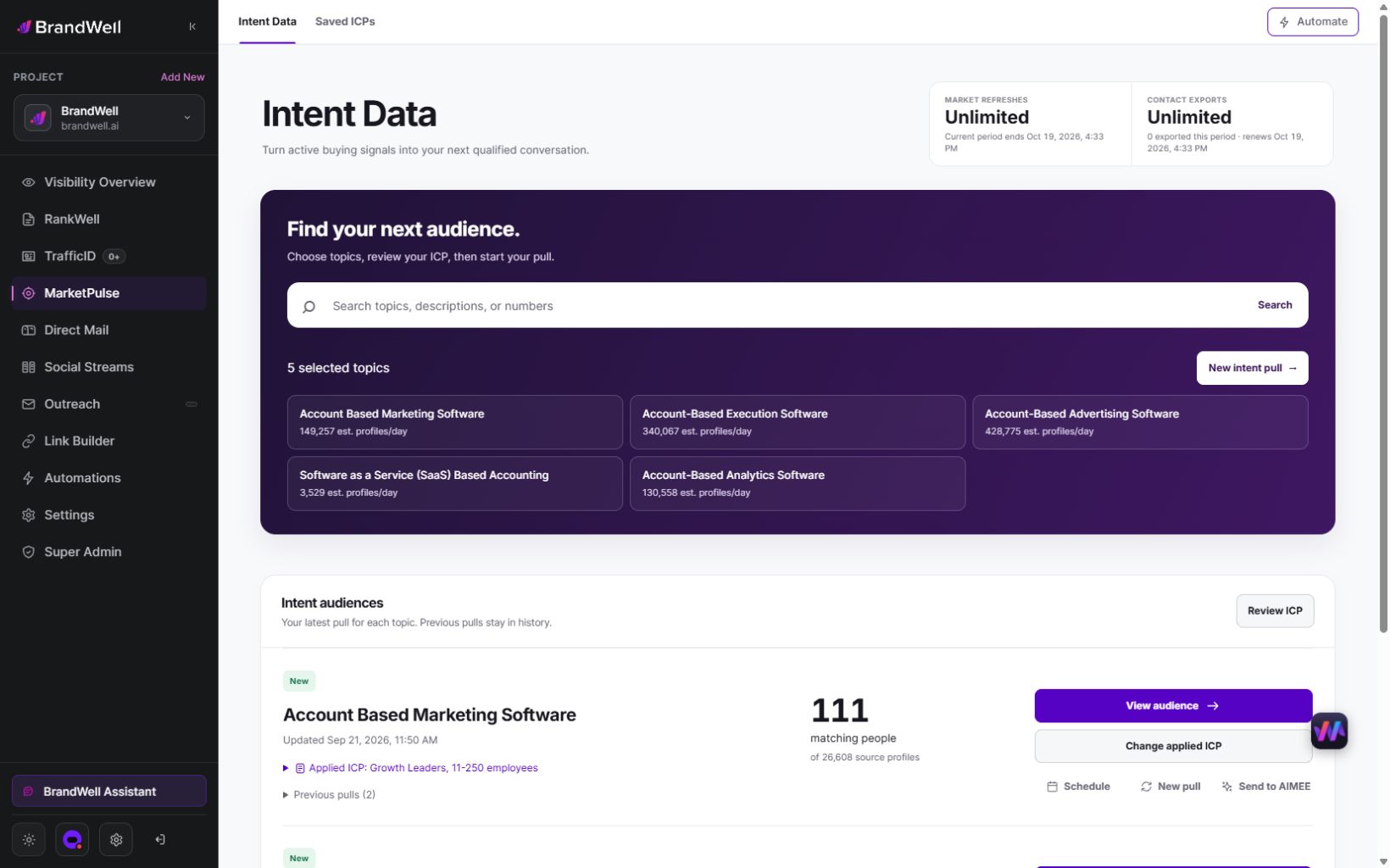
Start with one topic and actual output, identify client review and connected-system dependencies, and test your proposed delivery schedule before committing. Watch the demo and review current plans.
Reviewed and updated October 3, 2026.

Written by