On this page
- Current MarketPulse workflow
- Define the controlled operating backbone
- Assign roles, systems and review cadence
- Evaluate capabilities and launch evidence
- Add people and tools to a measured bottleneck
- Model client cost and scarce review capacity
- Measure operations and client economics
- Expand through readiness stages
- Preserve client-specific evidence states
- Control access, retries and delivery risks
- Maintain capacity and recurring service quality
- Use queue averages with a consistent boundary
- Worked example: average flow is not a delivery promise
- Frequently asked questions
Direct answer: Scale multi-client intent-data operations by standardizing the service core while isolating every client’s purpose, access, configuration, retention, destinations, quality checks, and approvals. Add accounts only when measured capacity, exception load, and cost to serve support them. More automation or headcount without that operating system multiplies risk rather than scale.
Current MarketPulse offer: intent-data plans start at $500/mo. See the product, demo, and current plans. Updated October 3, 2026.
Who this is for: Agency owners moving from founder-led intent delivery to a repeatable multi-client operation with accountable quality and economics.
Multi-client scale is not one workflow copied fifteen times. Clients differ in topics, entity structure, fit rules, suppressions, permissions, integrations, teams, and commercial objectives. The scalable design standardizes how those differences are declared, tested, approved, monitored, and changed. It never lets one tenant’s convenience weaken another tenant’s boundary.
The unit of control should be a client-specific configuration with a traceable version, not an analyst’s memory. A shared operating backbone can then support common ingestion, quality, routing, reporting, and support work while preserving separate data and decisions.
Current MarketPulse workflow
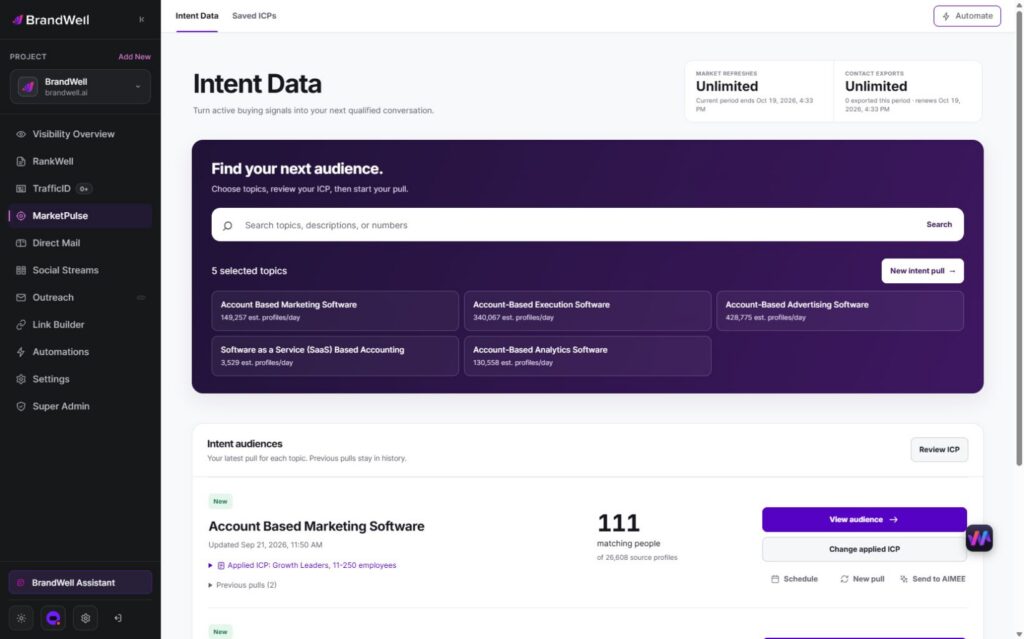
BrandWell MarketPulse: intent data starting at $500/mo. Find people researching topics relevant to what you sell, apply saved ICP filters, and review available contact details before taking action.
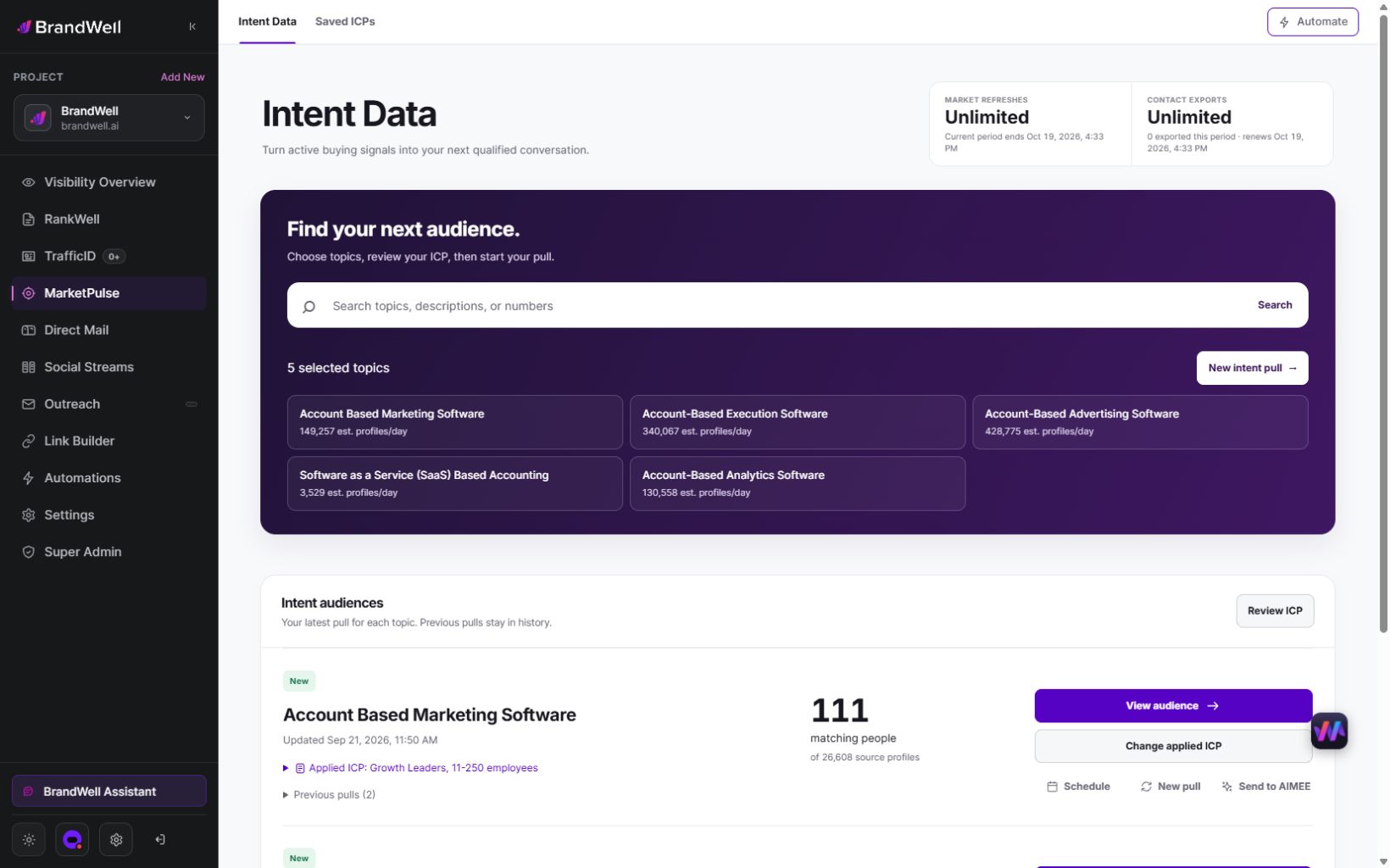
MarketPulse plans are starting at $500/mo. Verify current package scope and offers on the product page.
| Plan | Topics and refreshes | Monthly exports |
|---|---|---|
| Starter | 1 topic, weekly | 25,000 contacts |
| Growth | 3 topics, daily | 100,000 contacts |
| Scale | 10 topics, daily | Unlimited contacts |
Swipe the table to see all columns.
A pull retrieves available data from the previous 24 hours for one topic. Daily use across all included topics provides 90 Growth pulls or 300 Scale pulls in a 30-day month. Weekly Starter pulls vary by calendar month. Available audience size and contact fields vary, and audiences may overlap. Refreshes stop at the plan limit without overage charges.
- Find and qualify: search the topic catalog, save your ICP, and review the people and companies that match.
- Act on the research: export qualified contacts or prepare an Outreach or Direct Mail workflow. Connected products, channel usage, and fulfillment may cost extra.
- Get help from AIMEE: Growth and Scale include AIMEE for the initial user to research accounts and prepare the next step through connected tools.
Agencies and other service businesses can build client deliverables around their available Intent Scans and exports. Keep each client’s scope, permissions, and service fees clear. A subscription is not a promise of a white-label platform or exclusive access to a market.
Explore MarketPulse and watch the demo or compare plans starting at $500/mo. Any early-access discount is a separate, time-limited offer shown to an eligible recipient.
Define the controlled operating backbone
Define the minimum viable operating system before pursuing account volume. Document the standard service stages, mandatory controls, permitted variations, and exceptions requiring approval. Set capacity in analyst minutes, review queues, integration load, reporting effort, and support burden rather than an aspirational client count. Use observed delivery data to decide when to add clients.
Protect quality with acceptance criteria at each stage and protect economics with client-level cost attribution. Growth is healthy only when new recurring fees exceed the incremental platform, usage, labor, QA, support, and rework burden under a declared model. Neither revenue nor profit is guaranteed. A client that requires extensive custom logic may still be valuable, but it belongs in a different package or price rather than hidden inside the standard tier.
The eight-control multi-client operating backbone
- Tenant register: record client purpose, contract, owners, access, geography, retention, and data destinations.
- Source and topic configuration: version approved sources, topics, synonyms, exclusions, freshness, and pause rules per client.
- Identity and quality policy: define company resolution, hierarchy, fit, validation, duplicate, suppression, and correction rules.
- Access and retention control: isolate workspaces, credentials, exports, logs, retention schedules, and deletion evidence.
- Activation control: approve destinations, owners, messages, rate limits, handoffs, and human decision points.
- Exception system: classify severity, assign owners, set resolution targets, record root cause, and prevent recurrence.
- Capacity and unit economics: measure throughput, analyst time, rework, usage, support, and contribution for each tenant.
- Evidence and change control: preserve actions, outcomes, corrections, configuration versions, approvals, and client decisions.
Convert this backbone into a versioned intent-data delivery SOP. The SOP should contain standard work plus links to each client’s controlled configuration, never shared credentials or copied client data.
Assign roles, systems and review cadence
At minimum, assign a portfolio owner, delivery operations lead, quality owner, integration owner, and client success owner. A privacy or security specialist and qualified legal review enter based on purpose, contract, jurisdiction, and risk. One person may hold multiple roles at small scale, but responsibilities and backup coverage must still be explicit.
Run daily queue and integration checks, weekly capacity and exception reviews, monthly client decision meetings, and a periodic control review tied to material change. Systems should include a tenant register, configuration store, role-based access, credential management, workflow orchestration, quality queue, delivery receipts, incident and correction log, reporting layer, cost ledger, and version history. The process should allow a client to be paused without breaking other tenants.
Evaluate capabilities and launch evidence
Evaluate capability categories rather than looking for a single “scale” button. The stack may include contracted signal and identity infrastructure, a client portal, an orchestration layer, secure secrets, CRM connectors, quality review, monitoring, ticketing, reporting, and a finance or capacity model. Prefer tools that support tenant isolation, granular roles, audit history, idempotent processing, safe retries, versioned configuration, export controls, and deletion.
Key templates are the tenant launch card, data-flow diagram, topic configuration, access matrix, destination contract, acceptance test, exception taxonomy, capacity worksheet, change request, and offboarding checklist. Verify current capabilities, pricing, limits, and contract rights from primary provider documentation before selection. A connector that works in a demo can still fail under client-specific fields, rate limits, or permissions.
Add people and tools to a measured bottleneck
Adding headcount can relieve a known bottleneck when the work is defined, the queue is stable, and the role has measurable output. Adding a tool can remove a repetitive step when inputs, failure modes, and ownership are understood. Without a repeatable operating system, however, new people learn conflicting practices and new tools automate hidden errors. The agency gains throughput while losing control.
Build the operating system first when exceptions are rising, work depends on founders, client configurations are undocumented, data is copied manually, or costs cannot be attributed. Add people after the workflow exposes a durable capacity constraint. Add automation after the team can describe correct output, negative cases, reconciliation, and rollback. Use a specialist service when risk or complexity exceeds the internal team’s capability. Pause scale when isolation or evidence quality cannot be preserved.
Model client cost and scarce review capacity
Invest in operating design, platform and usage, integrations, client portal configuration, security and access controls, documentation, onboarding, quality review, support, monitoring, training, and contingency. Include offboarding and deletion, which often disappear from acquisition-focused models. Separate shared fixed costs from tenant-specific variable costs and attribute exception work to its cause.
For each client, model retail fee minus contracted data and platform usage, analyst and specialist time, integration amortization, reporting, meetings, support, rework, and allocated overhead. Track contribution before claiming gross margin. Add expected, low-usage, high-usage, and high-exception cases. Capacity should be constrained by the scarcest controlled step, often human review or client follow-up, not raw record processing. Use observed minutes and error rates instead of generic benchmarks.
Per-tenant capacity card
- Contracted scope: topics, markets, cadence, destinations, service levels, exclusions, and change allowances.
- Observed demand: ingested observations, review minutes, eligible accounts, destination events, and support tickets.
- Quality burden: false matches, duplicates, suppressions, corrections, failed delivery, and analyst rework.
- Capacity headroom: remaining controlled throughput at ingestion, review, activation, reporting, and client follow-up.
- Economics: recurring fee, attributable usage, labor, support, exceptions, allocated overhead, and observed contribution.
Measure operations and client economics
Portfolio metrics should include active tenants, onboarding cycle time, first-pass acceptance, delivery latency, backlog age, analyst capacity, automation success, failed destinations, exceptions by severity, correction rate, support hours, configuration drift, and control-test results. Client-level metrics should add usable-account rate, acceptance, action coverage, no-action reasons, satisfaction evidence, renewal, expansion, and cancellation reason.
Economic metrics include recurring fee, direct delivery cost, contribution under the agency model, rework cost, support cost, and revenue concentration. Do not blend profitable standard tenants with loss-making custom work. Report denominators and segment by package, maturity, topic complexity, and destination. Revenue, margin, and retention changes are observed business outcomes. The operating system may contribute, but it is not proven as the cause without a suitable design.
Expand through readiness stages
The strongest agency fit has a repeatable B2B service, a defined client segment, stable core controls, multiple clients needing similar evidence stages, and enough demand to justify shared infrastructure. White-label resellers, demand-generation agencies, RevOps providers, and GTM consultancies can benefit when their differentiation is topic design, qualification, activation, and client operations rather than bespoke plumbing.
Strong client fits have identifiable business accounts, clear topics, approved destinations, responsible reviewers, and follow-up capacity. Exclude or separately scope clients requiring unsupported person-level inference, uncontrolled exports, incompatible security terms, highly bespoke integrations, guaranteed outcomes, or workflows the agency cannot monitor. A founder-led agency with two dissimilar clients may benefit more from documenting the service than prematurely automating it.
Use readiness stages rather than a client-count threshold. In the documented stage, founders can still operate the workflow but exceptions are recorded. In the repeatable stage, trained owners can run standard work and reconcile outputs. In the controlled stage, tenant tests, monitoring, backup coverage, and unit economics are stable. In the scalable stage, the agency can add a qualified client within declared capacity without bypassing controls.
Preserve client-specific evidence states
Standardize the evidence states while keeping the values client-specific. Preserve source class, provenance, observation time, topic version, freshness, company match confidence, hierarchy, fit result, contact validation when used, suppression, approved action, destination receipt, client disposition, and later outcome. Do not merge first-party and third-party observations into an unexplained score.
Run automated validation for format, completeness, duplicates, known exclusions, and destination schema. Route ambiguous identity, sensitive context, and high-impact action to human review. A reusable lead and intent data QA checklist should contain client-level fixtures and correction paths. Outcome evidence must remain tenant-specific and should include rejected, untouched, corrected, and expired records alongside positive events.
Control access, retries and delivery risks
The critical risks are cross-tenant leakage, credential reuse, wrong-client routing, configuration drift, stale topics, hidden manual work, unsafe retries, duplicate activation, missing deletion, uncontrolled exports, access creep, vendor dependency, integration failure, and unpriced exceptions. Client trust also suffers when an agency markets scale as data volume while service quality or human review declines.
Use appropriately scoped access, credentials, test records, destination controls, reconciliation, rollback, monitoring and offboarding evidence. Review the actual architecture and risk with qualified owners. Shared and separate components require tested authorization; neither a label nor a branded interface establishes isolation.
Exercise the controls with negative fixtures. Test a wrong-tenant destination, expired credential, repeated record, malformed company identifier, revoked user, deletion request, and retry after partial failure. A test passes only when the system stops safely, raises a useful alert, and leaves a reconcilable log. Repeat after integration, permission, schema, or workflow changes.
Maintain capacity and recurring service quality
A controlled backbone turns one-off delivery into a recurring service with a standard launch, configurable scope, predictable reviews, measurable exceptions, and client-level economics. It can reduce duplicated effort and make training easier. Those benefits appear only if the agency measures them and keeps custom work visible. Stronger agency economics are an operating goal, not a commitment.
Build a capacity council into the recurring model. Operations reports bottlenecks and exceptions, quality reports control performance, client success reports adoption, and finance reports cost to serve. The council approves new tenant starts, package changes, and automation releases. This prevents commercial urgency from silently overriding the controls that make the service credible.
Use a multi-client intent service scaling model to decide which work belongs in the shared core and which belongs in a priced exception.
AIMEE can help prepare a capacity memo or client brief through configured connected tools. Preserve supplied evidence, uncertainty and client scope. Authorized owners approve architecture, access, pricing and external action.
MarketPulse supplies topic audiences and saved ICP filtering starting at $500/mo. Build appropriately scoped client deliverables around available pulls and exports. Custom client portals, recurring operations, integrations and separate client access need separately confirmed capability, implementation and rights.
Copyable agent-ready capacity and control workflow
Evaluate whether an agency can add one more intent-data client without weakening controls.

Inputs: tenant register, service stages, role capacity, queue history, exception log, client configuration, platform usage, labor records, support records, contracts, and proposed scope.

1. Map the proposed client to the eight controls and mark every required variation.
2. Calculate capacity at each controlled stage using observed minutes, backlog, and rework, not record volume alone.
3. Model expected, high-usage, integration-failure, and high-exception costs.
4. Test tenant isolation, credentials, routing, duplicates, retry behavior, destination failure, deletion, and rollback.
5. List custom requests that need separate scope or pricing.
6. Recommend accept, accept with conditions, postpone, redesign, or decline.
7. Stop if purpose, rights, access, isolation, quality thresholds, owner capacity, or offboarding cannot be verified.

Claude, ChatGPT, or AIMEE may organize supplied configurations, calculate scenarios, and draft the decision memo. Human operations, security, commercial, and client owners approve architecture, access, pricing, activation, and launch.
Use a launch readiness review for each tenant. The reviewer should confirm the signed scope, approved purpose, configuration version, roles, credentials, sources, topics, identity checks, suppressions, destination tests, evidence fields, support route, retention, offboarding, and capacity allocation. Add a deliberate wrong-tenant fixture and a failed-destination fixture. A successful happy-path record is not enough to authorize production.
Maintenance covers common and client-specific components. Shared changes need representative regression tests; client changes need approval and a contained release. Reconcile documented and active settings before delivery. Include testing and rollback costs in the change estimate rather than assuming they always save a fixed amount.
Plan business continuity before growth exposes the dependency. Document backup owners, credential recovery, provider outage behavior, queue preservation, client notification rules, and the point at which delivery pauses. Test whether a second trained operator can reconstruct a tenant’s state from the register and logs without private founder knowledge. Recovery evidence belongs beside capacity evidence in the launch decision.
Scale is a controlled ability to serve another client well. If the agency cannot explain isolation, capacity, exceptions, and unit economics per tenant, it has more volume, not a scalable operation.
Use queue averages with a consistent boundary
MIT’s queueing lecture presents Little’s Law: average items in a stable system equal flow rate multiplied by average time in that system. Keep the measurement boundary consistent. A queue-only count needs queue waiting time; a count including active review needs time through that whole review stage.
This relationship describes averages, not the deadline for each record. It does not identify the bottleneck or establish how many additional clients an agency can safely admit. Measure exceptions, arrival changes and long-waiting records separately.
Worked example: average flow is not a delivery promise
Suppose a fictional review stage has an average of 12 records waiting or in review, and completes eight records per working day during a stable observation period. Average time through that same stage is 12 / 8 = 1.5 working days. This is not a guarantee that every record completes within 1.5 days, and working days are not calendar days.
A separate staffing estimate provides 40 hours weekly, reserves eight for incidents and changes, and assigns four clients seven routine hours each. Routine use is 28 hours against a 32-hour allowance, leaving four hours beyond the reserve. Another seven-hour client would exceed that allowance by three hours. Investigate the actual slow stage before changing staffing or promising a faster SLA.
For a fictional monthly financial estimate, four clients pay $1,500 each. Shared software costs $1,000 and recurring labor, reporting and support total $3,200. Defined cost is $4,200 against $6,000 in fees, leaving $1,800, or 30%, before acquisition, general overhead, setup recovery, tax and financing. An unpriced 12-hour incident at $75 adds $900, halving the remainder to $900, or 15%. These are invented planning inputs, not typical results or BrandWell agency terms.
Keep the product and operating layers separate
In MarketPulse, review an available topic, apply the saved client ICP and preserve the actual preceding-24-hour pull window. AIMEE can draft the account context through configured tools; the designated owner approves the handoff. Measure custom review, client reporting and integration workload in the agency’s own operating records. A weekly pull is not a full previous week’s history.
Frequently asked questions
Does processing more records prove scale?
No. Verify client scope, delivery quality, cost, human review and realistic exception capacity.
Is average review time an SLA?
No. A service commitment needs its own event definition, calendar, exclusions and evidence.
Does a topic subscription supply an agency operations console?
MarketPulse supplies its stated audiences and export allowances. Custom client delivery and operations need separate confirmation.
When is another client supportable?
When tested controls, supported rights, measured workload and financial scenarios support the additional scope.
Evaluate the topic-data input: explore MarketPulse and current plans.
Reviewed and updated October 3, 2026.

Written by