On this page
- ChatGPT Search vs. Google: what should marketers compare?
- Which crawlers control ChatGPT search inclusion?
- What helps content qualify for Google AI discovery?
- How to track ChatGPT visits in GA4
- Original example: turn a referral report into an editorial decision
- Use RankWell to improve the page behind the answer
- Questions marketers ask
ChatGPT Search and Google Search are different discovery channels, and your website can receive visits from both. For a marketing team, the useful question is not which one will replace the other. It is which questions bring relevant visitors, which pages help those visitors, and which visits lead to a meaningful next step.
This guide separates search visibility from referral traffic, explains the crawler controls that matter, and shows how to build a practical GA4 report without mistaking a citation for a visit.
ChatGPT Search vs. Google: what should marketers compare?
- Discovery experience: evaluate whether a customer finds an answer, a source link, a product page or a local business result for the question you care about.
- Source evidence: open the linked source and check whether it supports the answer, including its date and limitations.
- Website outcome: measure the landing page, engagement and appropriate key event after someone reaches your site.
A conversational answer may help someone narrow a question before clicking. A search result may bring someone directly to a page. Neither experience proves that the visitor is qualified, and a useful answer can result in no website visit at all.
Avoid comparing chatbot messages, website visits, active users and search queries as if they were the same metric. Those denominators describe different behavior. This article does not use old launch-era audience totals or forecasts as evidence of today’s market share.
Which crawlers control ChatGPT search inclusion?
OpenAI’s crawler documentation distinguishes three controls: OAI-SearchBot supports search discovery; GPTBot relates to potential model-training use; ChatGPT-User handles certain user-requested page visits. These are separate purposes. You can permit the search crawler while blocking the training crawler.
Check robots.txt and your hosting or CDN rules against the current published searchbot IP ranges. Blocking OAI-SearchBot prevents inclusion in ChatGPT search answers, although navigational links can still appear. Allowing it does not guarantee a citation or referral. Do not treat Bing indexing alone as a sufficient test of ChatGPT visibility.
Keep a short technical record: the affected URL, HTTP response, crawler rule, date checked and any firewall change. A server-log bot request is evidence of access, not evidence that a person read an answer or clicked your site.
What helps content qualify for Google AI discovery?
Google’s guidance for generative AI features emphasizes the same foundation as Search: accessible pages, useful original content and accurate business information. There is no special AI schema or required llms.txt file for Google visibility.
For an individual article, add the evidence a reader needs to make a decision: an actual example, a clear explanation of your method, a source for a factual claim and the circumstances where the advice does not apply. Do not generate hundreds of near-identical pages for every phrasing of a question.
Use descriptive headings because they help readers navigate, not because a particular heading formula guarantees an AI citation. Review Search Console’s available Web and generative AI reports separately; their metrics and coverage should not be assumed identical.
How to track ChatGPT visits in GA4
Start with session source / medium and the landing page, rather than filtering every visit to the Referral channel. Channel classification depends on the source and tagging received. A referral-only filter can exclude traffic you intended to examine.
- Open your property’s Traffic acquisition report. Its position in the navigation depends on the report collection your property publishes.
- Select Session source / medium as the primary dimension. Look for the ChatGPT source values actually recorded in your property, such as chatgpt.com, rather than assuming all links arrive with one medium.
- Add Landing page + query string as a secondary dimension. Alternatively, use the Landing page report and add Session source / medium.
- Compare sessions, engaged sessions and the key event that fits the page’s purpose. Check that the event works before interpreting a zero.
- Save the report or exploration if your account permissions allow it. Record the date range, filters and source values so another person can reproduce the comparison.
This report setup follows Google’s landing-page reporting instructions. First user source answers a different question about initial acquisition; use session dimensions when examining where the current visits came from.
What if the traffic is missing?
Check your own redirects and whether tagging reaches the destination intact. Consent choices, missing referrer data and tracking blockers can leave gaps. Google explains several reasons for direct traffic; a direct visit cannot automatically be assigned to ChatGPT.
Test the journey with a permitted analytics setup and inspect the resulting source and destination. Avoid adding campaign tags to internal site links as a workaround for missing external attribution.
Original example: turn a referral report into an editorial decision
Imagine an IT services firm has a backup-recovery checklist. This is a planning example, not a measured BrandWell customer result.
- Question: which pages bring visitors who want help testing their backups?
- Evidence: review the recorded source, checklist landing page and consultation-request event over the same period.
- Content inspection: check whether the article explains restore testing, responsible roles and the information needed before requesting help.
- Change: add an original sample test record and a clear next step if the page currently stops at general advice.
- Evaluation: compare later periods with the same filters and note other changes, seasonality and small sample sizes.
If the page gets citations but no recorded visits, do not call that a conversion failure without more evidence. If it gets visits but no qualified requests, examine the promise, audience and next step before publishing more articles on the same topic.
Use RankWell to improve the page behind the answer
In the current BrandWell portal, use RankWell to develop and review the content brief and draft. Bring the customer question, verified references, original example and desired next step into the brief. Check factual statements and links in the editor before publishing through your configured workflow.
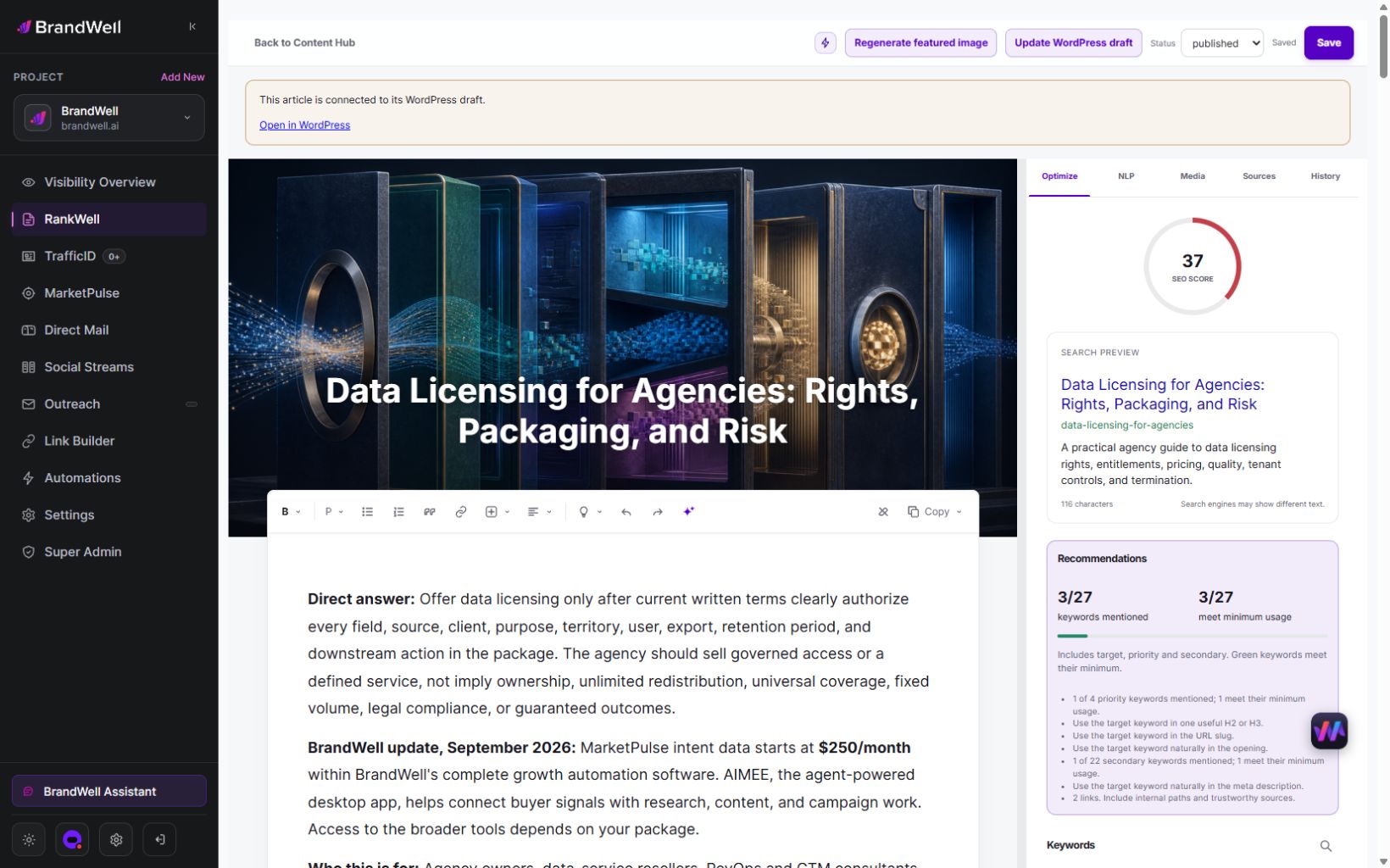
RankWell supports content production and review. It does not guarantee search rankings, AI citations or a particular referral volume. If you also need buyer-research audiences, MarketPulse is starting at $500/mo; intent-data Intent Scans are distinct from GA4 visits and search visibility.
Questions marketers ask
Does an AI citation count as a website visit?
No. Someone must reach your website for a visit to be recorded, and your measurement setup must be able to observe it. Track visibility and visits as separate evidence.
Should I stop optimizing for Google?
Use your audience and business results to allocate effort. Useful, accessible, evidence-backed pages remain a practical foundation. A new referral source is a reason to measure, not a reason to abandon a channel that works.
Can one GA4 report prove total AI visibility?
No. It describes the website activity and attribution your property records. It does not reveal every answer, citation, unclicked mention or visit whose source information was lost.
Reviewed and updated October 2, 2026.

Written by

 Justin McGill