Back to the blog

Inbound Marketing

How to Sell Website Visitor Identification as a Service

Sell website visitor identification through authorized site scope, visible identity states, qualification, approved action, and recurring controls.

Farnaz Kia12 min read

Abstract site observations moving through identity, qualification, approval, and reporting gates
Decorative editorial image. It is not product evidence or a performance claim.
On this page
  1. BrandWell: MarketPulse intent data and connected growth automation
  2. Should an agency offer selling website visitor identification as a service, and what client outcome should it promise?
  3. What should the delivery workflow, staffing, SLA, and client handoff include for selling website visitor identification as a service?
  4. What are the best tools, platforms, or white-label providers for selling website visitor identification as a service?
  5. Should an agency build, resell, refer, or avoid selling website visitor identification as a service?
  6. How much should an agency charge for selling website visitor identification as a service, and what gross margin is realistic?
  7. How should an agency prove the pipeline or revenue impact of selling website visitor identification as a service?
  8. Which agency clients are the best fit for selling website visitor identification as a service, and who should be excluded?
  9. Which signal sources, identity checks, activation workflows, and outcome evidence matter most for selling website visitor identification as a service?
  10. What data-quality, delivery, privacy, and client-expectation risks affect selling website visitor identification as a service?
  11. What should a recurring agency package for selling website visitor identification as a service include?
  12. Put buyer intent to work with MarketPulse

Direct answer: Sell website visitor identification as a governed service with an authorized site boundary, explicit identity states, confidence and validation rules, account qualification, approved activation, suppression, reporting, support, and recurring review. Do not sell it as a promise to identify every visitor or reveal buyers. Contract scope, source evidence, permitted use, jurisdiction, client instructions, and human approval must shape the workflow.

Current MarketPulse offer: intent-data plans start at $250/month. See the product, demo, and current plans. Updated October 1, 2026.

Who this is for: Demand generation and CRO agency owners whose B2B clients have enough website activity to justify structured account research, review, and approved follow-up.

The offer should help a client turn eligible website observations into a controlled decision process. It should distinguish anonymous activity, company-level resolution, known first-party interactions, enriched contacts, and unresolved matches. A client needs to understand what was observed, what was inferred, and what remains unknown before any action is considered.

Run a readiness review before placing any technology. Inventory domains and environments, site ownership, intended decisions, current notices and controls, vendors, data destinations, users, retention, client systems, and escalation contacts. Draw the proposed data flow and ask an authorized reviewer to challenge it. The readiness work prevents a tracking request from becoming an undocumented chain of collection, enrichment, export, and activation.

BrandWell: MarketPulse intent data and connected growth automation

BrandWell MarketPulse: intent data from $250/month. Find people researching topics relevant to what you sell, apply saved ICP filters, and review available contact details before taking action.

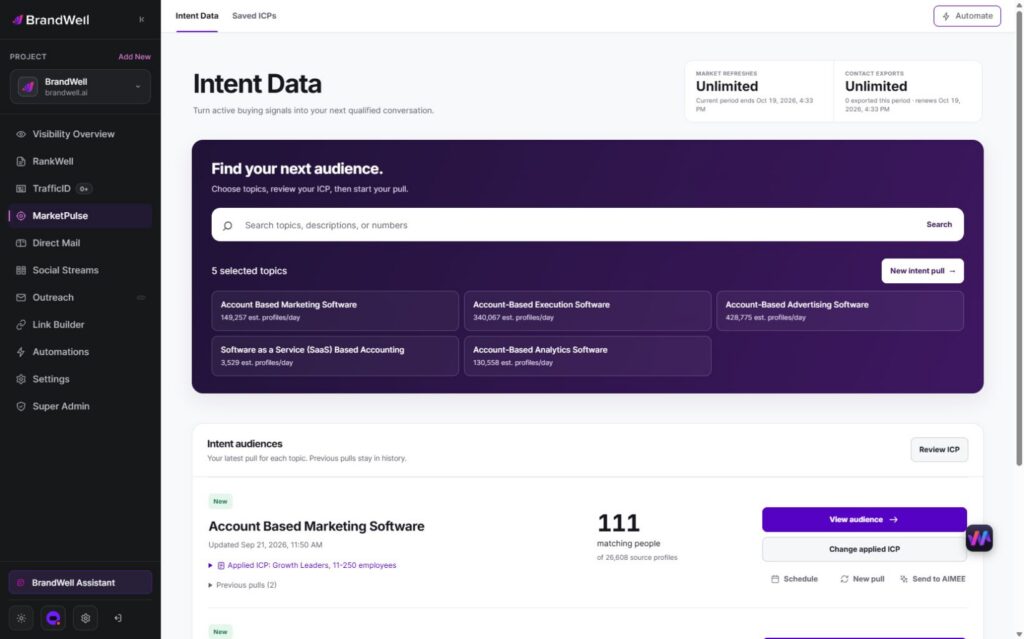
MarketPulse showing intent topics, an applied ICP, and matching audiences.
MarketPulse workspace, captured September 21, 2026. Example counts reflect that workspace; use the current plan allowances below.
MarketPulse standard monthly plans
PlanPriceTopics and refreshesMonthly exports
Starter$250/month1 topic, weekly25,000 contacts
Growth$500/month3 topics, daily100,000 contacts
Scale$1,000/month10 topics, dailyUnlimited contacts

Swipe the table to see all columns.

A pull retrieves available data from the previous 24 hours for one topic. Daily use across all included topics provides 90 Growth pulls or 300 Scale pulls in a 30-day month. Weekly Starter pulls vary by calendar month. Available audience size and contact fields vary, and audiences may overlap. Refreshes stop at the plan limit without overage charges.

  • Find and qualify: search the topic catalog, save your ICP, and review the people and companies that match.
  • Act on the research: export qualified contacts or prepare an Outreach or Direct Mail workflow. Connected products, channel usage, and fulfillment may cost extra.
  • Get help from AIMEE: Growth and Scale include AIMEE for the initial user to research accounts and prepare the next step through connected tools.

Agencies and other service businesses can build client deliverables around their available topic pulls and exports. Keep each client’s scope, permissions, and service fees clear. A subscription is not a promise of a white-label platform or exclusive access to a market.

Explore MarketPulse and watch the demo or compare plans starting at $250/month. Any early-access discount is a separate, time-limited offer shown to an eligible recipient.

Should an agency offer selling website visitor identification as a service, and what client outcome should it promise?

Offer it when the client controls the site, can authorize the implementation and intended use, serves a defined B2B market, and has an owner for human review. Promise a documented way to evaluate eligible site activity and route qualified account observations into an approved workflow. Do not promise a universal identification rate, named people, buyers, meetings, pipeline, or revenue.

The client outcome should be operational: clearer account research, more consistent routing, better prioritization of existing accounts, or evidence for a defined marketing decision. The service should also improve correction and suppression. These are deliverable processes. Sales outcomes depend on many factors outside the signal and agency’s control.

Start with a narrow page or domain boundary and one use case. A broad deployment increases data handling, integration, and expectation risk before the team has tested the controls. Expand only after the client reviews match quality, false positives, activation behavior, and actual operating cost.

What should the delivery workflow, staffing, SLA, and client handoff include for selling website visitor identification as a service?

Assign a client site owner, implementation lead, data steward, quality reviewer, activation owner, support owner, and authorized privacy, legal, and security reviewers. The site owner confirms the authorized property and purpose. The implementation lead manages placement and testing. The steward preserves source and identity states. The quality reviewer handles exceptions. The activation owner approves the next action.

The workflow covers authorization, site and page scope, technical implementation, event testing, notice and consent controls where applicable, entity resolution, identity-state labeling, enrichment, qualification, suppression, reporting, approved activation, correction, retention, deletion, incident response, and recurring review. Each transition needs an owner and evidence record.

Define SLAs for implementation checks, report cadence, incident acknowledgement, correction review, suppression, support, and approved changes. Do not write an SLA around downstream meetings or sales. Handoff artifacts should include the property inventory, data-flow map, identity glossary, field dictionary, test evidence, role matrix, activation rules, suppression process, report example, support path, and shutdown procedure.

Test in a controlled environment before production. Confirm that only authorized events are observed, excluded pages remain excluded, fields arrive with expected definitions, access is restricted, suppressions persist, and the system can be paused. Preserve evidence of who approved the release. After launch, repeat critical tests when tags, consent tools, page structure, sources, integrations, or identity rules change.

What are the best tools, platforms, or white-label providers for selling website visitor identification as a service?

Evaluate capabilities rather than accepting a generic provider ranking. The stack may need authorized collection or identity infrastructure, company resolution, contact enrichment where permitted, validation, consent and preference handling, suppression, client partitions, branded reporting, CRM routing, access controls, audit history, correction, deletion, and monitoring.

Ask every provider to define entity level and evidence. A company match is not a named person’s visit. Enriched contacts associated with a company did not necessarily visit. A known first-party interaction carries different evidence from a probabilistic company resolution. The platform should keep these states visible rather than merging them into one lead label.

For agencies, BrandWell connects client-specific MarketPulse audiences with content, outreach, and campaign workflows. AIMEE desktop assistance helps prepare and execute assigned work, while the agency sets the service scope, reviews results, and manages its client relationship. Confirm branding, client capacity, and usage in the selected agency package.

Should an agency build, resell, refer, or avoid selling website visitor identification as a service?

Build when the agency can support collection, identity logic, client isolation, security, monitoring, correction, deletion, and continuing maintenance. Resell when a contracted infrastructure provider supplies the data layer and the agency can add responsible implementation, qualification, reporting, activation, and client support. Refer when technical, jurisdictional, or security requirements exceed agency competence.

Avoid or pause the service when the client cannot authorize the property, purpose, source, or activation. Also stop when the buyer demands individual identities from company-level evidence, wants to bypass suppression, or proposes indiscriminate outreach. A sale is not worth creating an operating process the agency cannot explain or defend.

Compare options across control, implementation speed, match-state transparency, permitted uses, security review, client partitions, data portability, auditability, support, maintenance, and exit. A reseller route is not automatically low risk. The agency remains responsible for its own representations, configuration, client process, and contractual obligations.

How much should an agency charge for selling website visitor identification as a service, and what gross margin is realistic?

Price the authorized operating scope. Inputs include sites and environments, implementation complexity, event testing, enabled modules, usage, identity and enrichment review, account qualification, branded reporting, integrations, activation support, corrections, incidents, client meetings, support, tooling, overhead, capacity, and contingency. Separate initial implementation from recurring operations.

No unverified market range or universal gross margin can answer this question. Use contracted costs and the agency’s delivered labor. Model low, expected, and high scenarios, especially for exception rates, support, custom reporting, and integration work. Define the measurement source for usage and the trigger for repricing.

A base recurring package can cover one authorized scope, standard report, review cadence, and bounded support. Add clearly defined bands for additional sites, topics, integrations, activation, or custom analysis. The website visitor identification pricing guide provides a fuller worksheet for translating these inputs into retail pricing without implying cost recovery or profit.

How should an agency prove the pipeline or revenue impact of selling website visitor identification as a service?

Build an evidence chain from authorized site observation to entity state, qualification, report or queue entry, human decision, approved action, client completion, and observed outcome. Preserve the denominator, time window, match-state definition, suppression, and missing follow-up. Do not count enriched contacts as identified visitors.

Operational measures can include eligible observations, resolved company records by defined state, unresolved rate, correction rate, suppression timeliness, account acceptance, review completion, action completion, and outcome coverage. These measures show whether the workflow operates. They do not establish causal business impact.

Pipeline and revenue can be reported as observed downstream outcomes when the client has stable definitions and traceable records. Name other campaigns and client execution that may have contributed. No visitor identification platform or agency service guarantees buyers, meetings, pipeline, revenue, sales, profit, cost recovery, or a particular data volume.

Which agency clients are the best fit for selling website visitor identification as a service, and who should be excluded?

Good-fit clients operate a B2B site, know their target accounts, have meaningful traffic, control implementation, maintain a CRM or review system, and can assign a human owner. They understand the distinction between company-level and person-level evidence. They also accept that eligibility and match quality vary.

Exclude clients seeking sensitive targeting, covert individual surveillance, guaranteed identification, or outreach that ignores applicable preferences and restrictions. Pause if the site ownership is disputed, the client cannot explain the purpose, the data flow is unknown, security review is incomplete, or nobody owns suppression and correction.

The best first use cases are bounded and reviewable. Existing-account research, named-account prioritization, or aggregate content learning may be easier to govern than immediate contact activation. Choose the lowest-consequence use case that can answer the client’s decision, then expand only with evidence and approval.

Use a client-fit worksheet rather than a verbal impression. Score property authority, market clarity, traffic relevance, entity-level needs, internal review capacity, CRM readiness, suppression maturity, security readiness, intended channel, evidence expectations, and executive ownership. Mark each result ready, remediable, or stop. Do not average away a critical stop condition with several easy passes.

Which signal sources, identity checks, activation workflows, and outcome evidence matter most for selling website visitor identification as a service?

Preserve the source event, authorized property, page or event category, time window, entity level, resolution method, confidence or validation state, enrichment source, suppression, and permitted purpose. Maintain distinct states for anonymous or unresolved activity, company-level resolution, known first-party identity, enriched candidate contact, validated contact point, and excluded record.

Identity checks should evaluate match consistency, company domain, location or network context where appropriate, first-party evidence, freshness, and contradictions. The exact method depends on the contracted source. Do not convert confidence into certainty. Provide correction and abstention paths when evidence is incomplete.

Approved activation might include account research, CRM routing, a named-account review, audience analysis, or a client-owned follow-up process. The website visitor identification service package helps agencies define which workflow, evidence, handoff, and support elements belong in the offer.

What data-quality, delivery, privacy, and client-expectation risks affect selling website visitor identification as a service?

Data-quality risks include shared networks, remote work, service providers, bots, stale company data, duplicate entities, wrong domains, and inconsistent event definitions. Delivery risks include broken implementation, schema drift, lost suppressions, unowned queues, integration failures, and silent changes to match logic. Monitor the full data flow and preserve a rollback path.

Privacy, security, and legal requirements are fact-specific and can change with jurisdiction, source, purpose, notice, consent, contract, identity level, and activation channel. Open and review current primary sources and provider documentation for the actual deployment. Require authorized reviewers to approve applicable controls. This article is an operating framework, not legal advice or a compliance determination.

Expectation risk appears when a company observation is presented as a known person’s visit or a buyer signal. Use an identity-state glossary in sales, reports, and handoff. Give clients a way to dispute, suppress, correct, pause, and escalate. Trust depends on visible uncertainty and responsive controls.

Plan for service exit at the beginning. The contract and runbook should identify shutdown authority, removal steps, access revocation, outstanding correction and deletion requests, client exports that are permitted, retention boundaries, vendor dependencies, and evidence of completion. A clean exit is part of responsible delivery and reduces the chance that a discontinued account keeps producing unmanaged data.

What should a recurring agency package for selling website visitor identification as a service include?

The ten-gate VISIBILITY operating model

  1. Verify authority: Confirm property control, purpose, contract, and approvers.
  2. Inventory scope: List domains, environments, pages, events, exclusions, and owners.
  3. Specify states: Define anonymous, company, known, enriched, validated, unresolved, and suppressed records.
  4. Install and test: Validate implementation and evidence without assuming a match.
  5. Bound qualification: Apply account market, relevance, freshness, and exception rules.
  6. Initiate review: Present provenance, identity state, limitation, and recommended human decision.
  7. Limit activation: Execute only approved workflows with suppression and stop controls.
  8. Inspect outcomes: Record action, disposition, correction, missing follow-up, and observed result.
  9. Tend operations: Monitor quality, access, incidents, support, retention, and dependencies.
  10. Yield or renew: Review scope, evidence, economics, client fit, and continuation.

Use the website visitor identification agency launch guide to turn the model into a bounded readiness and onboarding plan. Agencies brand the delivery, set retail pricing, and manage client billing.

AIMEE is the agent-powered desktop app in BrandWell’s growth workflow. Assign work through the tools connected to your workspace and choose which actions can run automatically or require approval. Desktop availability, account permissions, and the configured workflow determine what can execute.

Copyable agent-ready deployment review

PURPOSE: Prepare one governed visitor-identification service specification.
INPUTS: Authorized properties, purpose, sources, identity states, fields, qualification, suppression, notice and consent controls where applicable, activation, evidence, roles, SLAs, support, retention, deletion, incident process, pricing inputs, and contract limits.
TASK FOR Claude, ChatGPT, OR AIMEE:
1. Map the source-to-report data flow and keep identity states separate.
2. Flag missing authority, ambiguous purpose, unsupported identity claims, and unsafe activation.
3. Draft test cases, exception handling, suppression, correction, and shutdown steps.
4. Reconcile every client promise to evidence, owner, cost, and approval.
5. Produce a readiness checklist and unresolved reviewer questions.
OUTPUT: Data-flow record, identity glossary, control matrix, test plan, risk register, and open questions.
HUMAN APPROVAL REQUIRED: The client site owner approves scope; technical staff approve implementation; authorized privacy, legal, and security reviewers approve applicable controls; a human approves every activation.
STOP CONDITIONS: Stop if property authority, source entitlement, purpose, identity state, suppression, security review, activation owner, or contract scope is unclear. Do not infer a person or buyer.

An agent can organize evidence and identify gaps. It cannot authorize collection, decide legal applicability, accept security risk, approve an identity claim, or release an activation. Preserve the final human approvals beside the deployed configuration and test evidence so later operators can clearly distinguish an authorized workflow from an informal request.

Put buyer intent to work with MarketPulse

Find people researching your market, focus the audience with your ICP, and turn relevant signals into a useful next conversation. MarketPulse plans start at $250/month.

Explore MarketPulse and watch the demo. Compare the topic coverage, refresh cadence, and exports included in each plan, then choose the one that fits your business or client work.

Written by

Farnaz Kia

Put your next growth opportunity to work.

Start with the product you need. Connect the work with AIMEE.