
On this page
This historical Truth & Brand discussion explored a proposed content-service package, not an achieved $150,000 revenue increase. The original article mixed a four-client plan with a five-client revenue calculation. This review corrects that distinction and removes the promised net margin.
Historical software prices and package limits are not current BrandWell offers. For today’s content workflow, see the RankWell section below.
What Nancy described
In the original interview, Nancy Ruiz described Truth & Brand as a one-person operation providing SEO, branding and content-marketing guidance. In the opening discussion, she reported working with ten clients and giving them keyword-based writing roadmaps because she lacked writing capacity.
The interview’s later pricing discussion was a proposal. Around 44–47 minutes, the participants considered a 12-article package, writer costs and historical software costs. Around 52 minutes, the discussion changed from four clients to five when calculating $12,500 per month and $150,000 per year. Those figures were not presented with records of achieved sales.
Correcting the original article’s arithmetic
The original written article said four clients paying $2,500 per month would produce $12,500 per month. The multiplication is incorrect:
- Four clients: 4 × $2,500 = $10,000 per month, or $120,000 over 12 months.
- Five clients: 5 × $2,500 = $12,500 per month, or $150,000 over 12 months.
Both calculations assume those clients sign, pay that amount and remain for the entire period. They are projections of gross revenue, not confirmed customer revenue or profit.
The historical article also used an $852 direct-cost estimate for one package. At a $2,500 price, subtracting that estimate leaves $1,648 before other costs. Dividing $1,648 by $2,500 gives 65.92%. That arithmetic does not establish net margin: owner time, sales, administration, revisions, overhead and other expenses were not fully accounted for.
We therefore do not retain the original guarantee of at least a 50% net margin, claims of effortless income or statements that one additional writer would automatically support doubled revenue.
What this archive can and cannot show
The recording supports a discussion about adding a service and pricing a proposed package. It does not establish that the package launched, that customers purchased it or that any projected revenue was collected.
A measured outcome would require dated records of signed work, collections, churn, actual delivery costs and the comparison period. Without those records, the proposal should remain labeled as planning.
Apply the planning lesson to a current agency workflow
The useful question is how to add content delivery without promising more work than your team can review. Start with a defined client problem, an approved scope and the people responsible for research, drafting, editing, publishing and reporting.
- Specify the deliverable. Explain the reader, topic, format and acceptance criteria.
- Estimate all work. Include research, fact-checking, client review, revisions and reporting.
- Use current costs. Check your present package and allocate it consistently. Do not reuse historical per-article prices as today’s quote.
- Test delivery capacity. Measure a small approved project before committing to a monthly volume.
- Track collections and costs. Separate quoted revenue, invoiced amounts, payments and profit.
Use RankWell in the current BrandWell portal
RankWell is the content workflow in BrandWell. The Content Hub organizes articles, strategy, queue and calendar work. The editor includes the article, search preview, recommendations, media, sources and history.
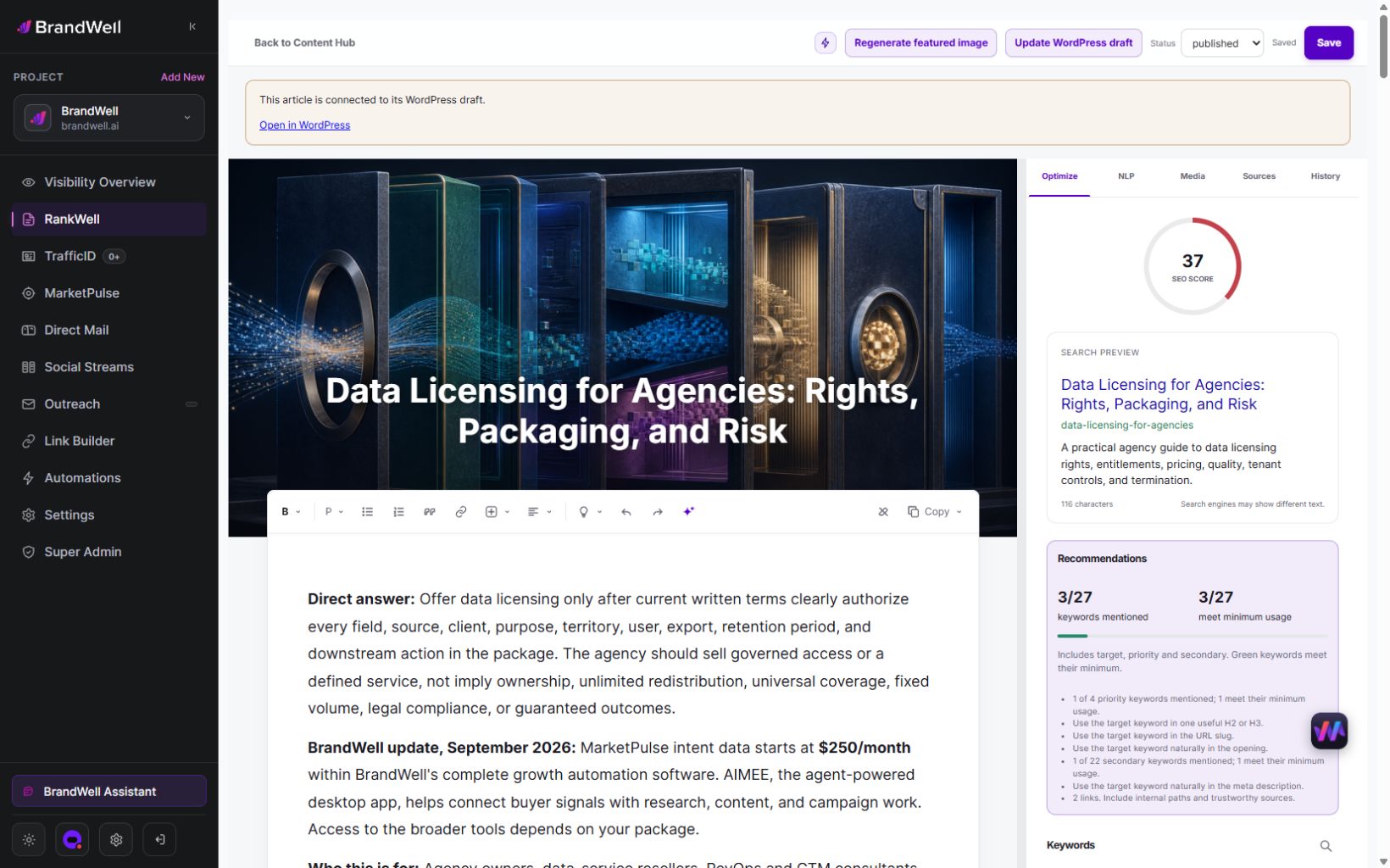
Prepare a brief, bring reliable sources and review the draft before publishing. Confirm product claims and quotations, add original useful examples and check the client’s requirements. A draft or recommendation score does not guarantee accuracy, originality, rankings or commercial results.
Open the current BrandWell portal for your workspace and configured tools. Agree the publishing and approval process with the client rather than assuming that generation completes the service.
Common questions
Did this case study establish $150,000 of added revenue?
No. The number was a proposed five-client annual revenue scenario. The original article incorrectly attached it to four clients and described the proposal too confidently.
Are the historical prices available now?
Do not treat them as a current offer. Check today’s product and package details when preparing a quote or capacity plan.
What is the practical takeaway?
Price the complete service, test the review workload and distinguish projected economics from measured outcomes. Use the current tools to support delivery while retaining a named editorial owner.
Reviewed and updated October 3, 2026.

Written by
Julia McCoy has contributed articles to BrandWell on content marketing, writing, and search engine optimization. This archive retains her original bylines; individual articles may be updated by the BrandWell editorial team.