



On this page
Good blog topics answer a specific question for the people your business serves. Start with customer conversations, queries already appearing in Search Console, and tasks you can explain from experience. Then choose an idea you can support with useful examples, current facts, and a clear next step.
You do not need to enter a supposedly profitable niche or publish on every trend. A payroll software company, IT service business, and marketing agency need different content because their buyers have different problems. The 60 prompts below help you turn those problems into an editorial plan.
How to recognize a topic worth writing
A worthwhile topic connects a reader’s task to something you can explain well. Before commissioning it, answer five questions:
- Who needs it? Identify a real role or situation, not everyone on the internet.
- What will they do afterward? Choose a decision, check, or practical task.
- What can you add? Bring a worked example, original template, demonstration, or documented experience.
- What needs verification? List sources for claims, statistics, prices, and instructions.
- Does a suitable page already exist? Update it when the new idea serves the same need.
Google’s people-first content guidance emphasizes useful original work for an intended audience. It does not recommend a preferred word count or pursuing unrelated topics simply because they are trending.
Where to find blog topics with evidence
Customer and support questions
Collect the questions people ask before buying, during onboarding, and while using the product. Group repeated questions by the task involved. Remove personal details and request permission before using an identifiable customer example.
For example, repeated questions about importing records could lead to an import-preparation checklist. A vague request to write about productivity is less useful than a specific question about the handoff that keeps delaying the work.
Search Console queries and existing pages
In the Search Console Performance report, review queries and pages using a consistent period. Look for pages being shown for a relevant question that the content only partially answers.
Compare clicks, impressions, CTR, and position together. A page appearing far down the results has a different problem from one ranking prominently with few clicks. Check the query, country, device, and period before deciding that a headline alone needs changing.
Keyword research and observed search results
Research language related to the customer’s task. Inspect what the search results currently emphasize: instructions, definitions, comparisons, product pages, or local services. Use that observation to refine the brief, then bring your own evidence and examples.
Google Trends can help compare relative interest over time. Its normalized values are not exact search counts. A seasonal spike is a reason to investigate timing, not proof that a topic will generate sales.
60 business blog topic ideas
These are original planning prompts, not verified claims about your business. Adapt them to an actual product or service, replace broad terms with the reader’s task, and substantiate the finished article.
Explain the problem: 6 ideas
- What does this workflow do, and who is responsible for it?
- Which signs suggest a process needs review?
- What is the difference between a symptom and its underlying cause?
- Which terms should a first-time buyer understand?
- When is a manual process still the sensible choice?
- What questions should a team answer before choosing software?
Teach a practical task: 6 ideas
- How to prepare source records before an import.
- How to set up a first project with clear ownership.
- How to review a draft before publishing it.
- How to document a repeatable handoff between two teams.
- How to test a configuration without changing live work.
- How to check whether a completed task achieved its purpose.
Help readers choose: 6 ideas
- Which plan fits a small team with one defined use case?
- When does a team need more capacity rather than more features?
- What should be included in a buying requirements brief?
- What tradeoffs matter when choosing a deployment method?
- Which questions should you ask during a product demonstration?
- What evidence should you request before committing to a workflow?
Explain scope and cost: 6 ideas
- What is included in the subscription and what costs extra?
- How do usage allowances differ from outcome guarantees?
- How should a team estimate implementation time?
- Which recurring tasks belong in the operating budget?
- How do you calculate cost per completed business action?
- What should a service proposal explain about exclusions?
Share original evidence: 6 ideas
- A documented before-and-after process review with its limitations.
- What a representative sample revealed about data completeness.
- A customer-approved account of a specific implementation.
- A demonstration using a clearly labeled example project.
- What your team changed after an unsuccessful test.
- How results differ when the starting conditions change.
Provide templates: 6 ideas
- A content brief with source and review fields.
- A project kickoff checklist with owners and deadlines.
- A requirements scorecard for evaluating a workflow.
- A reporting template separating activity from outcomes.
- A quality review log that records accepted and rejected work.
- A maintenance calendar for keeping published instructions current.
Address mistakes and troubleshooting: 6 ideas
- Why an import can fail and what to inspect first.
- How duplicate records affect a downstream report.
- Why a high activity count may not produce qualified opportunities.
- How to diagnose a missing handoff or notification.
- What to check when instructions no longer match the interface.
- How to recover from an incorrect configuration with a recorded rollback.
Serve a defined industry: 6 ideas
- An IT service onboarding checklist for a new business client.
- How a marketing agency prepares a monthly client review.
- What a payroll software buyer should verify before an import.
- How a local service business organizes incoming inquiries.
- How a professional-services firm documents an approved case study.
- What a software team should include in a release explanation.
Support ongoing use: 6 ideas
- What to review after the first week using a new workflow.
- How to train a new colleague on a recurring task.
- When to revisit saved filters or project assumptions.
- How to organize feedback without losing the original decision.
- Which settings should be reviewed when a team changes.
- How to identify instructions that need a substantive update.
Explain change without hype: 6 ideas
- What changed in a product release and which users it affects.
- How a new requirement changes the existing process.
- Which assumptions in last year’s guide still hold.
- How to evaluate a new capability before adopting it.
- What a planned experiment is intended to establish.
- What is known, uncertain, and still being tested in a new workflow.
Turn one idea into a BrandWell content brief
In the current BrandWell portal, select the appropriate Company Project and use the available keyword research workspace to investigate the reader’s language. Choose the relevant market and inspect keyword ideas and search context. Where Search Console is connected, use its first-party performance context alongside the research.
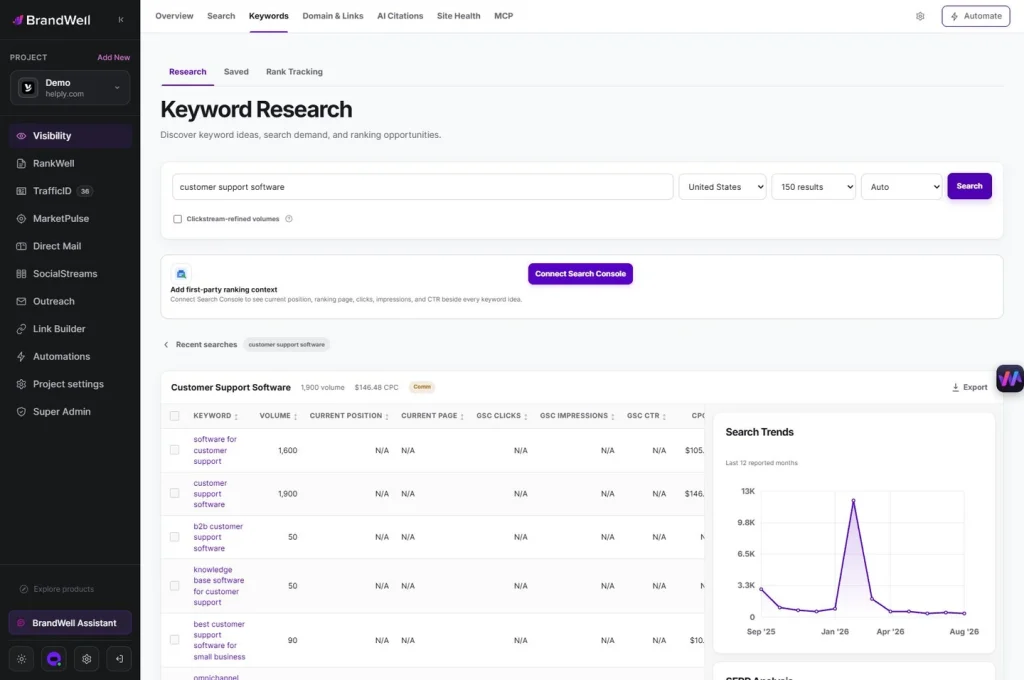
Use RankWell to develop the article from a reviewed brief. A useful original brief for an IT services article might contain:
- Reader: the person organizing a new provider handoff.
- Question: what information should the business prepare before onboarding?
- Deliverable: a practical checklist with owners and verification steps.
- Sources: the provider’s actual process and relevant official documentation.
- Visual: an approved example checklist or workflow screenshot.
- Review: confirm scope, avoid publishing credentials, and verify the instructions.
- Next step: a clearly described consultation or related service page.
Read the draft, test any instructions, verify factual claims, and add the team’s actual expertise before publishing. Do not present a generated example as a real customer result.
Make answers easy to understand and maintain
Give the main answer early, use descriptive headings, and include a worked example when it helps the reader act. Link a factual claim to its supporting primary source near the claim. Use dates when the information depends on a release, reporting period, or policy.
Google’s generative AI search guidance does not prescribe a special paragraph length or schema for inclusion. A direct answer and clear structure help people understand the page; they do not guarantee an AI Overview citation.
After publication, review both search performance and the intended business action. If the page earns impressions without clicks, inspect its actual queries and position before changing the title. If readers visit without taking the intended next step, check whether the article and offer serve the same need.
Common questions
What is the best topic for a business blog?
A specific question your intended reader needs answered, where your business can contribute useful evidence or experience. Popularity alone does not establish fit.
Should every idea become a new article?
No. Improve an existing page when it already serves the same reader and task. Create a separate article when the question and useful answer are meaningfully different.
Can AI help generate topic ideas?
Yes, as a starting point for research and planning. Validate relevance, facts, and available evidence before turning a suggestion into an editorial assignment.
Reviewed and updated October 2, 2026.

Written by
Jeff Joyce has been helping brands grow online since the Myspace era, when custom HTML layouts were still a competitive advantage. What started in design quickly evolved into a career spanning social media, content strategy, video, agency ownership, and growth marketing. After building his own agency and testing countless AI tools, Jeff joined BrandWell with a clear focus: helping marketers understand how AI can actually improve the way they create, optimize, and scale content. Today, Jeff brings a CMO-level perspective to BrandWell's marketing strategy, blending brand positioning, content, video, customer education, and growth. His work centers on turning complex AI concepts into clear, practical marketing that helps brands move faster, create better content, and stay competitive without losing their voice.

 Farnaz Kia