On this page
- 1. Check what the searcher wants
- 2. Group searches by the decision they support
- 3. Map topics to your existing library
- 4. Prioritize relevance and capacity
- 5. Turn each priority into a brief
- 6. Use Visibility for research and RankWell for content work
- 7. Improve the page without keyword stuffing
- 8. Publish, distribute and measure
- Frequently asked questions
After keyword research, group related searches, map them to existing pages and choose the next useful action: improve a page, create one or leave the opportunity for later. Your deliverable is a prioritized content plan with a reader, owner, evidence and success measure for each item.
A keyword list is research input. It becomes a plan when you connect it to the questions your business can answer and the decisions your customers need to make. This guide walks through that handoff using BrandWell’s current Visibility and RankWell workflow.
1. Check what the searcher wants
Read the query and inspect the results for the relevant country and language. Is the reader seeking an explanation, a comparison, a product or a specific website? Look at the formats and questions that appear, then decide what useful information your team can contribute.
Results vary over time and between contexts. Record the date of your review and avoid treating one search as a permanent description of demand. Do not copy another publisher’s outline simply because its page ranks.
2. Group searches by the decision they support
Place related queries together when one coherent page can answer them. Similar wording alone is insufficient. A definition, implementation checklist and purchasing comparison may need different pages because they serve different tasks.
For example, a payroll business might group questions about migration preparation into a checklist. A question about its product’s supported integrations belongs with verified integration documentation. These are illustrative examples, not BrandWell payroll features.
3. Map topics to your existing library
Search your published content before commissioning anything new. Record the best current URL, its purpose, content gaps and performance. Check whether two pages duplicate the same answer or whether each has a distinct audience or use case.
- Improve: the current page answers the right question but lacks evidence, current details or a clear next step.
- Create: there is a meaningful unanswered need and your team has something useful to contribute.
- Consolidate carefully: overlapping pages can be combined when their useful material and relevant search intent are preserved. Plan redirects and update internal links.
- Defer: the topic is outside your product, lacks evidence or would distract from a more valuable priority.
4. Prioritize relevance and capacity
Consider business relevance, existing impressions, the reader’s need, evidence available and the effort to publish a good answer. Search volume and competition estimates are supporting inputs. A high-volume phrase is not automatically your best opportunity.
In an illustrative planning week, a team can review three articles thoroughly. It selects one outdated product guide, one page with relevant impressions and weak click-throughs, and one missing implementation checklist. It postpones ten broad topics that would require new research. This is a capacity example, not a ranking formula.
5. Turn each priority into a brief
A workable brief includes:
- The reader and the question the page should answer.
- The existing URL or proposed page, plus why it is needed.
- The main answer and supporting sections.
- Primary sources, approved product facts and original examples.
- The writer, reviewer, deadline and publishing destination.
- A relevant call to action and a measurable outcome.
For a migration checklist, a useful original contribution might be a preparation worksheet with an owner, required data, test and approval for each step. Invented customer results and unsupported statistics do not improve a brief.
6. Use Visibility for research and RankWell for content work
Explore keyword opportunities in the Keyword Research area of Visibility. Bring the selected reader question and supporting material into RankWell. The Content Hub supports article, strategy, queue and calendar work; the editor brings together the draft, search preview, recommendations, media, sources and history.
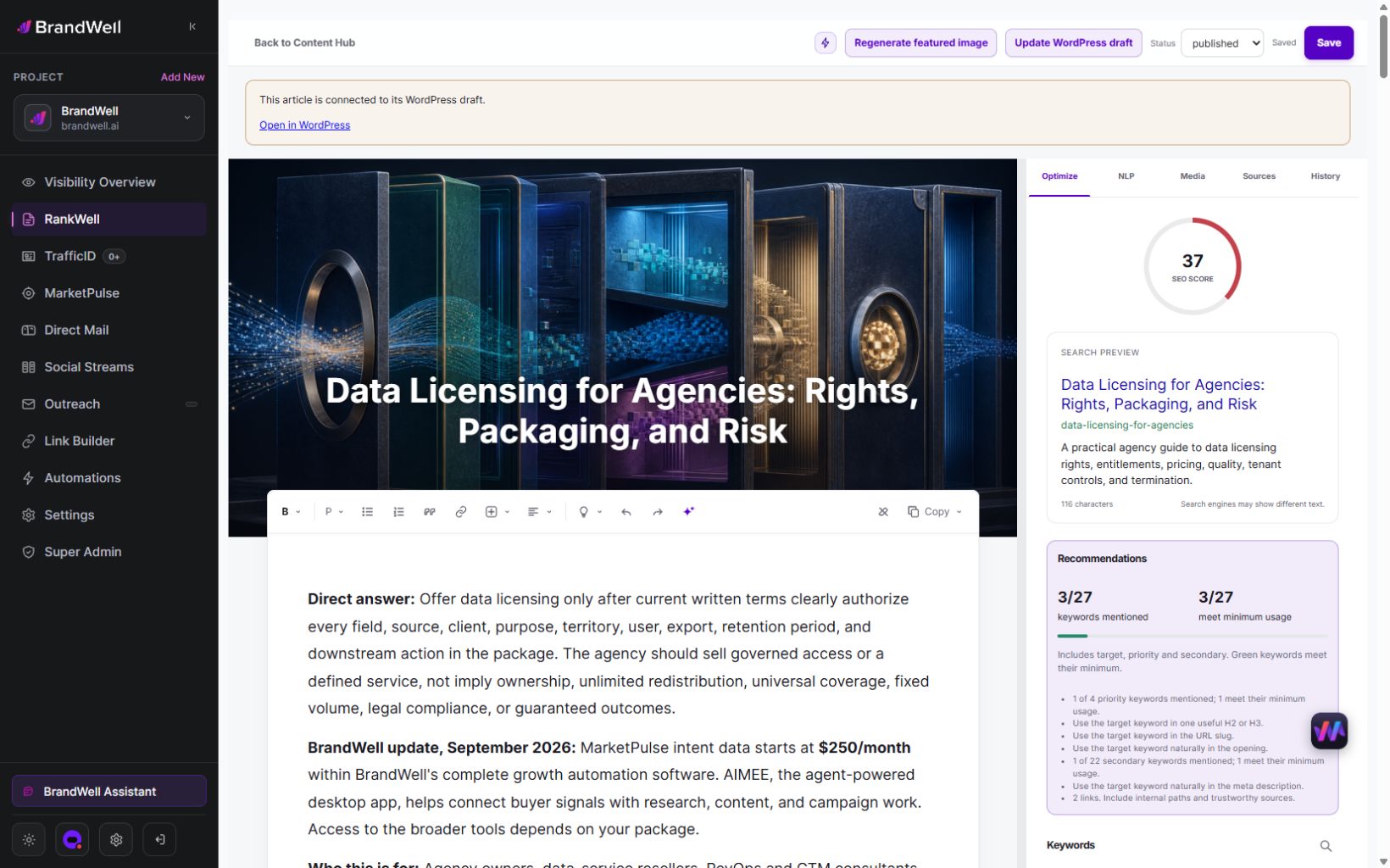
Review the draft rather than assuming the whole strategy is complete because text was generated. Verify claims, add your team’s knowledge and check the configured publishing connection before approving the destination page. An editorial score does not promise search placement.
7. Improve the page without keyword stuffing
Write a descriptive title and a direct opening answer. Use headings that reflect the reader’s questions and link to relevant supporting pages. Mention important terms naturally when they help explain the topic.
There is no keyword-density target in this workflow. Google’s keyword-stuffing policy addresses unnatural repetitions and keywords inserted to manipulate rankings. Repeating a phrase to reach a percentage can undermine readability.
Use a useful featured image and informative alternative text. Review tables, image loading, navigation and the call to action on mobile. Keep the title and description consistent with what the page actually provides.
8. Publish, distribute and measure
Record the publication or substantive update date and the changes made. Share the finished resource through appropriate channels with a specific reason to read it. Distribution can bring readers; it should not be described as guaranteed search-ranking improvement.
In Search Console, compare relevant page impressions, clicks, click-through rate and average position over comparable periods. In your analytics, examine useful actions such as demo requests or qualified inquiries. Account for changes in audience, device, demand and search position when interpreting results.
For example, 5,000 impressions and 50 clicks produce a 1% CTR. At 6,000 impressions and 90 clicks, CTR is 1.5%. That is a 0.5 percentage-point increase. This hypothetical calculation explains the metric; it does not establish that one content change caused the difference.
Frequently asked questions
Should I create a page for every keyword?
No. Map related queries to a page that answers a coherent need. Create separate pages when the purpose or audience warrants it, rather than generating near-duplicates for small wording changes.
Should I update an article or write a new one?
Update when the existing URL already serves the right question and can be improved. Create when the need is distinct and your team can provide a useful answer. Review overlap before deciding.
How often should I revisit keyword research?
Use changes in the business, search demand, product details and page performance to guide the cadence. A launch or an outdated guide can require immediate attention; a stable resource may need less frequent review.
What is the next step I can take today?
Choose one relevant topic, identify its current URL, write a short evidence-based brief and assign a reviewer. That creates a concrete handoff from research to content work.
Explore RankWell to turn approved research into content your team can review, publish and maintain.
Reviewed and updated October 3, 2026.

Written by
Julia McCoy has contributed articles to BrandWell on content marketing, writing, and search engine optimization. This archive retains her original bylines; individual articles may be updated by the BrandWell editorial team.