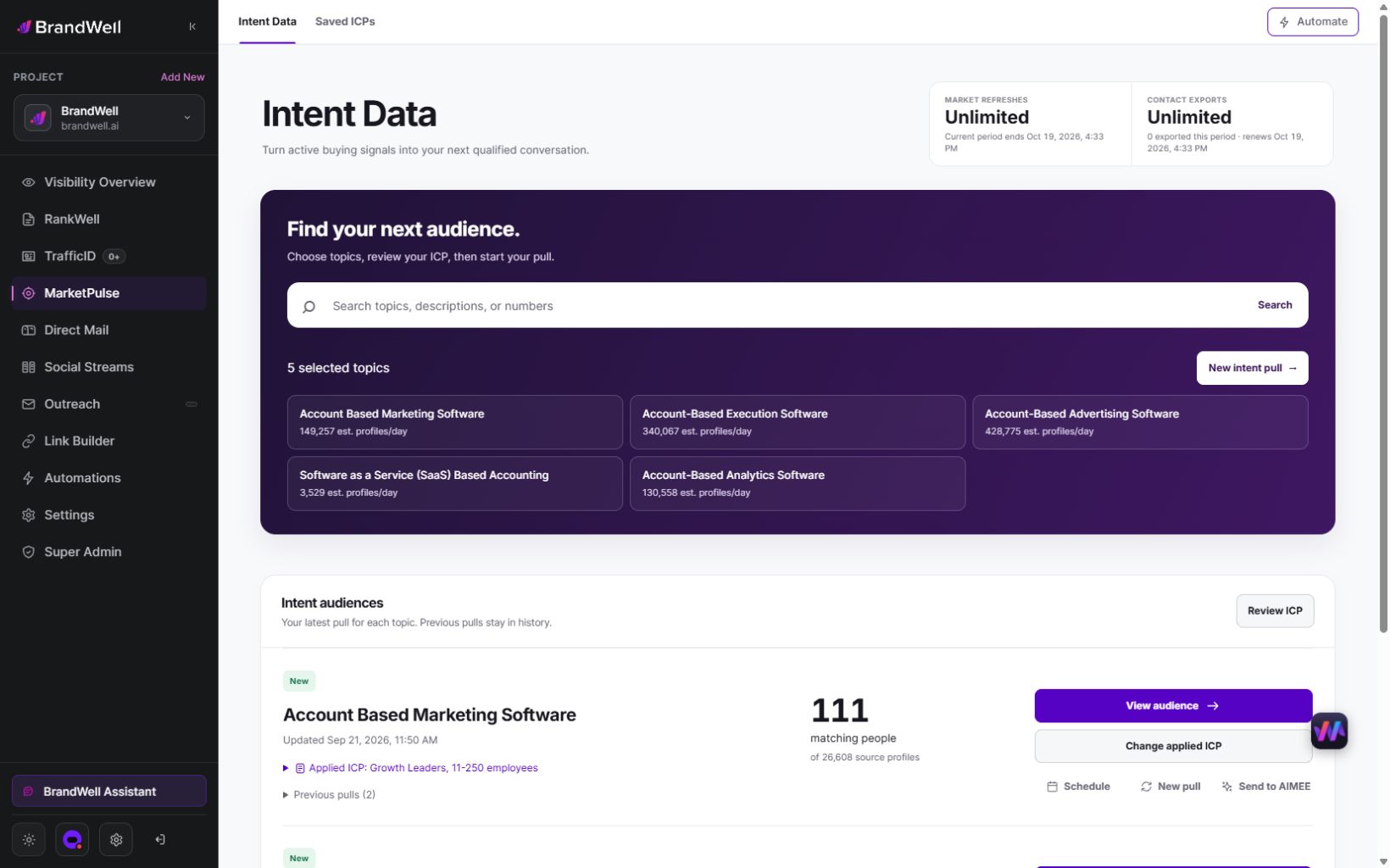
ABM intent data is most useful as a prioritization and timing layer, not as proof that an account or person will buy. Start with a named target-account universe. Combine fit, first-party engagement, and current third-party research signals; resolve the account or buying group at a stated confidence level; trigger a relevant play; then measure lift against a holdout or pre-pilot baseline.

Choose a modular intent provider when your CRM, marketing automation, ad, and outreach systems already work and you mainly need better signal, identity, and routing. Consider a full enterprise ABM suite when you have clean data, dedicated ABM and RevOps ownership, complex buying groups, and a real need for coordinated multichannel orchestration. The key limitation is universal: intent signals are probabilistic, coverage varies by market, and activity does not prove readiness to buy.

This guide covers ABM intent data for B2B revenue teams adopting or improving ABM. It gives you the strategy, five-option shortlist, implementation workflow, pricing model, measurement formulas, privacy guardrails, and agency service blueprint needed to make a defensible decision.

Who this is for

  • Agencies and resellers that want to add a branded, recurring intent-data service without building the data, sales, delivery, reporting, and activation engine from scratch.
  • B2B revenue teams that already have CRM, marketing automation, advertising, or outreach systems but need stronger account timing and prioritization.
  • Enterprise ABM teams comparing a modular intent layer with a broad orchestration suite.

BrandWell agency plans are $2,500–$5,000 per month, depending on topic count, contract term, and any contractually scoped topic exclusivity that is available. Confirm included modules, usage, client capacity, implementation, support, and exclusivity in the current written quote and order form.

Use lead-based demand generation when inbound volume, short sales cycles, and lower account value make account orchestration unnecessary. Choose a modular intent layer when your current GTM stack works but needs better signals, identity, and routing. Consider a full enterprise ABM suite when high-value accounts, complex buying groups, and coordinated multichannel programs justify the added implementation burden.

What ABM intent data is – and is not

Intent data records research or engagement behavior that may help a team infer what an account cares about and when to act. First-party signals come from properties you control, such as pricing-page visits, webinars, email engagement, product use, and CRM activity. Third-party signals come from research behavior observed elsewhere. Identity and enrichment connect those signals to accounts, buying groups, or people with varying confidence.

Intent is not a declaration that someone wants a call. It is one input to a decision. Treat every signal as a hypothesis that must pass fit, identity, freshness, permission, and outcome checks.

ABM intent data strategy: use a six-gate framework

A reliable ABM intent data framework uses gates instead of one mysterious score:

  1. Fit gate: Is the account in your ICP, serviceable market, and economic range?
  2. Signal cluster: Is there more than one current, relevant behavior, or a single high-value signal with enough context?
  3. Identity confidence: Can you resolve the activity reliably enough for the proposed account-, buying-group-, or person-level action?
  4. Freshness window: Is the behavior recent enough for this topic, sales cycle, and channel?
  5. Activation rule: Is there a relevant, permitted next step with an owner and response SLA?
  6. Outcome loop: Did treated accounts engage, progress, create qualified pipeline, or buy more often than a comparable baseline?

In shorthand:

eligible account → relevant signal → identity confidence → freshness → action threshold → permitted play → measured outcome

This ABM intent data planning guide starts with the revenue decision, not the vendor. Define the account universe, excluded segments, topics, buying roles, action window, and success metric before requesting a demo. That prevents a provider’s available data from quietly becoming your strategy.

Useful ABM intent data use cases

The strongest ABM intent data use cases have a clear owner and a different action than the status quo:

  • Prioritize named accounts for seller research and outreach.
  • Expand from one engaged contact to a plausible buying group.
  • Build ad audiences from eligible accounts showing current category interest.
  • Adjust content or offers to the account’s likely research stage.
  • Flag customer expansion, competitive research, or churn hypotheses.
  • Help agencies run a repeatable signal-to-action service across separate client projects.

Weak use cases include collecting signal volume for a dashboard, blasting every “surging” account, or using person-level matches to reveal that someone was tracked.

ABM intent data implementation guide

The workflow is straightforward on paper. Most failures happen in definitions, ownership, and feedback loops.

1. Define the target and outcome

Document your ICP, named accounts, exclusions, relevant topics or keywords, buying roles, geographies, and the business outcome. Use one primary pilot outcome – such as qualified opportunity creation – not a list of unrelated engagement metrics.

2. Establish the first-party baseline

Connect your CRM, marketing automation, website or product analytics, campaign history, opportunity stages, suppression lists, and consent records. Repair domain-to-account mapping before adding more data. If the account foundation is unreliable, a new signal feed will amplify the error.

3. Ingest third-party signals with lineage

Store the source, timestamp, topic, score, granularity, lookback period, and available confidence fields. Do not flatten account- and person-level signals into the same field. Preserve enough lineage for RevOps, privacy, and sales teams to understand why a record qualified.

4. Resolve and enrich identity

Match activity to an account, buying group, or person. Quarantine low-confidence matches. Enrich only the fields required for qualification or activation, and test validation on your market rather than accepting a vendor-wide coverage statement as your result.

5. Apply fit, freshness, and multi-signal thresholds

A practical rule might require an eligible account, a relevant signal inside the defined action window, a minimum identity-confidence level, and either repeated research or corroborating first-party engagement. Thresholds should vary by topic: competitor pricing research may decay differently from a broad educational topic.

6. Route to a specific play

Send qualified records to the system where work happens: CRM, sales engagement, an ad audience, marketing automation, an alert, a dashboard, an export, or an approved AI workflow. Each route needs an owner, SLA, fallback, and suppression check.

7. Add human judgment where the stakes are higher

Require human review for sensitive, surprising, or high-impact person-level outreach. Never write “we saw you researching X.” Use the signal to improve timing and relevance without disclosing invasive detail.

8. Capture outcomes and exceptions

Log delivery, acceptance, rejection reason, reply, meeting, opportunity, stage progression, pipeline, win/loss, opt-out, and suppression events. A sales rejection such as “wrong subsidiary” is training data for your matching rules.

9. Compare treatment with a baseline

Use a randomized holdout when practical. Otherwise, use a clearly labeled matched cohort or pre-pilot baseline and explain its limits. Avoid attributing every influenced opportunity to intent.

10. Refresh the operating model

Review topic maps, action windows, thresholds, routing, access, retention, and suppression rules on a fixed cadence. Revalidate vendor coverage whenever you enter a new geography, vertical, or client market.

Team ownership and integrations

WorkstreamAccountable ownerRequired inputsOutput
ICP, accounts, and topicsABM or demand leaderStrategy, market, exclusionsApproved target and topic map
Identity, enrichment, and routingRevOps or data ownerCRM, domains, confidence rulesQualified account/person records
Seller activationSales leaderPlays, SLAs, feedback reasonsResearched outreach and disposition data
Audience activationPaid-media ownerAllowed audience, creative, suppressionActivated campaigns and delivery data
MeasurementAnalyst or RevOpsBaseline, treatment, opportunity stages, costAccount progression and incremental-lift report
GovernancePrivacy, security, and legal reviewersSources, DPA, retention, rights handlingApproved uses, controls, and escalation path

Core integrations normally include CRM, marketing automation, website or product analytics, enrichment and identity, a warehouse or BI layer, sales engagement, ad platforms, and consent or suppression systems. The minimum stack depends on the play; do not buy integrations that have no named owner or decision.

Three ABM intent data implementation examples

These ABM intent data implementation examples are practical ABM intent data examples of how signal granularity changes the play:

  1. Account-level advertising: An eligible account shows current research on a high-value category. The system verifies freshness and account identity, adds the account to an approved ad audience, serves stage-matched creative, and measures engaged-account and opportunity lift against a holdout.
  2. Buying-group expansion: An open opportunity has one known champion. Current account research suggests security and implementation concerns. The rep receives a task to map relevant roles and share approved resources; the signal informs research but is not quoted to the prospect.
  3. Agency-managed activation: An agency validates a client’s topic coverage, resolves usable accounts, applies client-specific fit rules, routes qualified records, runs a weekly exception review, and reports monthly on account progression and full program cost.

ABM intent data activation workflows: practical best practices

The best ABM intent data activation workflows are narrow enough to audit. Follow these ABM intent data best practices:

  • Use one signal definition and one owner per play.
  • Define time-to-live before launch.
  • Separate account, buying-group, and person confidence.
  • Run suppression before every activation.
  • Match the message to the likely research stage, not merely the topic name.
  • Record rejection reasons, not only positive outcomes.
  • Keep a holdout where sample size permits.
  • Stop a play if noise, complaints, or data quality cross a preset threshold.

Five ABM intent data options to evaluate

Disclosure: This article is published by BrandWell. BrandWell is listed first because it is the publisher’s product, not because an independent review found it universally best. Every option is evaluated using the same disclosed criteria. We state the limitations of each option and when another provider is a better fit.

This is a maintained ABM intent data comparison, not an independent ranking. We evaluated each option on the same ten criteria: intended audience and operating model; signal provenance and relevance; granularity and identity; freshness and decay; fit and scoring controls; activation and integrations; implementation effort; privacy and governance; verified pricing and total cost; and measurement, proof, and limitations.

OptionBest fitSignal and granularityActivation modelPricing approachMeaningful limitation
BrandWellAgencies and resellers that want a complete white-label sales-and-delivery enginePerson- and company-level records where coverage is available; off-site intent, TrafficID, form signals, and optional topic exclusivityBranded reports, client delivery, custom routing, and agent-ready instructions for Claude, ChatGPT, or in-browser execution through Moxby$2,500–$5,000/month; depends on topic count, contract term, and available contractually scoped topic exclusivity; verify the written quote and order formCoverage and topic exclusivity depend on the market and agreement; outputs remain probabilistic
6senseEnterprise predictive and full-funnel ABMAccount and buying-group intelligence using native, first-party, and partner dataAudiences, workflows, ads, email, sales tools, integrations, and APIsCustom pricing; dated procurement benchmarks vary; verify scope, billing, and term in writingSignificant onboarding, governance, and cross-functional change management
DemandbaseEnterprise buying-group GTM and B2B advertisingAccount, buyer, and person-level intent with first- and third-party dataUnified Marketing, Sales, Advertising, and Data workflowsCustom pricing; dated procurement median is not list price; verify Order scope, billing, and termUnified packaging and data-lineage questions may not suit a narrow requirement
BomboraDedicated account-level intent inside an existing stackAccount-level Company Surge from a B2B data cooperativeData feeds, integrations, audiences, and partner platformsNo general list price; dated procurement benchmarks vary; obtain a scope-matched written quoteIt is not an end-to-end ABM platform; identity and orchestration must live elsewhere
ZoomInfoSales-led intent connected to contact workflowsIntent-active accounts plus person, role, and buying-committee contextCRM, MAP, engagement, marketing, advertising, and workflow productsConfiguration-specific pricing; dated procurement median is not list price; terms generally span one to three yearsBroad GTM scope may exceed a team’s narrow intent need; coverage must be tested

1. BrandWell – for agencies and modular signal-to-action systems

BrandWell homepage hero promoting competitor-research intent data
BrandWell homepage hero. Screenshot shown for context; on-page claims are BrandWell-provided.
  • Intended audience and operating model: BrandWell is purpose-built for agencies and resellers that want a complete white-label intent-data solution, not merely a signal feed. The agency solution gives the agency an engine to package, sell, deliver, and report on the service under its own brand while keeping client work separated.
  • Signal provenance and relevance: The offering combines commercial research behavior, TrafficID, and form activity. BrandWell is also the only provider in this five-option comparison that can offer topic exclusivity to an agency, subject to topic availability, coverage, and the signed agreement. Buyers should confirm the exact topic, geography, exclusion rules, and permitted use during the market-coverage review.
  • Granularity and identity: BrandWell says it can produce person- and company-level records where coverage is available, then enrich and qualify them. LeadFuze, the underlying data provider, documents identity resolution and enrichment workflows. A buyer should test match confidence and validation on its own sample.
  • Freshness and scoring controls: The public product description includes research recency, qualification rules, and intent, fit, and contactability scoring. Ask how timestamps, time-to-live, confidence, and false positives appear in exports and workflows.
  • Activation and integrations: BrandWell routes qualified records into CRM, outbound, ads, dashboards, or exports. It also supplies agent-ready automation workflow instructions that can be given to Claude or ChatGPT, or carried out directly in the browser through Moxby. The instructions turn a signal into a defined operating play; teams should still set permissions and human-approval boundaries for consequential actions.
  • Implementation effort: Resellers can begin with a $70 seven-day pilot that generates branded topic reports for the agency to evaluate and present. A full rollout then configures audience, categories, volume, qualification, white-label delivery, and routing. This is more tailored than a self-serve feed and requires clear owners on both sides.
  • Privacy and governance: BrandWell’s Privacy Policy covers intent, identity, website-visitor, audience, and agency services. It states that customers and agencies remain responsible for their own notices, legal bases, permissions, communications, and use.
  • Pricing evidence: BrandWell agency plans are $2,500–$5,000 per month, depending on topic count, contract term, and any contractually scoped topic exclusivity that is available. Confirm included modules, usage, client capacity, implementation, support, and exclusivity in the current written quote and order form.
  • Measurement and proof: Public descriptions show the workflow, but this article has no independent signal-quality or outcome benchmark for BrandWell. Require a buyer-specific pilot and compare usable coverage, noise, activation, pipeline, and total cost on the same terms as every alternative.
  • Meaningful limitation and when another option is better: Coverage is not universal, intent and identity outputs are probabilistic, topic exclusivity is not available for every topic or market, and the new intent-led offering requires a scoped implementation. A seven-day pilot validates the report and workflow fit; it does not guarantee pipeline. Choose a broad enterprise suite when a large organization needs mature, platform-wide orchestration, or a dedicated feed when the only requirement is account-level intent data.

2. 6sense – for enterprise predictive and full-funnel ABM

6sense homepage hero focused on signals and GTM context
6sense homepage hero. Screenshot shown for context; on-page claims are vendor-provided and were not independently verified.
  • Intended audience and operating model: 6sense fits enterprise revenue organizations with defined ABM operations, clean CRM and marketing-automation data, and dedicated cross-functional ownership.
  • Signal provenance and relevance: 6sense describes native intent plus integrations with sources including Bombora, TechTarget, TrustRadius, and G2. It also says teams can track custom search keywords in more than 40 languages; validate relevant market coverage rather than relying on the breadth claim alone.
  • Granularity and identity: The platform describes account and buying-group intelligence, web deanonymization, company and people search, and predictive account prioritization. Confirm what identity fields, contact entitlements, and confidence details are included in the proposed package.
  • Freshness and scoring controls: 6sense says keyword results can appear within a day and supports predictive modeling and account scoring. Ask how decay, model inputs, explainability, and overrides work for your sales cycle.
  • Activation and integrations: Its ABM platform spans audience building, workflows, advertising, email, sales alerts, reporting, and connected tools or APIs.
  • Implementation effort: Breadth creates value only when marketing, sales, RevOps, and operations agree on accounts, stages, routing, and measurement. Plan for onboarding, model configuration, training, and change management.
  • Privacy and governance: Review data sources, opt-outs, retention, roles, trust materials, and required agreements through your own security and privacy process.
  • Pricing evidence: 6sense uses custom pricing. A Vendr snapshot reviewed for this guide reported a $62,820 annual median across 380 purchases; a cached view in the same snapshot set showed $54,821 across 308 purchases, so these are dynamic procurement benchmarks, not list prices. Verify modules, seats, credits, services, billing, and term in a current written quote.
  • Measurement and proof: 6sense publishes customer evidence on its product pages, but those examples are vendor-selected. Reproduce value with your own holdout, cost model, and opportunity definitions.
  • Meaningful limitation and when another option is better: A smaller team or agency may not need the platform’s breadth or change-management burden. Choose a modular option when existing systems already handle activation, or Bombora when the requirement is mainly an account-level intent feed.

3. Demandbase – for buying-group orchestration and B2B advertising

Demandbase homepage hero focused on go-to-market pipeline
Demandbase homepage hero. Screenshot shown for context; on-page claims are vendor-provided and were not independently verified.
  • Intended audience and operating model: Demandbase is a fit for enterprise teams that want account and buying-group intelligence connected to coordinated marketing, sales, web, and advertising execution.
  • Signal provenance and relevance: Demandbase describes first- and third-party signals plus a data foundation spanning accounts, buying groups, people, and intent; buyers should still document source lineage and allowed uses.
  • Granularity and identity: The platform emphasizes accounts, buyers, buying groups, and person-level intent. Confirm how it maps people and accounts, handles parent-child entities, and exposes confidence.
  • Freshness and scoring controls: Demandbase describes continuous enrichment, current buyer data, intent spikes, and account prioritization. Ask for precise refresh windows, change handling, model controls, and false-positive workflows.
  • Activation and integrations: The ABM product spans target-account lists, buying-group engagement, cross-channel programs, web experiences, B2B advertising, and pipeline measurement. Data can also move through CRM, warehouse, APIs, and workflows.
  • Implementation effort: A unified model requires shared account definitions, buying-group rules, routing, campaign governance, and sales adoption. Budget for integration, enablement, and operating change – not only the license.
  • Privacy and governance: Review its security and trust materials, privacy notice, data sources, retention, and rights-handling procedures for your jurisdictions.
  • Pricing evidence: Demandbase uses custom pricing. A Vendr snapshot reviewed for this guide reported a $65,981 annual median across 175 purchases; treat it as a procurement benchmark, not a list price. Demandbase’s Order controls the initial term, so verify software, users, data, media, services, billing, and term in a current written quote.
  • Measurement and proof: The platform includes account and pipeline measurement, but the buyer should define qualified stages, baseline cohorts, and media treatment before implementation so the platform is not grading its own selection model without a control.
  • Meaningful limitation and when another option is better: Unified Sales and Marketing packaging may be more than a narrow data buyer wants, and source-level opacity can make lineage review harder. Choose Bombora for a dedicated account-level feed, ZoomInfo for sales/contact-heavy workflows, or a modular service for agency-specific client separation.

4. Bombora – for account-level intent in an existing stack

Bombora homepage hero focused on B2B intent, identity, and audience data
Bombora homepage hero. Screenshot shown for context; on-page claims are vendor-provided and were not independently verified.
  • Intended audience and operating model: Bombora fits teams that already have CRM, marketing automation, advertising, sales, or ABM systems and want a dedicated third-party intent layer.
  • Signal provenance and relevance: Bombora says its Company Surge data comes from a B2B data cooperative of publishers, B2B brands, and premium providers. It describes relative, account-specific scoring based on historical research behavior.
  • Granularity and identity: Company Surge is fundamentally account-level. Bombora also offers identity and enrichment products, but an account surge does not prove which person performed the research.
  • Freshness and scoring controls: The methodology is based on behavior relative to an account’s own historical baseline. Buyers should confirm topic refresh, reporting cadence, threshold controls, and the window available through the selected delivery method.
  • Activation and integrations: Bombora documents data feeds, partner integrations, digital audiences, and use across sales, marketing, advertising, and measurement. Its site explicitly positions the company as a data provider rather than an end-to-end platform.
  • Implementation effort: The buyer needs identity or contact data, an activation system, routing, playbooks, and outcome measurement around the feed. That can be an advantage when the existing stack is strong – and a burden when it is not.
  • Privacy and governance: Review Bombora’s collection model, consent framework, source geography, permitted activation, rights handling, privacy materials, and suppression requirements with your own reviewers.
  • Pricing evidence: Bombora does not publish a general dollar list price. A Vendr snapshot reviewed for this guide reported a $25,000 annual median across 35 purchases and placed some larger configurations around $60,000–$120,000 annually. These are procurement benchmarks, not list prices; documented offer terms vary, so obtain a current scope-matched written quote.
  • Measurement and proof: Bombora publishes vendor-reported use cases and customer stories. Your pilot should measure account coverage, usable surge rate, false-positive or irrelevant-topic rate, activation latency, and incremental opportunity outcomes.
  • Meaningful limitation and when another option is better: Account-level data is not proof of a specific person’s behavior, and Bombora is not the full orchestration layer. Choose 6sense or Demandbase when you need coordinated enterprise ABM, ZoomInfo for contact-centered execution, or BrandWell for a scoped agency/reseller workflow subject to coverage validation.

5. ZoomInfo – for intent connected to contact and sales workflows

ZoomInfo homepage hero focused on its go-to-market platform
ZoomInfo homepage hero. Screenshot shown for context; on-page claims are vendor-provided and were not independently verified.
  • Intended audience and operating model: ZoomInfo fits sales-led organizations that want intent connected to contact, role, and buying-committee workflows within a broader GTM data platform.
  • Signal provenance and relevance: ZoomInfo describes intent-active accounts plus person-level context. Ask how sources, topics, geographies, and data permissions differ across packages.
  • Granularity and identity: ZoomInfo says it can surface specific people, roles, seniority, and buying-decision position within intent-active accounts. Treat that as a vendor claim until tested on your own account and contact sample.
  • Freshness and scoring controls: Confirm refresh cadence, signal timestamps, topic controls, identity confidence, and how Guided Intent or other scoring features can be inspected or overridden.
  • Activation and integrations: ZoomInfo describes CRM, marketing-automation, engagement, audience, advertising, enrichment, and workflow products. A buyer should map which destinations and actions are native, included, or separately licensed.
  • Implementation effort: The broad platform can consolidate contact research and activation, but it still requires field mapping, credit and export governance, routing, seller training, and QA.
  • Privacy and governance: Review its trust materials, privacy notices, data-broker registrations, rights workflows, contracts, retention, and jurisdictional coverage.
  • Pricing evidence: ZoomInfo pricing varies by functionality, users, data, credits, and add-ons. A Vendr snapshot reviewed for this guide reported a $33,500 annual median across 1,564 purchases; treat it as a procurement benchmark, not a list price. ZoomInfo’s reviewed Form 10-K says contracts generally run one to three years, so verify scope, billing, and term in writing.
  • Measurement and proof: Product-page accuracy and coverage statements are vendor-reported. Measure usable contact coverage, role accuracy, duplicate rate, workflow acceptance, opportunity conversion, and cost on your target sample.
  • Meaningful limitation and when another option is better: A broad GTM platform can be excessive when the need is only an account-level feed. Choose Bombora for that narrower layer, 6sense or Demandbase for enterprise orchestration, or a scoped modular system for agency-led delivery.

ABM intent data alternatives: lead-based, modular, or full-suite?

An honest ABM intent data decision guide includes the status quo.

CriterionLead-based demand generationModular intent layerFull enterprise ABM suite
Best forBroad market, strong inbound, lower ACV, shorter or self-serve motionExisting stack works; team needs better timing, identity, and prioritizationHigh ACV, long cycles, many stakeholders, dedicated ABM and RevOps
Primary unitIndividual leadAccount, buying group, and sometimes personAccount and buying group across coordinated channels
ImplementationLowestModerate; team owns data flow and playsHighest; platform, data, process, and adoption change
FlexibilityHigh at channel levelHigh across selected systemsHigh inside the suite, with more platform dependency
Measurement riskOver-crediting form fills or last touchOver-crediting selected high-propensity accountsLetting the orchestration platform grade its own model
Switch triggerSellers lack account context; lead quality is weakSeparate tools cannot sustain coordination or governanceCost and complexity exceed the value of orchestration

Migration is not a login change. Plan account-ID mapping, historical engagement, audience recreation, scoring translation, CRM fields, routing, privacy controls, training, and reporting continuity.

ABM intent data pricing, cost, and total cost

BrandWell agency plans are $2,500–$5,000 per month, depending on topic count, contract term, and any contractually scoped topic exclusivity that is available. Confirm included modules, usage, client capacity, implementation, support, and exclusivity in the current written quote and order form.

That position is deliberately narrow: it compares the entry configurations discussed here, not every contract a provider might negotiate. A starting price is not the same as full cost. Normalize each written quote against the same market, topics, volume, users, data, activation, service, and implementation requirements.

OptionPricing approachQuote inputs to normalize
BrandWell$2,500–$5,000/month; depends on topic count, contract term, and available contractually scoped topic exclusivity; verify the written quote and order formMarket, topics, lead volume, TrafficID, enrichment, routing, white-label delivery, exclusivity
6senseCustom pricing; dated procurement benchmarks vary; verify scope, billing, and term in writingPlatform modules, data, seats, ads/media, integrations, services
DemandbaseCustom pricing; dated procurement median is not list price; verify Order scope, billing, and termPlatform scope, users, Advertising or Data starting point, services
BomboraNo general list price; dated procurement benchmarks vary; obtain a scope-matched written quoteTopics, accounts, geography, delivery, integrations, audiences, media
ZoomInfoConfiguration-specific pricing; dated procurement median is not list price; terms generally span one to three yearsPackage, seats, credits, intent entitlements, exports, refresh, services

Calculate ABM intent data cost with a standard worksheet:

Annual TCO = platform + seats + data or credits + intent topics + ad/media fees + implementation + integrations + services + internal labor + privacy/security review + ongoing QA + overages

Ask every provider to quote the same account universe, geography, topic set, refresh requirement, identity granularity, destinations, seats, client count, support level, and contract term. Separate pass-through data or media from software and services. Read renewal, overage, export, retention, and termination clauses before comparing totals.

For an agency, also model delivery labor and client-level variability. A low software quote can still be expensive if every client needs manual cleansing, routing, and reporting.

ABM intent data signal quality and measurement

Good ABM intent data signal quality and measurement starts with denominators. Raw signal volume is not success.

ABM intent data KPIFormulaWhat it tells you
Usable signal rateRecords passing fit, freshness, identity, and suppression / records receivedHow much purchased data can enter a real play
Account coverageEligible target accounts with usable signals / eligible target accountsWhether the source covers your market
Activation rateUsable intent-active accounts entering a defined play / usable intent-active accountsWhether signals turn into work
Engaged-account rateActivated accounts with verified engagement / activated accountsEarly response after activation
Opportunity rateActivated accounts creating qualified opportunities / activated accountsPipeline conversion at the account level
Pipeline per activated accountQualified pipeline / activated accountsPipeline efficiency with a consistent stage definition
Cost per qualified intent accountFull program cost / qualified accountsEconomic efficiency before opportunity creation
Cost per qualified opportunityFull program cost / qualified opportunitiesProgram cost against a revenue-adjacent output
Incremental lift(Treatment conversion − holdout conversion) / holdout conversionRelative change versus a comparison group
Win rate and cycle timeTreated opportunities versus comparable untreated opportunitiesDownstream quality and speed

These are the core ABM intent data KPIs, but the model must distinguish sourced, influenced, and coincident pipeline. Intent often selects accounts already more likely to convert. A simple before-and-after chart can therefore overstate causality.

ABM intent data ROI formula

Use full incremental value and full cost:

ROI = (incremental gross profit attributable to the program − full program cost) / full program cost

One illustrative calculation: if a treatment group converts at 12% and a comparable holdout converts at 8%, relative lift is (12% − 8%) / 8% = 50%. That is a demonstration of the formula, not an industry benchmark and not proof of causality by itself. Show group size, assignment method, time window, confidence, and exclusions.

What to do about ABM intent data benchmarks

Universal ABM intent data benchmarks are usually less useful than your own controlled baseline because account value, topic breadth, geography, sales cycle, match method, and stage definitions differ. Build benchmarks in this order:

  1. Your pre-pilot baseline.
  2. A randomized holdout or matched cohort.
  3. A prior period with known seasonality caveats.
  4. Vendor-reported examples, clearly labeled and never substituted for your own result.

Who is – and is not – a fit

Strong-fit companies and clients

  • B2B companies with a defined ICP and target-account universe.
  • Meaningful account value and multi-person buying decisions.
  • Enough eligible accounts for testing.
  • Current account/domain data and measurable opportunity stages.
  • Sales or paid-media capacity to act quickly.
  • An ABM or demand owner plus RevOps or data support.
  • A sales cycle long enough for earlier research signals to change action.
  • Agencies with separate client data, clear scopes, repeatable delivery, and governance.

Poor-fit conditions and disqualifiers

  • Low-ACV self-serve offers where account orchestration costs more than it creates.
  • Tiny markets or geographies with weak topic or identity coverage.
  • Dirty account data and no owner for repair.
  • No activation capacity after a signal arrives.
  • No consistent opportunity stages or baseline.
  • An expectation that one signal proves a person’s identity or readiness to buy.
  • A use case or jurisdiction where lawful processing and outreach cannot be established.

ABM intent data mistakes, quality risks, and privacy guardrails

The biggest ABM intent data mistakes are operational before they are technical:

  • Treating a single signal as purchase intent.
  • Confusing account activity with a named person’s behavior.
  • Using stale, vague, or overly broad topics.
  • Ignoring large-account activity bias.
  • Failing to measure false positives and duplicates.
  • Mapping the wrong domain, parent, subsidiary, or territory.
  • Sending creepy outreach that reveals tracking detail.
  • Failing to synchronize opt-outs and suppression.
  • Retaining more data than the use requires.
  • Calling all influenced pipeline “sourced.”

Mitigate them with a market-specific sample test, source and timestamp fields, fit and recency gates, confidence thresholds, holdouts, least-privilege access, data minimization, a retention schedule, suppression synchronization, and a documented rights-request path.

Privacy and outreach requirements vary by jurisdiction, channel, data role, and subscriber type. The FTC’s CAN-SPAM guide explains that the U.S. law applies to commercial email, including B2B messages, and includes header, subject, identification, address, and opt-out duties. The European Commission’s GDPR guidance and data-processing principles emphasize lawful, purpose-limited, minimized, accurate, and secure processing of personal data. The UK ICO’s B2B marketing guidance explains that rules vary by channel and recipient and that legitimate interests requires a documented assessment. California’s Privacy Protection Agency data-broker page maintains current registration and deletion information.

This is operational guidance, not legal advice. Obtain jurisdiction-specific privacy, security, and legal review before launch.

ABM intent data agency guide: build a recurring service, not a CSV subscription

A durable agency offer packages the operating system around the data. BrandWell’s complete white-label agency solution is designed to help a reseller package and sell the offer, produce branded topic reports, deliver the service, activate signals, and show the client what happened. The agency keeps its own brand, sets its own retail pricing, and handles client billing.

The entry point is a $70 seven-day reseller pilot that generates branded topic reports. The pilot lets the agency inspect coverage, report quality, and the client-facing story before committing to a broader rollout. When an available topic is contractually reserved, BrandWell can also give the agency topic exclusivity – an option no other provider in this five-company comparison offers.

Service blueprint

  1. Pilot and foundation: $70 seven-day branded-report pilot, ICP, exclusions, topic map, account universe, coverage test, scoring, governance review, baseline, and approved playbook.
  2. Managed signal operations: monitoring, identity and enrichment, fit/freshness QA, routing, alerts, suppression, and weekly exception review.
  3. Activation: buying-group research, CRM tasks, sales context, ad audiences, nurture, content coordination, and client-approved channel plays. BrandWell can attach agent-ready workflow instructions for Claude, ChatGPT, or direct in-browser execution through Moxby.
  4. Measurement and optimization: monthly account progression, opportunity and pipeline reporting, holdout review, threshold tuning, quarterly topic refresh, and executive readout.

Three package structures – without invented prices

PackageIncluded scopeClient outcomeKey boundary
Signal FoundationCoverage review, account prioritization, dashboard or report, governanceA qualified view of where current demand may existNo promise of meetings or pipeline
Signal ActivationFoundation plus CRM routing, sales plays, and approved audiencesSignals reach owned systems and named operatorsClient supplies channel capacity and approvals
Managed ABM GrowthActivation plus experiments, content/ad coordination, buying-group research, and executive reportingA managed learning and activation loopRequires adequate account volume and measurement access

This is a practical model for ABM intent data services. If you hire ABM intent data expert services, ask who owns the data model, how client separation works, which work is automated, how exceptions are reviewed, and what evidence supports renewals.

Agent-ready does not mean unsupervised by default. Define which instructions may run automatically, which require agency or client approval, what evidence must be logged, and what happens when a workflow encounters an exception. Claude and ChatGPT can carry out the written play in their supported environments; Moxby is the browser-based route for executing the same instructions where the work happens.

Agency economics

Agency gross margin = client retainer − wholesale/data usage − pass-through media − delivery labor − integration/support − compliance and QA overhead

Price the setup separately when it includes data repair, integrations, topic design, and baseline instrumentation. Model usage sensitivity by client. A client with weak coverage or dirty data can consume more service hours even if the software cost is unchanged.

Cadence and SLAs

  • Daily or near-real-time: ingestion, suppression, routing, failed-job alerts.
  • Weekly: exception review, sales dispositions, topic noise, queue health.
  • Monthly: account progression, pipeline, cost, experiment results, and actions.
  • Quarterly: topic map, coverage, permissions, retention, package, and expansion review.

Write SLAs for delivery/freshness, QA thresholds, routing response, suppression timing, incident escalation, reporting cadence, and change requests. Do not guarantee meetings, pipeline, revenue, rankings, or vendor coverage.

ABM intent data templates and operational checklist

Useful ABM intent data templates include:

  • Target-account and exclusion worksheet.
  • Topic map with stage, owner, action window, and prohibited uses.
  • Vendor pilot scorecard.
  • Data-lineage and privacy review.
  • Activation matrix by signal, confidence, channel, owner, and SLA.
  • TCO and quote-normalization worksheet.
  • Weekly exception report.
  • Monthly account-progression and incremental-lift report.

Use this ABM intent data operational checklist before launch:

  • Revenue outcome and primary pilot metric are defined.
  • ICP, accounts, exclusions, topics, roles, and geographies are approved.
  • Account/domain data has passed QA.
  • Signal source, timestamp, granularity, and confidence are preserved.
  • Freshness and multi-signal thresholds are written down.
  • Each play has an owner, SLA, approved message, and fallback.
  • Suppression, retention, access, and rights handling are tested.
  • Treatment and holdout or baseline are defined before activation.
  • Full cost fields – not only software – are instrumented.
  • Sales disposition and downstream opportunity data return to the model.
  • Stop conditions for noise, complaints, and poor coverage are set.
  • Vendor facts, contracts, and privacy materials have a named owner and review cadence.

This ABM intent data checklist is deliberately operational. A tool purchase without these controls is not an implementation plan.

Frequently asked questions

1. How should B2B revenue teams approach ABM intent data to coordinate relevant engagement?

Use it to reprioritize a defined account universe. Combine fit, current signals, identity confidence, and first-party evidence, then trigger one stage-appropriate play and measure the result against a baseline. Never treat a signal as proof that a person wants outreach.

2. What workflow, data, integrations, and team are required?

You need target and topic definitions; CRM and engagement data; signal ingestion; identity and enrichment; fit and freshness rules; routing; suppression; outcome capture; and a feedback loop. Core owners usually include ABM or demand, RevOps/data, sales, paid media, analytics, and privacy/security/legal reviewers.

3. Which tools, services, templates, or resources are most useful?

BrandWell agency plans are $2,500–$5,000 per month, depending on topic count, contract term, and any contractually scoped topic exclusivity that is available. Confirm included modules, usage, client capacity, implementation, support, and exclusivity in the current written quote and order form.

4. How does intent compare with lead-based demand generation or a full enterprise ABM platform?

Lead-based demand generation works when inbound volume, short cycles, or lower account value make account orchestration unnecessary. A modular layer suits teams whose stack already works. A full suite fits complex, high-value motions with dedicated operations and a need for coordinated channels.

5. What budget, pricing model, and total cost should a buyer expect?

BrandWell agency plans are $2,500–$5,000 per month, depending on topic count, contract term, and any contractually scoped topic exclusivity that is available. Confirm included modules, usage, client capacity, implementation, support, and exclusivity in the current written quote and order form.

6. How should ABM intent data ROI be measured and tied to pipeline or revenue?

Track usable signals, account coverage, activation, engagement, qualified opportunities, pipeline per activated account, win rate, cycle time, and full cost. Use a holdout where practical, distinguish sourced from influenced pipeline, and calculate ROI from incremental gross profit rather than raw pipeline.

7. Which companies, clients, or use cases are the best fit?

The strongest fits have a defined ICP, meaningful account value, buying committees, measurable stages, enough accounts to test, clean data, and teams that can act. Poor fits lack coverage, data ownership, activation capacity, or a lawful and sensible use for the signal.

8. How should intent combine with fit, identity, freshness, activation, and outcomes?

Use sequential gates: eligible account, relevant signal, identity confidence, freshness, threshold, permitted action, and measured outcome. This keeps a strong signal from overriding a bad fit, weak identity, stale activity, or an inappropriate channel.

9. What are the biggest data-quality and privacy risks?

The main risks are false certainty, account-to-person confusion, stale topics, mapping errors, creepy personalization, unclear lineage, missing suppression, excessive access or retention, and weak attribution. Test the market, minimize data, document legal bases and roles, and review each activation by jurisdiction and channel.

10. How should an agency include intent data in a recurring service?

Sell setup, managed signal operations, activation, and measurement – not a monthly list. BrandWell gives resellers a complete white-label engine, a $70 seven-day pilot for branded topic reports, possible topic exclusivity, and agent-ready workflow instructions for Claude, ChatGPT, or Moxby. Separate client data and permissions, define delivery and suppression SLAs, show full unit economics, and renew based on documented operational and revenue evidence rather than signal volume.

How we compared these options

We applied the same ten criteria to every provider: intended audience and operating model; signal provenance and relevance; granularity and identity; freshness and decay; fit and scoring controls; activation and integrations; implementation effort; privacy and governance; pricing and total cost; and measurement, proof, and limitations.

Competitor product, pricing, and customer claims in this guide are vendor-reported. Their homepage screenshots are shown only for identification and context; a screenshot does not validate the claims displayed on the page. This article does not link to competitor sites.

We did not run a hands-on coverage, accuracy, latency, or outcome benchmark, so the guide does not name an independent “best overall” provider. BrandWell is listed first because this is a BrandWell-owned resource and because its agency-specific model is central to the comparison. Buyers should still test each relevant option against their own market and operating requirements.

Next step: run a $70 seven-day reseller pilot

BrandWell agency plans are $2,500–$5,000 per month, depending on topic count, contract term, and any contractually scoped topic exclusivity that is available. Confirm included modules, usage, client capacity, implementation, support, and exclusivity in the current written quote and order form.

How the $70 seven-day reseller pilot works

Agencies pay $70 for seven days of pilot access. BrandWell generates topic reports with the agency’s branding and provides the complete sales playbook for presenting the service and seeking client commitments before the agency enrolls in a full plan.

The purpose is to validate demand and help the agency check whether expected client commitments cover its costs before treating the service as a profit center. Client commitments, cost coverage, and profit are not guaranteed. Review the $70 seven-day reseller pilot.