On this page
- Current MarketPulse research workflow
- Define field ownership and the intended action
- Follow seven controlled integration stages
- Copyable source-to-CRM field contract
- Choose a delivery path you can maintain
- Budget setup and recurring exception work
- Keep product and custom integration scope clear
- Preserve access controls and evidence
- Copyable assistant mapping review
- Ten practical implementation questions
- Worked example: reconcile a timed-out write
- Frequently asked questions
Direct answer: Integrate intent data with a client CRM by defining the decision before choosing the connector. Specify which signals qualify, how identities are represented, which fields may be written, who reviews an activation, what happens when a record is wrong, and which downstream outcome returns to the evidence log. Start with a reversible batch in a staging object. Automate only after the agency and client can explain every field and exception.
Who this is for: RevOps and implementation leads building a repeatable agency delivery system across client CRMs, marketing automation, sales workflows, and reporting.
An intent signal is evidence of observed behavior, not proof that a named person is ready to buy. The integration should preserve that distinction from ingestion through activation.
Current MarketPulse offer: intent-data plans start at $500/mo. See the product, demo, and current plans. Updated October 3, 2026.
Current MarketPulse research workflow
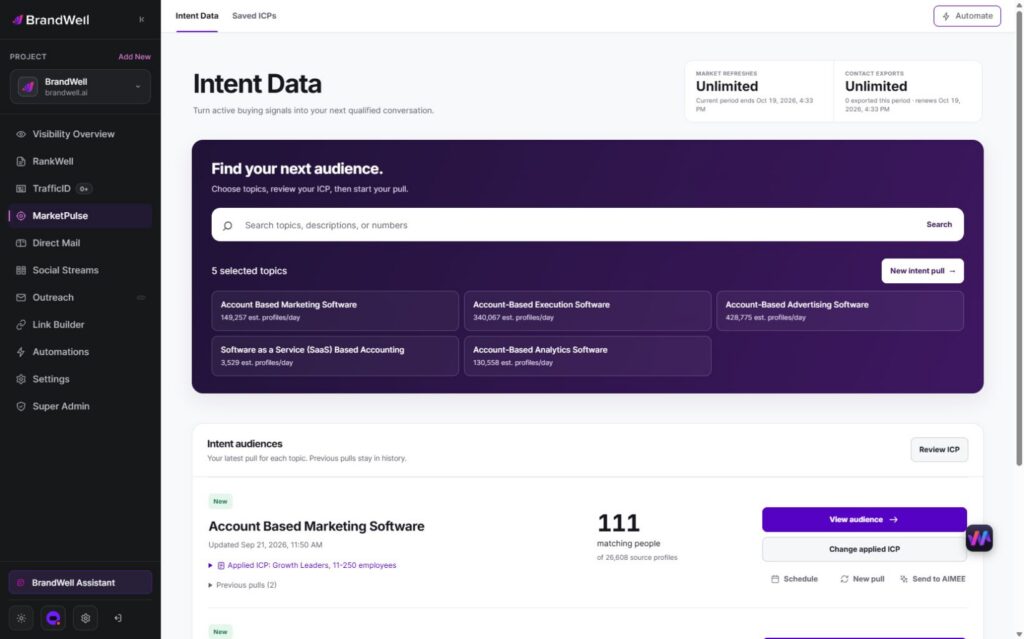
BrandWell MarketPulse: intent data starting at $500/mo. Find people researching topics relevant to what you sell, apply saved ICP filters, and review available contact details before taking action.
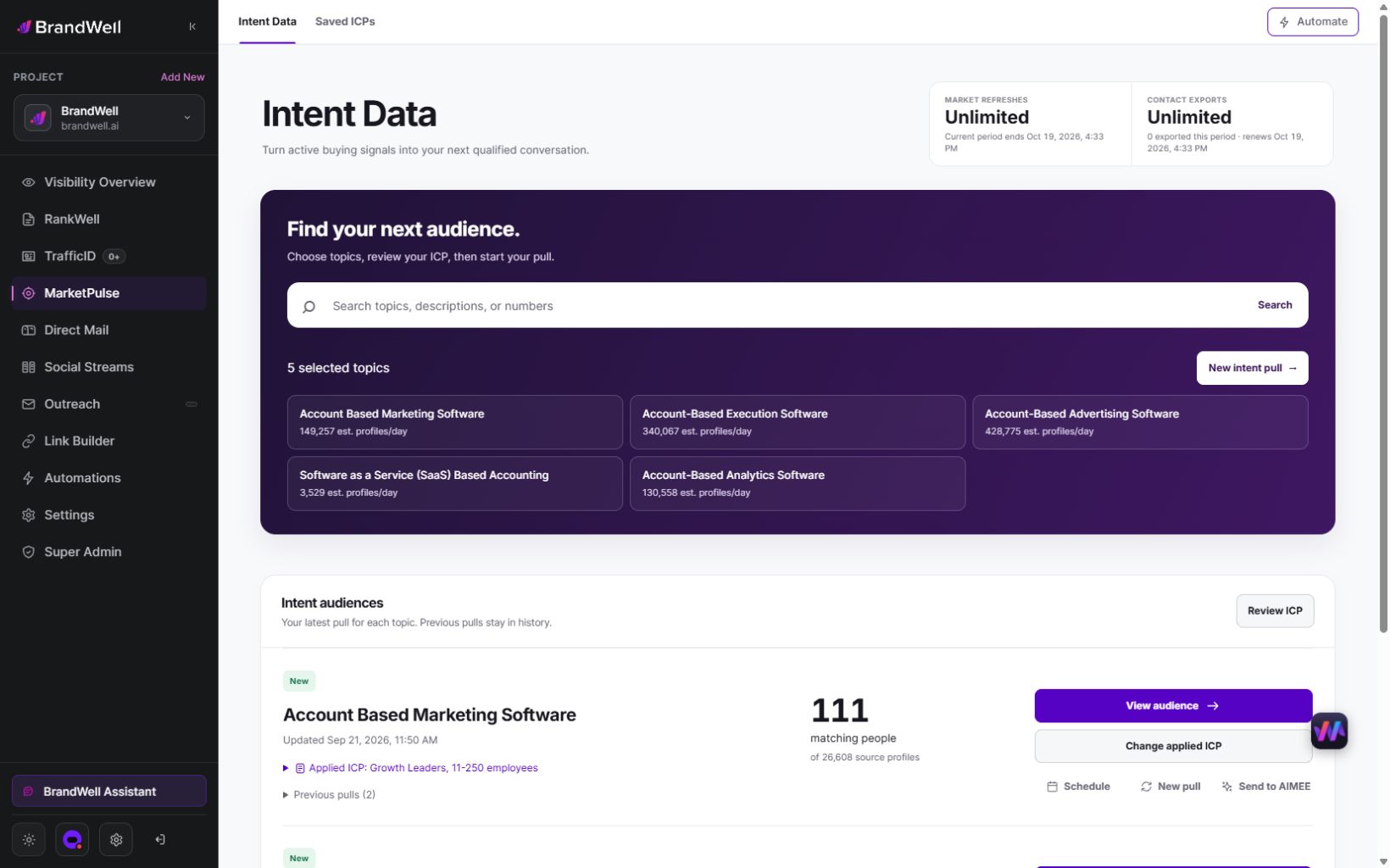
MarketPulse plans are starting at $500/mo. Verify current package scope and offers on the product page.
| Plan | Topics and refreshes | Monthly exports |
|---|---|---|
| Starter | 1 topic, weekly | 25,000 contacts |
| Growth | 3 topics, daily | 100,000 contacts |
| Scale | 10 topics, daily | Unlimited contacts |
Swipe the table to see all columns.
A pull retrieves available data from the previous 24 hours for one topic. Daily use across all included topics provides 90 Growth pulls or 300 Scale pulls in a 30-day month. Weekly Starter pulls vary by calendar month. Available audience size and contact fields vary, and audiences may overlap. Refreshes stop at the plan limit without overage charges.
- Find and qualify: search the topic catalog, save your ICP, and review the people and companies that match.
- Act on the research: export qualified contacts or prepare an Outreach or Direct Mail workflow. Connected products, channel usage, and fulfillment may cost extra.
- Get help from AIMEE: Growth and Scale include AIMEE for the initial user to research accounts and prepare the next step through connected tools.
Agencies and other service businesses can build client deliverables around their available Intent Scans and exports. Keep each client’s scope, permissions, and service fees clear. A subscription is not a promise of a white-label platform or exclusive access to a market.
Explore MarketPulse and watch the demo or compare plans starting at $500/mo. Any early-access discount is a separate, time-limited offer shown to an eligible recipient.
Define field ownership and the intended action
The most important line in an implementation plan is not the API endpoint. It is the decision contract: When this combination of fit, topic activity, recency, identity confidence, and exclusions appears, this owner may take this approved action. That sentence determines the data model, review gate, workflow, and measurement plan. Without it, a technically successful sync can still fill the CRM with unexplained scores and create more work for the client.
Write the contract with sales, marketing, RevOps, privacy or security, and the account owner. Name the system of record for each field. A CRM may own account status while an intent source owns observation time and topic. The agency may own a review disposition. Do not let a connector silently overwrite the client’s canonical company, contact, territory, consent, or lifecycle fields.
Use the agency’s intent-data delivery SOP to define the broader operating handoffs before you configure a client-specific integration. The integration is one controlled stage in that service, not the whole service.
Follow seven controlled integration stages
- Freeze scope. Record the client ICP, approved topics, signal sources, permitted use, excluded geographies, retention rule, users, and destinations. Separate what is in the first release from requested future work.
- Design the field contract. Give every inbound value a definition, type, source, owner, allowed values, null behavior, refresh rule, and deletion behavior. Preserve raw observation time separately from the time the CRM record was updated.
- Create a safe landing zone. Load a small, reversible batch into a staging object, custom table, or clearly isolated set of fields. Do not route unreviewed records directly into seller queues.
- Resolve identity without hiding uncertainty. Keep company, domain, known person, candidate person, and unresolved record as distinct states. Record the method and confidence used for a match. Never convert an account-level signal into a named-person claim.
- Apply quality and policy gates. Check required fields, duplicate rules, blocked accounts, customers, competitors, opt-outs, suppression lists, geography, ownership, and permitted activation. Failed records go to an exception queue with a reason code.
- Activate through an owned workflow. Assign the record to a named role, define the allowed next action, require approval where needed, and write the disposition back. A useful workflow ends with a decision, not a notification.
- Reconcile and improve. Compare source counts, accepted records, exceptions, assignments, actions, and outcomes. Investigate breaks, expire stale records, and version any change to fields, topics, thresholds, or routing.
This runbook makes integrating intent data with a client’s CRM and marketing stack repeatable because it treats the data path as an operating system. It also gives the agency a clean client handoff: definitions, owners, evidence, and rollback instructions are part of delivery.
Copyable source-to-CRM field contract
Use one row for each field or derived value. Copy this worksheet into the client’s approved documentation system and complete it before configuration.
FIELD CONTRACT

Business decision supported:
Approved activation:
System of record:

Field label:
API or import name:
Definition in plain language:
Source and source field:
Data type and allowed values:
Required, optional, or conditional:
Account, person, or unresolved identity state:
Observed-at timestamp:
Loaded-at timestamp:
Freshness or expiration rule:
Match method and confidence representation:
Quality checks:
Suppression checks:
Permitted readers:
Permitted writers:
Downstream workflow owner:
Exception reason codes:
Correction and deletion procedure:
Outcome field returned:
Approver and version:
Test the worksheet with three examples: a clean accepted record, a deliberately ambiguous identity, and a suppressed account. If the team cannot predict what the system will do in each case, the field contract is not ready.
Choose a delivery path you can maintain
A spreadsheet handoff, native connector, automation platform, custom API, and white-label workflow can all be valid. The decision guide is about change frequency and control, not technical prestige.
- Governed spreadsheet: Useful for a low-volume validation cycle when a human must inspect every row. Its weakness is version drift, weak exception handling, and manual reconciliation if it becomes the permanent system.
- Native connector: Useful when its object model, permissions, and update behavior match the client’s decision contract. Test deletions, duplicates, retries, and field ownership rather than assuming the label “native” removes implementation work.
- Automation platform: Useful for moderate complexity and visible orchestration. It adds another credential, error log, usage model, and failure surface that somebody must own.
- Custom API integration: Useful when the client needs distinctive logic, volume handling, or observability that packaged routes cannot provide. It also creates code, monitoring, security, and maintenance obligations.
- White-label delivery: Useful when the agency wants a branded, repeatable service across clients. Confirm tenant isolation, client billing boundaries, export rights, support responsibilities, and exactly which integrations are included.
Do not compare these approaches only on setup speed. Compare reversible setup, ongoing labor, reliability, security review, client adoption, exception time, and the ability to show why a record moved. A manual first release can be the fastest path to learning. A governed system integration becomes preferable when repeatability and change volume justify it.
Budget setup and recurring exception work
There is no defensible universal setup fee for CRM intent integration. Build the estimate from discovery, data mapping, sandbox work, connector or API configuration, testing, documentation, training, security review, and contingency. Then model recurring cost from monitoring, exception handling, changes, support, reporting, and any contracted platform usage. Use the client’s actual stack and written provider terms, not an unverified market range.
A simple worksheet is:
SETUP COST = discovery labor + mapping labor + build labor
           + testing labor + security review + training
           + licensed tools + contingency

MONTHLY DELIVERY COST = monitoring + exception handling
                      + maintenance + reporting + support
                      + contracted platform usage

CONTRIBUTION BEFORE OVERHEAD = agency client fee
                             - monthly delivery cost
Compare accepted records, review time, assignment completion, action adoption and defined outcome associations with a suitable prior process. These operational differences are not automatically financial ROI or causal lift. State total costs, the actual outcome value basis and the comparison limits.
Keep product and custom integration scope clear
MarketPulse supports topic research, saved ICP review and CSV export. Custom CRM connectors, API integration work and white-label client portals are separately scoped capabilities. Verify supported fields, actual destination behavior and permissions rather than presenting them as included subscription features.
Start with supported MarketPulse research starting at $500/mo and preserve the actual topic, available fields and pull window. AIMEE can help organize an approved mapping brief through configured tools. The agency owns separately implemented CRM logic, testing, maintenance and the client agreement.
MarketPulse plans are starting at $500/mo. Starter includes 1 topic, weekly refreshes, and 25,000 exportable contacts per month. Growth includes 3 topics, daily refreshes, and 100,000 exportable contacts. Scale includes 10 topics, daily refreshes, and unlimited contact exports. AIMEE for the initial user is included with Growth and Scale. Compare MarketPulse plans and current offers.
Preserve access controls and evidence
Document actual source rights, purpose, fields, access, retention, deletion and destination approvals. Use the minimum fields and permissions needed for the agreed work. An available connector or successful import does not certify identity, permission or correctness.
Operational evidence should include source, observation time, identity state, validation result, reviewer, approved action, destination, delivery result, exception, correction, and downstream disposition. Keep rejected and suppressed records in an appropriately protected audit log with reason codes. A polished dashboard that cannot explain exclusions or corrections is weaker evidence than a plain ledger that can.
Copyable assistant mapping review
AIMEE can help draft an approved field mapping and flag conflicts through configured connected tools. Preserve actual schemas, source windows, overwrite rules and unresolved states. Human owners approve credentials, writes, destinations and release decisions.
ROLE: Assist the agency integration lead. Do not execute writes.

INPUTS:
- Approved decision contract
- Redacted source schema and destination schema
- Field contract worksheet
- Allowed values, suppressions, and exception codes
- Sample accepted, ambiguous, and rejected records

TASK:
1. Draft a source-to-destination mapping.
2. Flag type conflicts, missing definitions, and overwrite risks.
3. Create tests for create, update, duplicate, retry, suppress, delete,
   rollback, and permission behavior.
4. Separate account, known-person, candidate-person, and unresolved states.
5. Produce an exception report and change summary.

BOUNDARIES:
- Do not infer a person's buying intent from an account signal.
- Do not invent missing values.
- Do not expose secrets or sensitive data.
- Do not activate or write without named human approval.

OUTPUT:
- Mapping table
- Test cases
- Open decisions
- Risks and rollback plan
Ten practical implementation questions
How should an agency design the integration for quick, repeatable client value?
Choose one decision, one destination, and one reviewed action for the first release. Load a reversible batch into staging, validate the field contract, then compare accepted records and completed actions with the prior process. Quick value means shortening the path to a trustworthy decision, not pushing every available signal into every system. Repeatability comes from frozen definitions, named owners, reason-coded exceptions, and a reusable test pack.
What steps, owners, SLAs, checks, and handoffs belong in the workflow?
Assign an executive scope owner, client data owner, agency integration owner, quality reviewer, workflow owner, security contact, and outcome owner. Define intake, validation, identity, suppression, staging, approval, routing, disposition, reconciliation, and change control. The SLA should state when each clock starts and stops, what pauses it, and how exceptions are escalated. Use the intent-data delivery SLA guide to turn those handoffs into explicit service levels.
Which tools, templates, portals, or integrations best support the work?
The best tool is the least complex option that satisfies the decision contract and governance needs. A staging table, field contract, test pack, exception queue, and evidence ledger are useful regardless of software. Evaluate native connectors, automation tools, APIs, and white-label portals on permissions, field behavior, retries, observability, tenant separation, export rights, and maintenance. Do not select software from a feature list before testing the exact client workflow.
How do manual, automated, and white-label approaches compare?
Manual delivery maximizes review and learning but becomes fragile when versions and volume grow. Automation improves repeatability after definitions stabilize, yet can scale a bad rule quickly. White-label delivery can reduce repeated client-facing setup and strengthen agency ownership, but contractual rights, data boundaries, support, and integration scope still require review. A sensible progression is manual validation, governed automation, then broader reuse when evidence supports it.
What delivery cost and setup fee should the agency model?
Price the actual discovery, mapping, build, testing, documentation, training, security, and contingency work. Add recurring monitoring, exceptions, maintenance, support, reporting, and provider usage. Show assumptions and change triggers in writing. Do not promise a margin or use a generic benchmark. Review actual time and tool invoices after the first cycle, then adjust future estimates without rewriting historical economics.
Which time-to-value, quality, adoption, and outcome metrics matter?
Use time to approved schema, time to first accepted batch, acceptance rate, duplicate rate, unresolved identity rate, suppression rate, assignment completion, action completion, exception age, correction time, and user adoption. Outcome evidence can include meetings, qualified opportunities, opportunity progression, or other client-defined dispositions, but association is not automatic causation. Preserve denominators, periods, and rule versions so comparisons remain meaningful.
How should the integration vary by maturity, stack, and package?
An early client may need a reviewed spreadsheet and a single CRM object. A client with stable governance may use a connector and automated assignment. A complex account-based program may need a warehouse, identity layer, orchestration, and multiple outcome feeds. The service package should expand only when the client has an owner, usable destination, clear permitted action, and capacity to review exceptions.
Which signals, identity checks, activations, and evidence matter most?
Retain source, topic, observation time, recency, recurrence, and applicable fit attributes. Represent identity state and method rather than a binary match alone. Define the permitted activation by state, such as account prioritization versus contact-level outreach. Evidence should connect the accepted record to reviewer, action, disposition, and later outcome while also retaining suppressions and failures. This makes signal quality and measurement inspectable.
What scope, data, security, integration, and expectation risks must be controlled?
Common failure modes include unclear field ownership, hidden overwrites, ambiguous identity, excessive collection, broad permissions, stale signals, missing opt-outs, duplicate routing, silent connector failures, unbounded custom work, and outcome promises the evidence cannot support. Put allowed use, retention, deletion, access, incident contacts, change control, and client responsibilities in writing. Test rollback before go-live.
What belongs in a recurring white-label integration service?
Include the decision contract, field map, approved sources, quality gates, client-branded delivery surface, monitoring, exception handling, change log, reconciliation report, support boundary, security responsibilities, reporting cadence, and renewal review. State which integrations and customizations are included. The agency should own client communication and billing while the platform responsibilities remain clear. Renewal should depend on useful decisions and operational adoption, never on a guaranteed revenue claim.
Worked example: reconcile a timed-out write
Suppose a fictional batch contains 100 rows, including 20 repeat rows. The 80 unique records split into 60 eligible, 10 suppressed and 10 unresolved. The first destination attempt acknowledges 50 writes and times out on 10. Reconciliation shows eight of those ten were written and two were not. Complete only the two remaining operations under the destination’s tested retry contract; the final result is 60 distinct eligible records, not 70 writes or 62 newly created records.
Amazon’s idempotent API design article explains retrying without additional side effects. That design principle does not prove a particular CRM connector supports idempotency. Test its actual create, update, request-identifier, retention and reconciliation behavior. A successful write also does not prove the correct field ownership, assignment or downstream treatment.
Use an approved batch identifier and source key, preserve payload versions and compare the destination with the intended result before replaying ambiguous operations. A rollback can restore supported data changes; it cannot unsend a message or undo every downstream action. Keep automation disabled during staging until owners approve the actual activation and failure tests.
Suppose recurring monitoring, tools and review cost $1,000 against a $1,500 service fee, leaving $500, or 33.3%, before acquisition, overhead, tax and financing. Recovering a fictional $1,800 setup over six months adds $300 per month and reduces the remainder to $200, or 13.3%. Four extra exception hours at $75 create a $100 delivery loss. These are invented planning inputs, not standard integration prices or guaranteed margins.
Begin with a supported export
Review MarketPulse’s available topic audience with a saved ICP, preserve its actual preceding-24-hour window and inspect the permitted fields. Export an approved CSV within the plan allowance. Map only supported fields into an approved staging process; do not assume a native CRM connector or public custom API. AIMEE can help draft the mapping through configured tools, with human approval of the actual destination and next action.
Frequently asked questions
Does a timeout mean no record was written?
No. Reconcile the unknown destination state before a replay.
Does idempotency prove data correctness?
No. Field ownership, identity and permission require separate checks.
Can rollback undo a sent message?
No. Data rollback and irreversible downstream actions are different.
Is a custom CRM integration included in MarketPulse?
Do not assume that. Verify supported features and scope custom work separately.
Review the supported research product: explore MarketPulse and current plans.
Reviewed and updated October 3, 2026.

Written by