On this page
- Current MarketPulse workflow
- Collect the baseline before writing
- Assign evidence and approval owners
- Build the evidence packet
- Choose the format that fits the work
- Budget evidence work and production
- Measure use without claiming causation
- Choose an appropriate client candidate
- Preserve the signal-to-outcome chain
- Control claims, disclosure and selection
- Make evidence part of recurring delivery
- Do not turn one result into a typical-outcome promise
- Worked example: percentage points and relative change
- Frequently asked questions
Direct answer: Create intent-data agency case studies from a client-approved evidence packet, not a persuasive narrative assembled after the fact. Lock the baseline, operating change, observed evidence, outcome, denominator, observation window, attribution limits, and client approval before writing. Show what happened and what remains unknown. Never invent a customer, quote, screenshot, result, or causal claim.
Current MarketPulse offer: intent-data plans start at $500/mo. See the product, demo, and current plans. Updated October 3, 2026.
Who this is for: Agency marketers and client-success leaders who need credible proof for a recurring buyer-intent service while protecting client trust and evidence quality.
A strong case study helps a buyer evaluate the agency’s process, not merely admire a result. It shows the starting condition, intervention, responsibilities, records, limitations, and repeatable lessons. That structure creates sales utility even when the outcome is modest, because the buyer can see how the service operates and decide whether the conditions resemble its own.
Decide the intended reader and decision before collecting material. A founder evaluating a new service needs a different level of detail than a RevOps leader validating routing, or a procurement reviewer checking data handling. One evidence packet can support multiple approved versions, but each version should retain the same claim boundaries. Changing the audience does not permit stronger language.
Current MarketPulse workflow
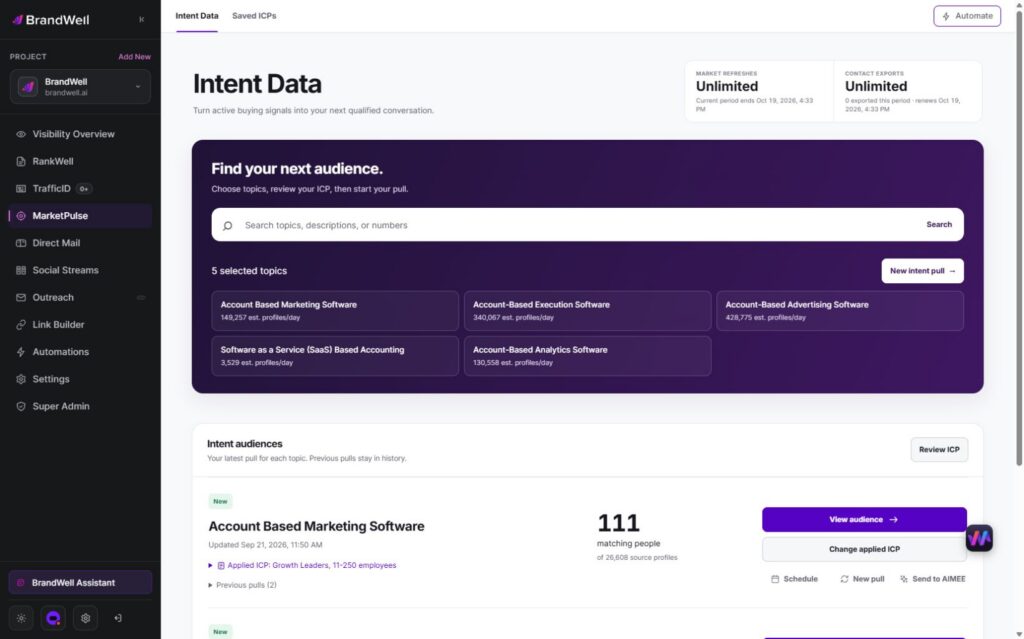
BrandWell MarketPulse: intent data starting at $500/mo. Find people researching topics relevant to what you sell, apply saved ICP filters, and review available contact details before taking action.
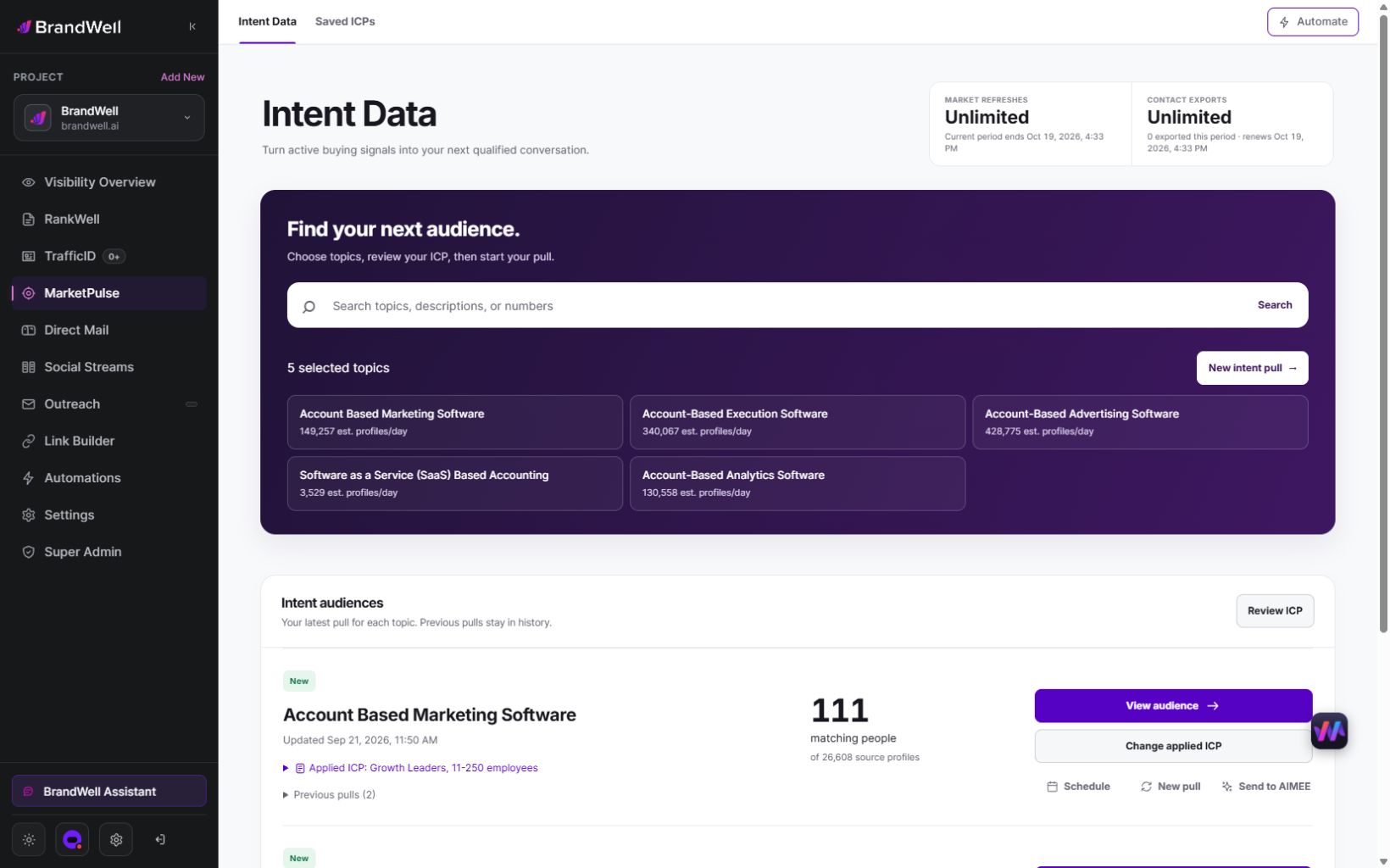
MarketPulse plans are starting at $500/mo. Verify current package scope and offers on the product page.
| Plan | Topics and refreshes | Monthly exports |
|---|---|---|
| Starter | 1 topic, weekly | 25,000 contacts |
| Growth | 3 topics, daily | 100,000 contacts |
| Scale | 10 topics, daily | Unlimited contacts |
Swipe the table to see all columns.
A pull retrieves available data from the previous 24 hours for one topic. Daily use across all included topics provides 90 Growth pulls or 300 Scale pulls in a 30-day month. Weekly Starter pulls vary by calendar month. Available audience size and contact fields vary, and audiences may overlap. Refreshes stop at the plan limit without overage charges.
- Find and qualify: search the topic catalog, save your ICP, and review the people and companies that match.
- Act on the research: export qualified contacts or prepare an Outreach or Direct Mail workflow. Connected products, channel usage, and fulfillment may cost extra.
- Get help from AIMEE: Growth and Scale include AIMEE for the initial user to research accounts and prepare the next step through connected tools.
Agencies and other service businesses can build client deliverables around their available Intent Scans and exports. Keep each client’s scope, permissions, and service fees clear. A subscription is not a promise of a white-label platform or exclusive access to a market.
Explore MarketPulse and watch the demo or compare plans starting at $500/mo. Any early-access discount is a separate, time-limited offer shown to an eligible recipient.
Collect the baseline before writing
Begin the case study during onboarding. Ask what decision the program will support, how the client currently works, which outcome definitions are accepted, and who can approve public use. Capture a baseline before changing the workflow. If baseline data is weak, say so and choose measures that can be observed prospectively.
The case study should explain the path from contracted signal to client action: topic selection, account boundary, identity or enrichment state, qualification, agency recommendation, client approval, activation, and observed outcome. Preserve the distinction between a company researching a topic and a named person intending to buy. Describe the evidence at its actual level.
Use the artifact to qualify, not to promise. A prospect should understand the client conditions, operating work, dependencies, and limits. This can support more productive conversations and recurring service design, but a case study does not guarantee qualified pipeline, revenue, renewal, or a similar result for another client.
Assign evidence and approval owners
Assign an evidence owner, account lead, data steward, writer, client approver, and authorized legal or privacy reviewer when needed. The evidence owner maintains the packet. The account lead confirms operational context. The data steward checks definitions and lineage. The writer translates verified facts without expanding them. The client approver controls confidentiality, attribution, and final release.
Use a collection cadence that matches delivery. Add candidate evidence during routine reporting, not from memory at renewal. Review baseline, signals, actions, and outcomes at agreed milestones. Maintain a case-study status such as proposed, evidence gathering, client review, approved, expired, or withdrawn. A public asset should have a named owner for later correction or removal.
Systems can remain simple: a governed evidence folder, metric dictionary, outcome ledger, permission record, draft, approval log, and publication inventory. Connect each public statement to a source record. Keep confidential raw data separate from the approved evidence excerpt. The weekly and monthly intent reporting framework can make evidence capture part of delivery instead of a last-minute marketing request.
Use a release checklist for every format. Verify the current approved language, image rights, redactions, destination, access level, owner, and withdrawal procedure. If a sales representative wants to adapt the case for a proposal, require the adapted claims to remain inside the approval. A private conversation is still a disclosure, and an old approval should not be assumed to cover a new channel or a broader audience.
Build the evidence packet
The best tools preserve provenance, permissions, versions, and client comments. A document platform handles drafting and approval. A spreadsheet or database can maintain the claim ledger. Reporting and CRM systems can supply observed records when definitions are stable. A secure file store can preserve supporting evidence. The agency still needs a reviewer to connect each claim to the right source and scope.
A useful template has separate fields for baseline, intervention, signal evidence, identity state, agency action, client action, outcome, denominator, window, limitations, approval, and reuse rights. Do not collapse those fields into a single results box. A screenshot is optional and should never substitute for a reproducible record. Redact or omit information the client has not approved.
Copyable PROOFCHAIN evidence packet
- Premise: State the client problem, target decision, and pre-program baseline.
- Rules: Record definitions, eligibility, exclusions, permissions, and success criteria.
- Operation: Describe topics, sources, identity states, qualification, and approved workflow.
- Observations: Preserve the signal, action, and outcome records with denominators and windows.
- Factors: List client execution, concurrent programs, missing data, and attribution constraints.
- Claims: Draft only statements that the evidence packet supports at the same level.
- Human approval: Obtain client, evidence-owner, and authorized reviewer signoff.
- Inventory: Track every place the approved claim appears and its withdrawal path.
The framework keeps source records, claims, limitations and approvals separate so a writer can check what each statement supports.
Choose the format that fits the work
An intent-data case study is appropriate when contracted signals materially shaped prioritization or timing and the agency can show that path. A manual case study is better when the work was primarily research, strategy, creative, outbound execution, or relationship development. A non-intent comparison can be useful when a prior workflow is documented, but it should not be manufactured when conditions changed.
Intent evidence can add precision about why an account entered a workflow. It also adds complexity: source definitions, identity states, time windows, permissions, and attribution limits must remain visible. A manual narrative may be easier to understand, but can hide selection decisions if the writer reconstructs them from memory. Both approaches need a baseline and client approval.
The decision guide is simple. Use the format that matches the actual intervention. Do not add intent language merely because it sounds more advanced. If multiple programs affected the outcome, present a combined operating story and explain the contribution that can be observed. An honest multi-factor case is stronger than an unsupported single-cause claim.
Budget evidence work and production
Model evidence work as part of the service, then separate optional public production. Recurring delivery may include metric definitions, outcome capture, quality review, permissions, and client reporting. A publishable case study adds interviews, evidence reconciliation, drafting, design, redaction, review rounds, approval, distribution, and maintenance.
Estimate labor by role, tooling, secure storage, design, client coordination, revision, legal or privacy review where applicable, and opportunity cost. Track planned versus actual effort. Do not justify the investment with an assumed lead value or conversion rate. Instead, identify the decisions the asset should support, such as proposal qualification, objection handling, service explanation, or renewal conversation.
Reuse can improve the economics when rights allow. One approved evidence packet can support a long-form case, proposal excerpt, sales slide, internal training example, and short client-approved summary. Track each derivative so a correction or withdrawal propagates. The agency intent-data proposal template is a suitable place to use a carefully bounded proof excerpt.
Measure use without claiming causation
First track evidence operations: eligible clients, consent to participate, packet completion, approval time, claim correction, asset age, and reuse coverage. Then track sales use: qualified conversations where the case was used, questions it helped answer, proposal progression, and reasons prospects found it relevant or irrelevant. Preserve denominators and do not credit every influenced deal to one asset.
For retention, record whether the evidence review clarifies goals, exposes delivery gaps, supports renewal planning, or produces an approved expansion hypothesis. For margin, compare case-production labor with the budget and measure whether evidence collection is embedded in normal reporting. Do not assume that more case studies produce better economics.
Revenue and pipeline may be observed as downstream associations. Use a defined window, compare with a documented baseline when possible, and name concurrent factors. A case study can support trust and decision quality without being the causal reason a deal closes. Report that distinction directly.
Qualitative evidence can be useful when it is attributed accurately. Capture the client’s description of a workflow change, decision speed, or reporting clarity only with permission and context. Do not convert a comment into a testimonial, or a testimonial into quantified business impact. Keep direct quotations exact, approved, and linked to the approval record.
Choose an appropriate client candidate
Productized-service agencies benefit because a case study can show a repeatable operating model. Consultancies benefit when the asset explains a complex decision and governance process. Demand generation, RevOps, account-based, and lead-generation agencies can use cases when they own enough of the signal-to-action path to document it honestly.
The best client candidate has a clear baseline, stable definitions, observable workflow, engaged owner, usable evidence, and willingness to review. A recognizable logo is not required. A smaller client with complete evidence can produce a more useful case than a prominent client with vague claims. The result should be relevant to the intended buyer, not chosen only for prestige.
Avoid public production when the client cannot approve disclosure, raw evidence is incomplete, outcomes are still changing, the agency cannot separate identity states, or a claim would expose sensitive strategy. An anonymized case still requires client permission and must not contain clues that defeat anonymity. An internal evidence memo may be the correct endpoint.
Preserve the signal-to-outcome chain
Record contracted source, topic definition, observation window, account universe, and the exact event that entered the workflow. Keep company, person, household, and contact identities separate. Note deterministic, validated, enriched, probabilistic, unresolved, and suppressed states as applicable. Do not backfill a stronger identity claim because the outcome was favorable.
Document the approved activation: research, CRM routing, audience creation, sales review, content choice, or another bounded action. Capture who approved it, who executed it, and whether it was completed. Then record the observed outcome at the right level, including no response, disqualification, or missing follow-up.
Attribution should connect evidence without overstating it. The intent-data pipeline attribution guide provides a structure for baseline, exposure, action, outcome, and limitation. Use it to show association and contribution. Do not claim causation unless the research design and evidence truly support that conclusion.
Control claims, disclosure and selection
Strategic risk appears when the agency selects only spectacular outcomes and presents them as normal. Operational risk includes lost evidence, inconsistent metrics, memory-based reconstruction, stale approvals, and public claims that cannot be traced. Client-trust risk includes pressure to disclose, scope creep in approval, and using a quote beyond its authorized context.
Data-use risk includes exposing identities, sensitive activity, account strategy, contractual data, or confidential outcomes. Define access, redaction, reuse, retention, correction, and withdrawal. Have authorized privacy, legal, security, and client reviewers assess the facts and applicable obligations. Approval for a private report does not automatically authorize public marketing.
Use an integrity stop gate. Stop publication if the denominator is missing, the window is undefined, the baseline was reconstructed without support, the result depends on an unapproved inference, or the client has not approved the exact final claims. Do not turn urgency into permission.
Make evidence part of recurring delivery
The evidence packet can become part of the recurring operating cycle. It encourages the agency and client to maintain definitions, capture actions, review outcomes, and identify constraints. That discipline can improve delivery and renewal decisions even when no public case is produced. It also gives sales a truthful explanation of how the service works.
AIMEE can help compare a draft with approved evidence and flag gaps through configured connected tools. A responsible reviewer verifies facts and the client approves the exact asset and disclosure scope.
MarketPulse supplies topic audiences and saved ICP filtering starting at $500/mo. Capture the actual topic and audience criteria in your evidence packet, keeping source observations distinct from interpretation. Custom reporting, CRM integrations, client approval and case-study production require their own supported workflow and service scope.
Copyable agent-ready evidence audit
PURPOSE: Test a draft case study against its approved evidence packet.
INPUTS: Baseline, operating change, source records, identity states, actions, outcomes, denominator, observation window, concurrent factors, permissions, and draft claims.
TASK FOR Claude, ChatGPT, OR AIMEE:
1. Map every draft claim to a specific evidence record.
2. Flag missing denominators, windows, definitions, and contradictory records.
3. Separate observed association from causal language.
4. Identify confidential, identifying, or unapproved details.
5. Produce a claim ledger and a client review checklist.
OUTPUT: Supported claims, unsupported claims, limitations, redaction list, and approval questions.
HUMAN APPROVAL REQUIRED: The evidence owner validates records; the account lead validates operations; authorized reviewers approve data use; the client approves the exact final asset.
STOP CONDITIONS: Stop if any quote, customer identity, screenshot, number, attribution statement, reuse right, or final approval is missing or inferred. Never invent proof.
The agent can reconcile records and expose gaps. Only authorized humans can approve disclosure, attribution, and publication. Keep the final claim ledger beside the published asset so future editors can verify language before reuse, correction, translation, or withdrawal.
Do not turn one result into a typical-outcome promise
The FTC’s consumer-endorsement guidance addresses substantiation and representations of generally expected performance. Where applicable, a disclaimer alone does not fix a misleading overall impression. Have the actual case-study claims and presentation reviewed for their context; do not assume client approval establishes substantiation.
A case can truthfully describe a specific observed period without demonstrating what other clients should expect. Record which clients were eligible, why this one was selected and whether incomplete or negative outcomes were excluded. Permission, factual support, typicality and causation are separate questions.
Worked example: percentage points and relative change
This invented teaching example is not a customer case study. In a baseline period, 20 of 100 reviewed accounts were accepted: 20%. In a later period, 30 of 120 were accepted: 25%. The difference is five percentage points, or a 25% relative increase in the acceptance rate. The accepted-account count rose by 50%, but that count also reflects the larger review volume.
A precise description is: “Acceptance was 20 / 100 in the first defined period and 30 / 120 in the second.” A claim that topic data caused the improvement needs a suitable evaluation, uncertainty analysis and consideration of concurrent changes. These two counts alone do not establish it.
Suppose five of the later accepted accounts reach a qualified opportunity stage. That is 5 / 30 = 16.7% of accepted accounts or 5 / 120 = 4.2% of reviewed accounts. Report the stage definition and observation window. Do not relabel an opportunity as revenue or credit the entire result to the case-study asset.
Capture product evidence without inventing a result
When reviewing a MarketPulse topic, record the selected topic, source window, saved ICP and the actual audience fields used in the decision. Capture only permitted, approved excerpts. Label a product screenshot as product context; it is not proof of a customer’s outcome. Use AIMEE to compare the draft with supplied evidence through configured tools, leaving missing facts unresolved.
For a fictional production budget, eight hours at $75 plus $200 in design costs totals $800. If the approval permits four assets, allocating that amount equally gives $200 each before future updates and other excluded costs. This allocation does not prove four assets generated revenue. Keep every published derivative in the correction and withdrawal inventory.
Frequently asked questions
Can AI fill gaps in a customer story?
No. It can organize supplied evidence and identify missing records, but must not invent a quote, customer, screenshot or result.
Does client approval prove the claim is supported?
No. Permission to publish and evidence supporting a factual claim are separate reviews.
Is a larger accepted-account count always a better rate?
No. Show both counts and denominators; review volume may also have changed.
Can a product screenshot prove revenue impact?
No. It shows product context. Outcome claims require their own records, definitions and appropriate evaluation.
Document the actual topic-data input: explore MarketPulse and its current plans.
Reviewed and updated October 3, 2026.

Written by