On this page
- Current MarketPulse workflow
- Define the decision an alert supports
- Build eight delivery steps and assign owners
- Evaluate the operating stack
- Build, resell, refer or decline
- Price scope and response capacity
- Measure delivery before commercial impact
- Qualify suitable clients
- Keep source and identity states separate
- Manage noise and delivery risks
- Define the recurring package
- Worked example: candidates, delivery and action
- Choose an interruption level
- Frequently asked questions
Direct answer: Sell an alerting subscription only when the agency can turn noisy signals into a governed client decision stream. The useful product is not a flood of notifications. It is a controlled service that defines relevance, severity, recipient, cadence, suppression, acknowledgment, escalation, and expiry before any alert leaves the system.
Current MarketPulse offer: intent-data plans start at $500/mo. See the product, demo, and current plans. Updated October 3, 2026.
Who this is for: Agency owners, GTM consultants, RevOps teams, demand generation leaders, and service-line operators seeking non-project recurring revenue from buyer-signal monitoring.
The central design question is simple: what should the client do differently after receiving an alert? If that action, owner, and time window are unclear, adding more sources will increase interruption rather than value. A sound alerting subscriptions strategy makes every packet traceable from source to approved action and then to an honestly bounded outcome record.
Current MarketPulse workflow
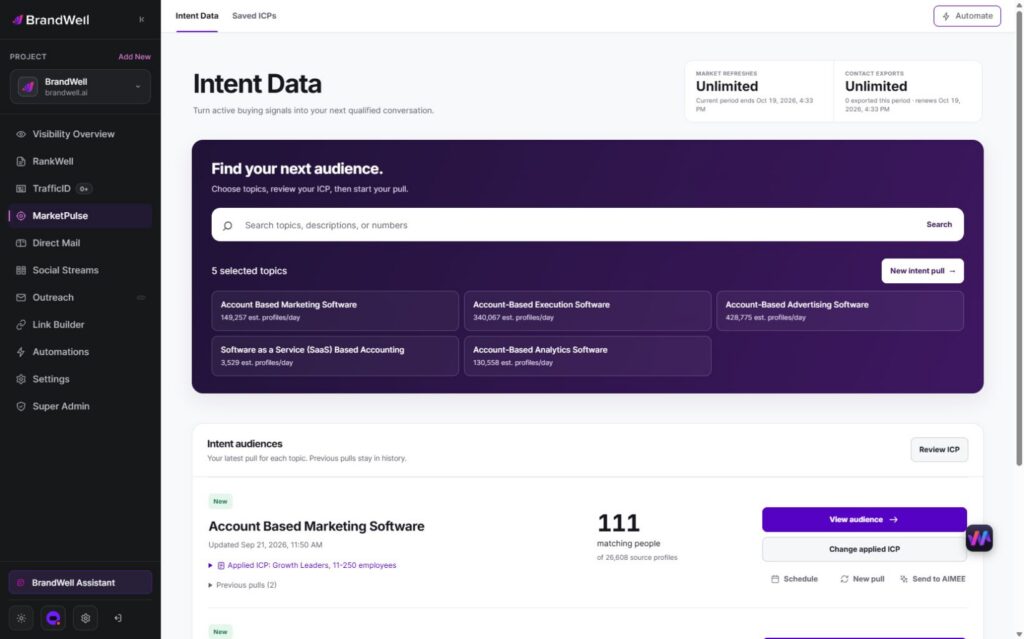
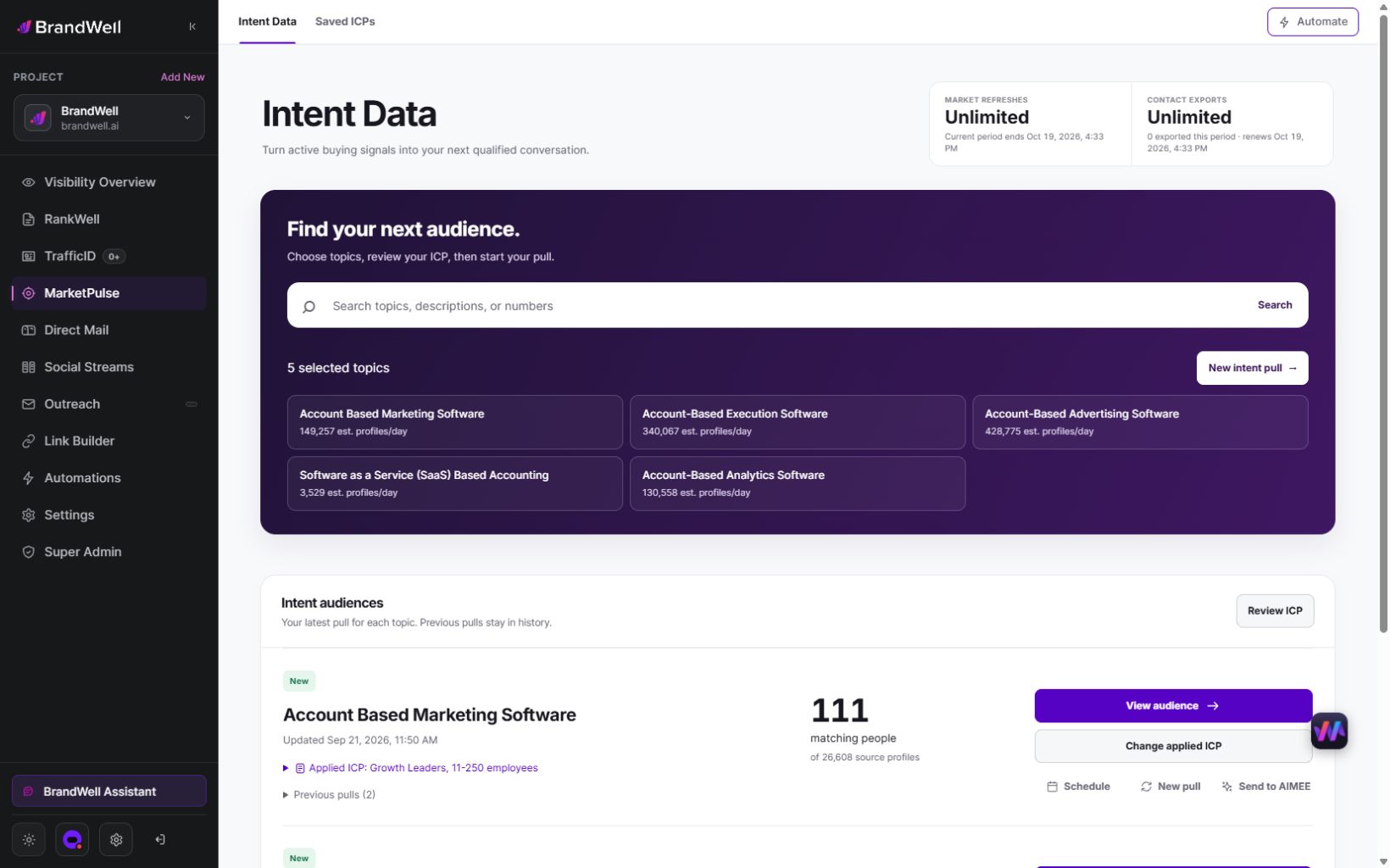
BrandWell MarketPulse: intent data starting at $500/mo. Find people researching topics relevant to what you sell, apply saved ICP filters, and review available contact details before taking action.
MarketPulse plans are starting at $500/mo. Verify current package scope and offers on the product page.
| Plan | Topics and refreshes | Monthly exports |
|---|---|---|
| Starter | 1 topic, weekly | 25,000 contacts |
| Growth | 3 topics, daily | 100,000 contacts |
| Scale | 10 topics, daily | Unlimited contacts |
Swipe the table to see all columns.
A pull retrieves available data from the previous 24 hours for one topic. Daily use across all included topics provides 90 Growth pulls or 300 Scale pulls in a 30-day month. Weekly Starter pulls vary by calendar month. Available audience size and contact fields vary, and audiences may overlap. Refreshes stop at the plan limit without overage charges.
- Find and qualify: search the topic catalog, save your ICP, and review the people and companies that match.
- Act on the research: export qualified contacts or prepare an Outreach or Direct Mail workflow. Connected products, channel usage, and fulfillment may cost extra.
- Get help from AIMEE: Growth and Scale include AIMEE for the initial user to research accounts and prepare the next step through connected tools.
Agencies and other service businesses can build client deliverables around their available Intent Scans and exports. Keep each client’s scope, permissions, and service fees clear. A subscription is not a promise of a white-label platform or exclusive access to a market.
Explore MarketPulse and watch the demo or compare plans starting at $500/mo. Any early-access discount is a separate, time-limited offer shown to an eligible recipient.
Define the decision an alert supports
Yes, for clients with a defined market, an accountable follow-up team, and a real need to react between scheduled reports. Promise a managed decision cue: a relevant signal, its confidence and reason, the approved next step, and a record of what happened. Do not promise a fixed alert count or that an alert proves a person is ready to buy. Buyer intent is evidence to review, not a declaration of purchase.
The clearest outcome is operational consistency. A client should know which events deserve attention, who receives them, how duplicates are suppressed, when an analyst intervenes, and how the agency reports acknowledgments and dispositions. This framing makes alerting subscriptions for agency clients a service, not an unmanaged feed.
Build eight delivery steps and assign owners
Use a named service owner, signal analyst, client approver, and destination owner. During onboarding, document allowed sources, tenant boundaries, priority definitions, business hours, response targets, sensitive categories, and escalation contacts. Then test representative alerts before activation. The client handoff should include a route map, glossary, examples of acceptable and rejected alerts, and a change-request path.
- Define the decision. Write the action an alert may support and the actions it must never trigger automatically.
- Register each source. Record provenance, refresh behavior, identity state, permitted use, and known blind spots.
- Set relevance rules. Combine topic, account fit, observed behavior, recency, and minimum confidence.
- Assign severity and destination. Map each level to a person, channel, operating window, and acknowledgment expectation.
- Suppress noise. Deduplicate, cap frequency, expire stale events, and exclude customers, employees, competitors, or other agreed groups.
- Run human QA. Review a sample for relevance, sensitivity, and tenant isolation before live delivery.
- Deliver and receipt. Log the packet, destination, delivery state, acknowledgment, disposition, and escalation.
- Review and tune. Inspect rejected alerts, missed handoffs, source drift, and client adoption on a fixed cadence.
Treat the SLA as a service rule, not a universal promise. Specify what the agency controls, such as review cadence or delivery after acceptance, and what it does not control, such as source availability, identity resolution, client response, or downstream sales. The companion guide to setting intent-data delivery SLAs helps separate controllable delivery targets from external outcomes.
Evaluate the operating stack
The best tool is the one that satisfies the operating model, not the one with the longest feature list. Score candidates on source provenance, tenant isolation, identity states, rule testing, frequency caps, suppression, approval queues, delivery receipts, audit history, export controls, deletion, permissions, and client-facing branding. Also assess what happens when a source is delayed, an integration fails, or the client disputes an identity.
A practical stack may combine a contracted signal source, identity or enrichment layer, decision rules, a human review queue, a delivery channel, and an evidence ledger. Avoid naming a universal winner because fit changes with client geography, data rights, destinations, and support capacity. Verify current primary product documentation and written terms before relying on any capability or price.
Build, resell, refer or decline
Resell or operate a managed layer when the agency has repeated client demand but does not want to build source collection, identity infrastructure, and tenant controls from scratch. Build only when the workflow is strategically distinctive, rights are clear, maintenance capacity exists, and the agency can support incidents. Refer when the client wants software ownership and the agency should not carry delivery responsibility. Avoid the offer when the client lacks an approved use, a response owner, or sufficient controls for the signal involved.
A decision guide should compare control, time to launch, recurring maintenance, support duty, contractual rights, data sensitivity, and exit cost. It should not assume resale is always lower risk. The agency still owns its promise, configuration, client communication, and any manual action it undertakes.
Price scope and response capacity
Price the service from scope and capacity, not from an unverified market average. Model source and module costs, expected usage, tenant setup, analyst review, integrations, delivery support, reporting, client meetings, exception handling, security work, and a contingency allowance. Keep source cost and agency labor visible so a volume or scope change does not silently consume delivery capacity.
Separate a base service from defined usage, destinations, review windows and out-of-scope changes. Stress-test expected, high-noise, high-support and incident cases. Name included and excluded costs before reporting a margin; support and acceptance can change the economics.
AIMEE can help research and prepare a proposed brief through configured connected tools. Check the supported action and actual destination result. A custom alert service, its controls and its delivery obligations need separate scope.
Start with a relevant MarketPulse topic and saved ICP, inspect the available matches and prepare an approved next step. AIMEE can help through configured connected tools. Separately scope custom alert rules, agency delivery and integrations.
Measure delivery before commercial impact
Prove service operation before claiming commercial influence. Report accepted alerts, rejection reasons, delivery success, acknowledgment time, approved actions, action completion, and client-recorded downstream stages. Define an attribution window and require evidence for any influenced opportunity. Show unknown or disputed cases rather than forcing credit.
A monthly report should explain rule changes, source incidents, suppressed volume, identity confidence, and what the client did with accepted alerts. The guide to weekly and monthly intent-data reporting provides a useful evidence structure. Pipeline and revenue can be tracked when the client system supplies a defensible link, but the subscription does not guarantee either result.
Qualify suitable clients
Best-fit clients have a narrow ICP, enough relevant signal activity to evaluate, an accountable response owner, a governed CRM or workflow, and willingness to label dispositions. Exclude clients seeking mass surveillance, automatic outreach from weak identity, guaranteed lead volume, or delivery into a system no one maintains. Also exclude use cases that fall outside contracted rights or the client’s approved privacy posture.
Run a qualification checklist: defined decision, approved sources, documented destinations, client owner, capacity to respond, data-use basis, suppression list, measurement access, and change-control agreement. A failed item does not always end the sale, but it must become a prerequisite or explicit limitation.
Keep source and identity states separate
Buyer intent can add topic interest and recency. Website behavior can add first-party context. Identity and enrichment can attach an account or contact state where permitted and available. Keep those states separate: anonymous session, company match, person match, enriched candidate, client-accepted identity. Do not merge them into a false certainty score.
MarketPulse supplies topic audiences and saved ICP filtering. TrafficID addresses eligible visitors to a connected website. Keep those sources distinct. A branded alert stream, custom routing, receipts and client support are separately designed service work, not automatic subscription entitlements.
Manage noise and delivery risks
Key risks are stale or ambiguous signals, false identity confidence, cross-client leakage, notification fatigue, delayed delivery, sensitive-topic exposure, unapproved outreach, and a client belief that every alert is a lead. Control them with provenance, explicit identity labels, tenant tests, frequency caps, sensitive-category review, delivery receipts, human escalation, and plain-language limitations.
Use a short incident playbook: stop affected routes, preserve evidence, notify accountable owners under current written terms, assess scope, correct the configuration, and document restart approval. Never hide an outage by changing the reporting denominator.
Alert packet worksheet
Use one row for each alert class, not each individual event. Capture the source, client decision, qualification rule, identity state, severity, recipient, destination, operating window, frequency cap, suppression, acknowledgment target, escalation, expiry, evidence fields, and accountable owner. Add two sample packets: one that should pass and one that should be rejected. This makes threshold debates concrete before they reach production.
For each live packet, preserve a compact evidence envelope: source event identifier, observed time, topic or behavior, account-fit inputs, identity state, confidence notes, applied rule version, suppressed duplicates, human reviewer where required, delivery receipt, acknowledgment, disposition, and client-recorded next step. Do not include more personal data than the approved action needs.
Three package levels without false promises
A focused package can cover one decision, a limited topic set, one destination, scheduled analyst QA, and a monthly evidence review. A coordinated package can add approved sources, severity routes, more destinations, weekly tuning, and manager reporting. A governed portfolio package can add multiple client teams, role-specific queues, incident support, and change governance. Name actual limits for topics, routes, reviews, and support instead of using “basic,” “pro,” or “unlimited” without substance.
Renew when the client still uses accepted alerts, owners respond, rules can be improved, data rights remain valid, and the evidence review identifies a next-cycle decision. Re-scope when alert types or destinations change. Stop when noise remains high after agreed tuning, the client will not disposition alerts, sensitive use expands beyond controls, or the economics no longer support review.
Common alerting mistakes
- Calling every website visit or topic event an alert without a client-fit rule.
- Sending the same packet to sales, marketing, and leadership even though they own different decisions.
- Letting a confidence score hide the difference between anonymous, company, and person identity.
- Reporting total alert volume while omitting duplicates, suppression, delivery failure, and rejection.
- Using urgency language after the event has expired or the relevant window is unknown.
- Allowing an automated draft to become an external outreach message without human approval.
These controls also make alerting subscriptions examples more useful. A good example shows why the alert passed, what action was approved, and how it was dispositioned. It does not celebrate a notification count.
Client alert acceptance test
Before activation, review a representative sample with the client. For each event, ask whether the source is permitted, the topic or behavior is relevant, the account fits, the identity state is clear, the event is recent enough, the proposed severity is justified, the recipient owns the action, and the packet contains enough evidence. Label it accept, reject, suppress, expire, or escalate. Record the reason in language that can become a rule.
Do not tune only toward a high acceptance percentage. A narrow rule can appear precise while missing useful events. Review both false positives and plausible misses. The client and agency should agree which error is more costly for each alert class and how much analyst review the package supports.
Support and change control
Separate an incident from a change request. A failed destination, tenant mix-up, or sensitive packet is an incident and may require an immediate stop. A new topic, source, recipient, threshold, or action is a change and should pass impact, rights, capacity, testing, and approval. Give each request an owner, priority, evidence, decision, effective point, and rollback plan.
Support boundaries should identify channels, hours, severity, client responsibilities, and excluded work. If a client changes credentials or destinations without notice, record the dependency rather than treating the resulting failure as proof the alert service itself was unreliable.
Renewal scorecard
Review usefulness by alert class, not only in aggregate. Show accepted, rejected, suppressed, expired, delivered, acknowledged, escalated, and actioned packets alongside rule changes and analyst effort. Ask which alerts changed a decision, which created interruption, and which required evidence the packet lacked. Preserve the client’s feedback in the next rule version.
Renew with a documented next-cycle design: retained sources and rules, removed noise, new prerequisites, capacity, owner, reporting cadence and stop conditions. Useful operation is not financial ROI. Any return calculation needs defined attributable benefits and full costs, with uncertainty and competing influences stated.
Define the recurring package
A recurring package should include onboarding, source and topic configuration, relevance rules, identity labels, destinations, suppression, human QA, delivery receipts, an evidence ledger, scheduled reporting, a tuning meeting, support boundaries, change control, and renewal criteria. Higher scopes may add more topics, destinations, analyst review, or client teams, but not vague “unlimited” obligations.
Copyable agent-ready alert workflow: Give Claude, ChatGPT, or AIMEE the approved source schema, client fit rules, suppression list, severity definitions, destination map, and examples. Instruct it to propose classifications and draft alert packets, never send them. Require a human to approve any identity-sensitive packet, external message, route change, or rule change. Stop when provenance is missing, confidence is below the client threshold, sensitive data appears, tenants may be mixed, or the requested action exceeds written scope. Log the input, proposal, reviewer, decision, and final disposition.
Start with one client decision, one destination, and a small approved rule set. Validate usefulness and noise before expanding sources. That sequence turns alerting subscriptions best practices into a controllable service rather than another notification problem.
Worked example: candidates, delivery and action
An invented monthly queue contains 200 candidate events. Fifty pass the agreed review, forty are delivered successfully, thirty-two are acknowledged and eight have a recorded approved action. Review acceptance is 50 / 200 = 25%; delivery success is 40 / 50 = 80%; acknowledgment is 32 / 40 = 80% of delivered packets. Action completion is 8 / 40 = 20% of delivered packets, or 8 / 200 = 4% of the original candidates.
Keep failed delivery, rejected events and missing dispositions visible. A delivered packet is not necessarily read; an acknowledgment is not proof of a useful action. Reducing notifications may improve the accepted queue while missing useful events, so inspect plausible misses as well as false positives.
Assume $250 allocated software cost, $600 review labor and $150 delivery support. Defined cost is $1,000: $25 per successfully delivered packet, or $125 per recorded approved action. These are different operating units, not price per Intent Scan or financial ROI. The figures are invented; setup, other products, overhead and taxes may add cost.
Choose an interruption level
A reviewed brief can belong in a scheduled digest, a work queue or a direct notification depending on who owns the decision and how quickly it needs action. Do not label ordinary topic interest an emergency. An urgent service-delivery failure is a different class from a prospect research cue.
Google’s SRE monitoring chapter discusses noise and interruption in engineering alerts. It is useful design context, not a benchmark for marketing response rates. Define the business decision and recipient before adapting that principle.
Frequently asked questions
Does a topic match require an immediate alert?
No. Review fit, freshness, relevance and the client’s response capacity. A digest or research queue may be more useful.
Is delivery success proof that someone read the alert?
No. Track delivery, acknowledgment and completed action as separate states.
Does MarketPulse include a custom client alert service?
The subscription supplies defined topic-data software allowances. Custom alerting, destinations, reporting and support need their own supported implementation and scope.
How should ROI be reported?
Use defined benefits and full costs under a stated attribution method. An accepted alert count or action rate alone is not financial ROI.
Start with a useful research queue: explore MarketPulse, then define which reviewed findings deserve an alert and what the recipient should do.
Reviewed and updated October 3, 2026.

Written by