On this page
Journey Engine’s historical customer story explores an agency’s decision to use AI-assisted drafting for a larger content workload. Its most useful lesson is how to evaluate production capacity alongside editorial review, client requirements and actual publication.
The original article discussed Justin Thomas and Andrew Sunil’s evaluation of the former Content at Scale product for an education-technology client. Today, RankWell supports this content workflow in BrandWell. The earlier prices, interfaces and capacity comparisons are historical, not current subscription terms.
An agency needed more content capacity
The original account described an agency managing strategy and analysis internally while outsourcing writing. It wanted to expand informational content without making the writing arrangement disproportionately expensive. The client assignment, rather than every account the agency served, was the scope of that comparison.
The article’s old headline described a 25-fold content increase and tenfold time savings as achieved results. Much of the body instead used forward-looking language about what the team would generate or save. A comparison of possible word allowances is not a measured increase in published, approved articles. We have removed those headline multipliers rather than presenting a capacity projection as a verified customer outcome.
Start with the client’s assignment
An agency brief should connect the reader’s question to the client’s actual expertise and offer. For an education business, a general question about program selection and a page describing a specific course need different evidence. Neither should acquire invented accreditation, admissions, pricing or employment-outcome claims during drafting.
- Reader: identify who needs the answer and what they already understand.
- Scope: distinguish general explanation from the client’s own product details.
- Evidence: supply authoritative sources and verified client information.
- Reviewer: assign responsibility for subject and product accuracy.
- Destination: specify the page, publishing connection and approval needed.
Use the current RankWell workflow
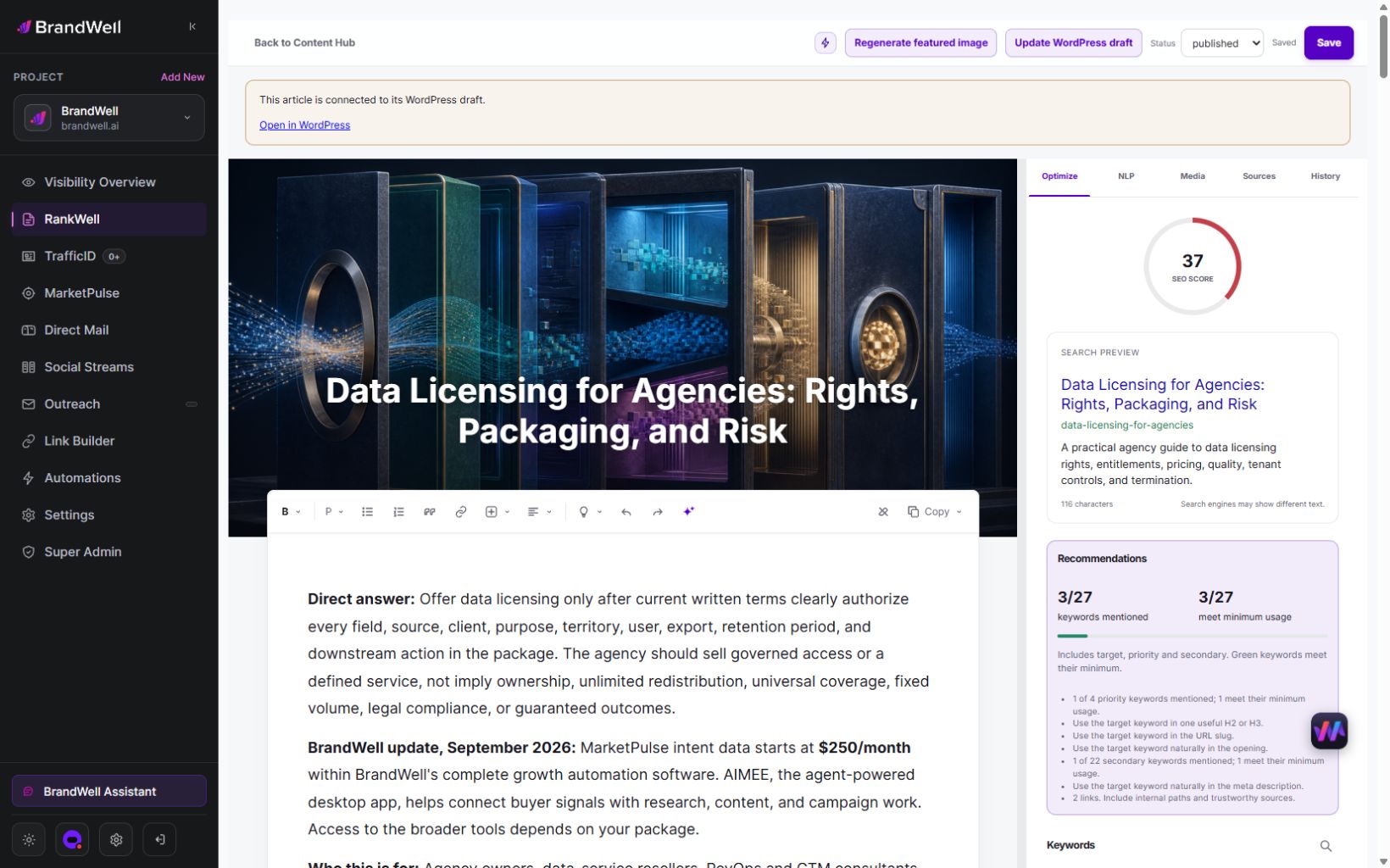
Develop a brief and draft in RankWell, then review the article in the editor. Check its sources, search preview and recommendations against the assignment. Add the client’s approved terminology and examples. Recommendations help direct attention; completing a checklist does not prove that search rankings or revenue will improve.
AIMEE can assist through configured tools and permissions. Define which actions require approval and verify the result of a publishing request. An article appearing in a draft queue and an article appearing on the client’s live website are separate completion states.
Compare reviewed articles, not possible words
Here is an original hypothetical evaluation, not a Journey Engine result. One workflow costs $900 for six approved articles. A second costs $500 for drafting plus $300 for review and produces five approved articles. Their costs are $150 and $160 per approved article respectively. The lower starting bill does not automatically mean a lower completed-article cost.
Include briefing, corrections, screenshots, subject review and publication in the comparison. Record rejected or delayed drafts separately. If two articles answer different questions or require different levels of expert review, do not treat their word counts as equivalent deliverables.
Keep client reporting grounded in evidence
Separate operational results from marketing results. Approved articles, publication dates and review hours describe production. Search impressions, qualified inquiries and attributed revenue describe other stages. A change in one does not establish a change in the others.
For an agency pilot, record the baseline and reporting period before changing the workflow. Document who checked each claim and which articles reached publication. When reporting outcomes, distinguish a customer-supplied observation from an independently verified measurement. If the necessary evidence is missing, state that limitation.
What an agency can take from the story
The historical evaluation raises a useful question: can the team handle more relevant assignments while preserving a clear review standard? Answer it with a bounded client project, approved output and documented costs. Do not turn a tool’s possible production allowance into a promise of client growth.
Explore today’s RankWell workflow and test it on an actual brief. Keep content production distinct from buyer-intent research: MarketPulse is BrandWell’s topic-intent product with plans starting at $500/mo, while content and other capabilities depend on the product and package selected.
Reviewed and updated October 3, 2026.

Written by
Julia McCoy has contributed articles to BrandWell on content marketing, writing, and search engine optimization. This archive retains her original bylines; individual articles may be updated by the BrandWell editorial team.