


On this page
AI can help you outline an ebook, develop draft sections and revise approved material. A generated manuscript still needs evidence review, editing, permissions, design and testing before publication. Drafting speed is not the same as producing a finished book.
Start with a specific reader problem and a realistic scope. This guide explains a practical nonfiction ebook workflow, an original outline example and the checks that make the final resource useful. It does not promise a publishable ebook in a fixed number of minutes.
Decide what the ebook helps a reader do
An ebook should have a purpose beyond collecting enough words. Define the intended reader, the decision or task they face and what they should understand after reading. A business resource can be valuable when it explains one process clearly rather than attempting to cover an entire industry.
- Audience: who needs the resource and what they already know.
- Outcome: the question or task the book helps resolve.
- Scope: what is included and what needs a separate resource or specialist advice.
- Evidence: approved information, primary sources and people who can review the subject.
- Format: how readers will receive and use the finished file.
Choose the delivery format early enough to plan navigation, images and accessibility. Do not assume that an article editor automatically produces a fully validated EPUB or a designed PDF.
Six stages for AI-assisted ebook writing
1. Prepare approved source material
Gather relevant notes, verified documents, permitted interview material and original examples. Record dates and source locations. Check whether you may reuse earlier articles, screenshots and customer stories. Owning a copy of a resource does not automatically establish publication rights.
2. Build an outline around reader progress
Arrange chapters in the order a reader needs the information. Give each chapter a purpose and identify the evidence it needs. AI can suggest structure, but review whether it repeats ideas, skips prerequisites or invents a step.
3. Draft a section at a time
Provide the section’s purpose, approved evidence, tone and intended next step. Ask for missing information to be flagged. Keep a terminology list and the agreed scope nearby so chapters do not contradict each other.
4. Add original explanation and examples
Explain how the information applies to your reader’s task. Label hypothetical scenarios as hypothetical. Do not invent customer results, quotes, statistics or case studies to make a draft appear authoritative.
5. Edit across the whole manuscript
Check the overall argument, transitions, repeated passages, terminology and claims. Verify every quotation and factual reference against the source. Reviewers should inspect the book as a whole, not only approve each chapter in isolation.
6. Design, test and approve the final file
Check headings, navigation, links, figures, captions and references in the actual exported format. Test on the devices and reading systems your audience will use. Retain the approved version and assign an owner for corrections and future updates.
An original example: an office-move technology guide
This hypothetical example is not a BrandWell customer ebook. An IT service business wants a guide for operations managers planning an office move. The resource helps readers identify dependencies and owners; it does not replace an individualized migration plan.
- Define the move: locations, schedule, staff needs and project ownership.
- Inventory the dependencies: connectivity, equipment, access and approved software.
- Build the handoff plan: responsible people, provider lead times and unresolved questions.
- Prepare for moving day: approved checks and communication responsibilities.
- Review after the move: confirm access and record problems for follow-up.
Each chapter could include a short explanation, a clearly labeled sample checklist and questions to ask the responsible specialist. The business should verify its actual service scope and the accuracy of any technical instructions.
“Draft the project-ownership section for an operations manager using the approved brief. Explain why each dependency needs an owner. Include a hypothetical checklist labeled as an example. Flag missing information. Do not add technical instructions, customer outcomes or quotations that are not in the supplied material.”
The editor can then add verified details and remove unsupported assumptions. A good prompt constrains the draft; it does not certify the result.
Use RankWell for the content work
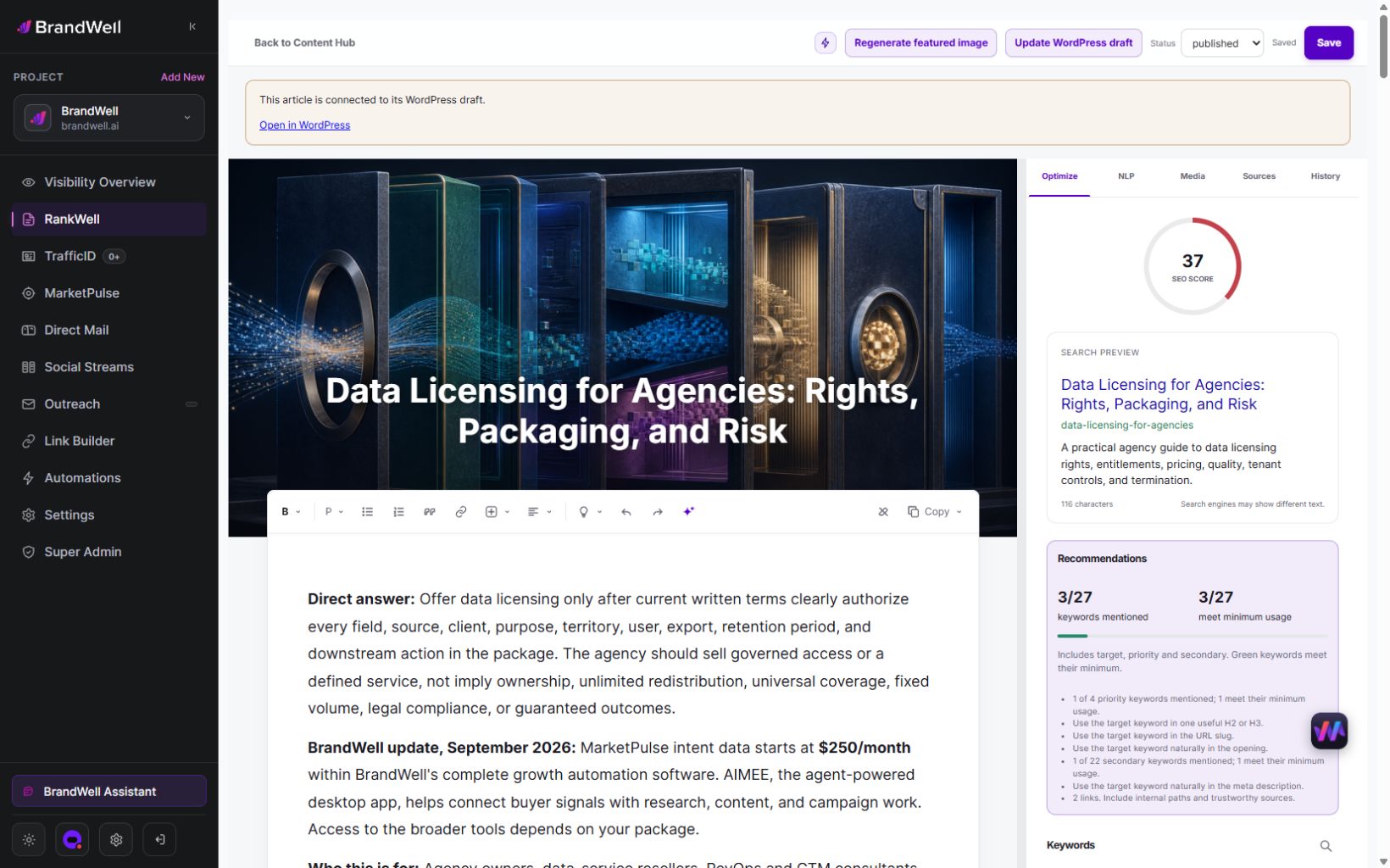
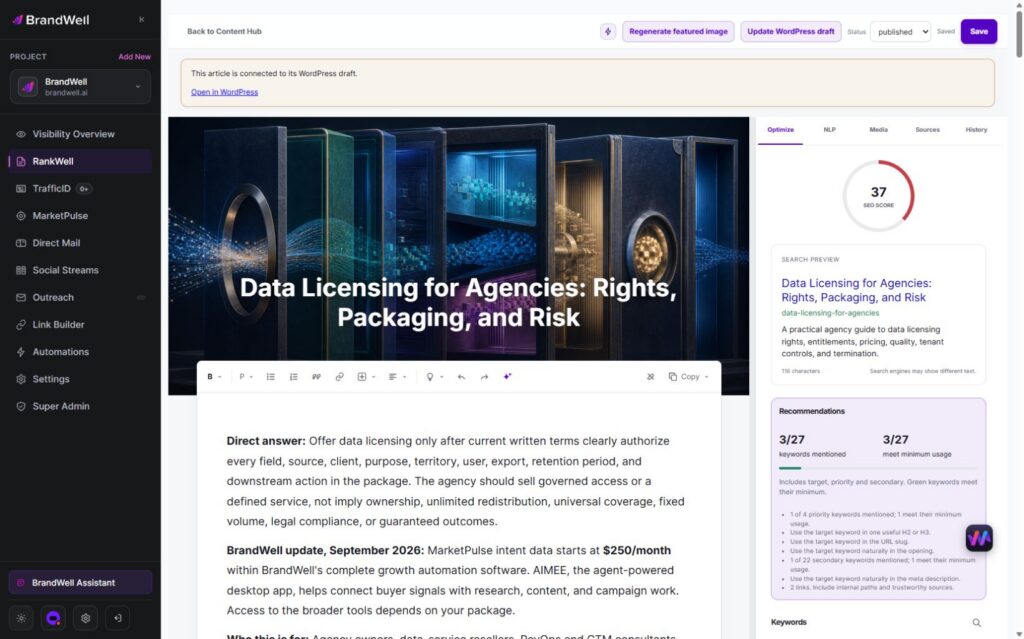
RankWell supports the content workflow within BrandWell. Bring a usable brief and approved material, prepare the draft and review the sources, examples and wording. The Content Hub organizes article, strategy, queue and calendar work.
Confirm the import and export options supported by your actual account. This guide does not claim that RankWell provides a dedicated ebook design, EPUB validation or bookstore-publishing feature. Use a suitable production workflow for the final file and review its output separately.
AIMEE can support tasks through configured tools and permissions. Define approvals before content moves to another destination. Generated material still needs editorial judgment, and an automated handoff is not proof that a book is ready to publish.
Make the ebook readable and accessible
Use clear heading levels, meaningful links and explanations of important visuals. Keep text readable on smaller screens and avoid turning whole pages of text into images. Readers should be able to navigate to the section they need.
For EPUB production, W3C’s EPUB Accessibility 1.1 specifies accessibility conformance and metadata requirements. A visually attractive file does not establish conformance. Evaluate the actual publication and report its accessible features accurately.
For a PDF or another format, inspect the actual file’s structure and reading experience. Check the table of contents, reading order, captions, text alternatives, links and zoom behavior using an appropriate review process. A preview inside an editor is not the same as testing the delivered file.
Measure the full production effort
Include planning, research, drafting, subject-matter review, editing, design and file testing. AI assistance might shorten one stage while adding work to another.
For illustration, a manual project takes 20 hours: four for planning and research, eight for drafting, four for review and four for production. An assisted project takes 16 hours: four for planning and research, four for drafting, four for review and four for production. That is a hypothetical 20% reduction in total time, not a BrandWell benchmark. If the draft requires extra corrections, include them.
For a business ebook, also track whether the resource helps its intended audience. Downloads, qualified questions and relevant next actions answer different questions. Do not infer sales or profitability from download counts alone.
Frequently asked questions
Can AI write a complete ebook?
It can produce substantial draft material, but a complete publication includes evidence, editing, permissions, production and testing. Review the actual output rather than equating word count with readiness.
How long should an ebook be?
Long enough to fulfill its purpose without unnecessary repetition. Set the scope around the reader’s task rather than an arbitrary length.
Can I turn earlier blog posts into an ebook?
Yes, when the reuse is permitted and the material fits the new resource. Update facts, remove repetition, add transitions and fill missing steps. A collection of posts is not automatically a coherent book.
Can AI translate the ebook?
It can assist with a draft where the workflow supports it. Use a qualified reviewer for meaning, terminology, examples and local context before publication.
Build an ebook around a useful outcome and a reviewed production process. Explore RankWell for the current content workflow.
Reviewed and updated October 3, 2026.

Written by
Jeff Joyce has been helping brands grow online since the Myspace era, when custom HTML layouts were still a competitive advantage. What started in design quickly evolved into a career spanning social media, content strategy, video, agency ownership, and growth marketing. After building his own agency and testing countless AI tools, Jeff joined BrandWell with a clear focus: helping marketers understand how AI can actually improve the way they create, optimize, and scale content. Today, Jeff brings a CMO-level perspective to BrandWell's marketing strategy, blending brand positioning, content, video, customer education, and growth. His work centers on turning complex AI concepts into clear, practical marketing that helps brands move faster, create better content, and stay competitive without losing their voice.
 Farnaz Kia