On this page
AI tools can help copywriters organize briefs, draft alternatives and revise approved material. Their value depends on the task, evidence and review process. Choose the workflow by the work you need to deliver, then measure the time and corrections required to produce an accepted result.
This guide focuses on ten useful tasks and the current BrandWell workflow. A generated draft or predictive score is not proof that copy is accurate, persuasive or ready to send.
10 copywriting tasks to test
1. Turn an approved brief into an outline
Supply the audience, task, product facts and scope. Ask for sections that answer the reader’s questions. Review omissions before drafting.
2. Organize research notes
Group supplied evidence by the claim it supports. Keep source links and dates attached. Do not let a plausible summary replace checking the original material.
3. Prepare a first draft
Use verified inputs and voice guidance. Ask the assistant to flag unknowns. A fluent paragraph may still contain a false feature or invented statistic.
4. Suggest accurate headlines
Request alternatives that describe the actual answer. Remove unsupported superlatives, numerical promises and claims of guaranteed results.
5. Summarize a page for search
Draft a concise description of what the page delivers. Check it against the content rather than treating a character count or score as the goal.
6. Explain a product feature as a useful benefit
Connect a verified feature to the reader’s task. “See which owner has the next approval” is more informative than “unlock seamless productivity.”
7. Adapt an approved passage for another format
Turn a reviewed article into an email introduction or social draft. Retain qualifications and context. A shorter version must not turn a conditional statement into a guarantee.
8. Revise for clarity and voice
Provide an approved example of the brand’s writing. Ask for concrete language, shorter repetition and explained terminology. Review whether the revision changes the meaning.
9. Prepare relevant variants
Use verified business context to adapt an example. Preview a generic fallback for missing information. Do not invent what a person researched or intends to buy.
10. Build a review checklist
Ask for unresolved claims, unclear steps, missing sources and inconsistencies. A checklist assists the reviewer; it cannot independently certify the draft.
Evaluate the workflow before expanding it
| Criterion | What to check |
|---|---|
| Evidence | Can reviewers trace claims to the approved source? |
| Product fit | Does the copy describe available features and the current offer? |
| Voice and meaning | Does the revision preserve factual qualifications and sound appropriate? |
| Review and access | Who can edit, approve and publish, using which configured tools? |
| Total effort | Count preparation, review, corrections and delivery, not just draft time. |
| Reader outcome | Can the reader complete the intended task? |
Swipe the table to see all columns.
The NIST AI RMF Playbook provides voluntary suggestions for managing AI use. It can inform a review process; referencing it does not certify a tool or establish its performance.
A copyable instruction for a service page
Draft a service-page introduction for operations managers preparing a payroll-provider handover. Use only the verified service facts in this brief. Explain the information to collect, the owner of each step and what requires approval. Do not promise error-free payroll, quote an unverified price or invent regulatory requirements. List missing evidence separately for review.
Use this as a starting instruction, then provide the actual evidence. Do not ask an assistant to supply first-hand experience that the business does not have.
Use the current BrandWell workflow
- Research relevant questions in Visibility and record the market, source and date.
- Review coverage in RankWell before deciding to create, improve or merge.
- Supply the approved brief, current product facts, original examples and brand voice. Use AIMEE with configured tools and access to prepare the work.
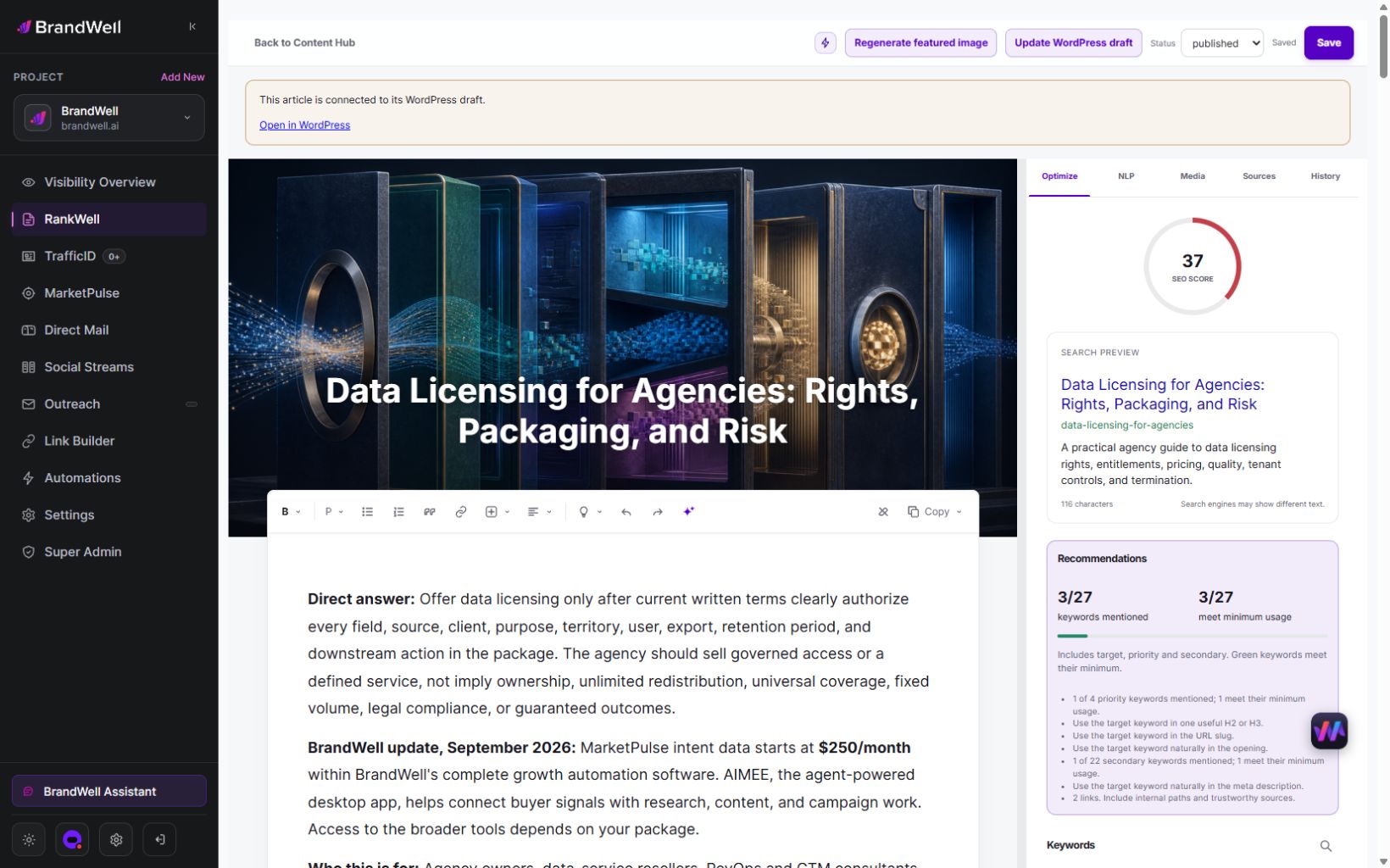
- Inspect the draft, sources, media and search preview. A human owner approves factual and editorial readiness.
- Publish through the available configured destination. For approved email work in Outreach, review recipients, message variants and suppression before sending.
Measure complete cost and useful results
For a fictional pilot, six drafts are prepared and four meet the acceptance standard. Report four accepted out of six attempted, not only the successful drafts. Include the time spent on the two rejected drafts in the cost of the pilot.
Measure qualified inquiries or other relevant actions separately from writing speed. A faster workflow can still produce less useful copy, and a higher click rate does not automatically mean more qualified demand.
Common questions
Can AI replace research?
It can help organize supplied material. The writer must verify facts, sources and current product details before publication.
Should you aim for a keyword percentage?
No. Use the terms needed to explain the task and remove repetition. A density quota does not establish relevance or quality.
Is a detector score a quality check?
It does not establish factual accuracy, ownership, usefulness or search performance. Review the actual content and its evidence.
Reviewed and updated October 7, 2026.

Written by
Julia McCoy has contributed articles to BrandWell on content marketing, writing, and search engine optimization. This archive retains her original bylines; individual articles may be updated by the BrandWell editorial team.