On this page
- Current MarketPulse workflow
- Define the client promise and operating layer
- Map owners, controls and handoffs
- Evaluate the complete service lifecycle
- Compare build, reseller and managed delivery
- Model setup and recurring cost
- Measure delivery and client adoption
- Adapt the package to client readiness
- Preserve evidence through activation
- Verify rights, security and expectations
- Maintain the recurring service package
- Branding does not establish client isolation
- Worked example: include the whole delivery layer
- Frequently asked questions
Direct answer: Build a white-label intent-data service by separating the client-facing agency brand from the governed wholesale data, modules, entitlements, configuration, support, and evidence underneath. The agency should own positioning, retail pricing, billing, and the client relationship. The platform should make the service operable without pretending to be the agency.
Current MarketPulse offer: intent-data plans start at $500/mo. See the product, demo, and current plans. Updated October 3, 2026.
A logo-swapped dashboard is not a complete white-label business. The service also needs a saleable promise, proof asset, client-scoped delivery, repeatable operations, margin model, support boundary, and renewal logic.
Who this is for: Agency founders, GTM consultants, RevOps firms, demand generation agencies, and data-service resellers deciding whether to build, resell, or operate an intent-data offer under their own brand.
Current MarketPulse workflow
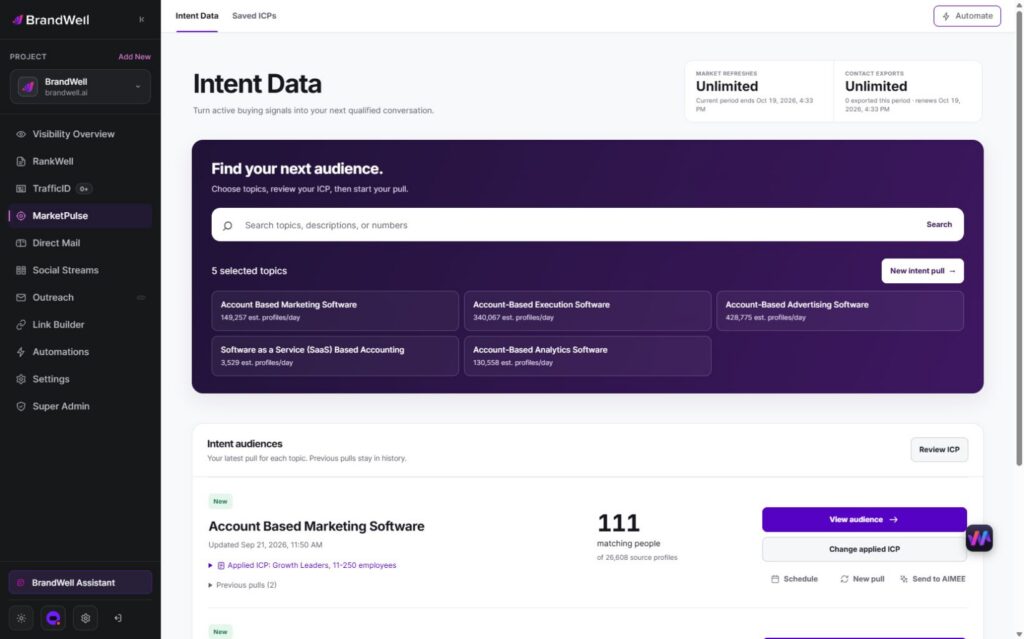
BrandWell MarketPulse: intent data starting at $500/mo. Find people researching topics relevant to what you sell, apply saved ICP filters, and review available contact details before taking action.
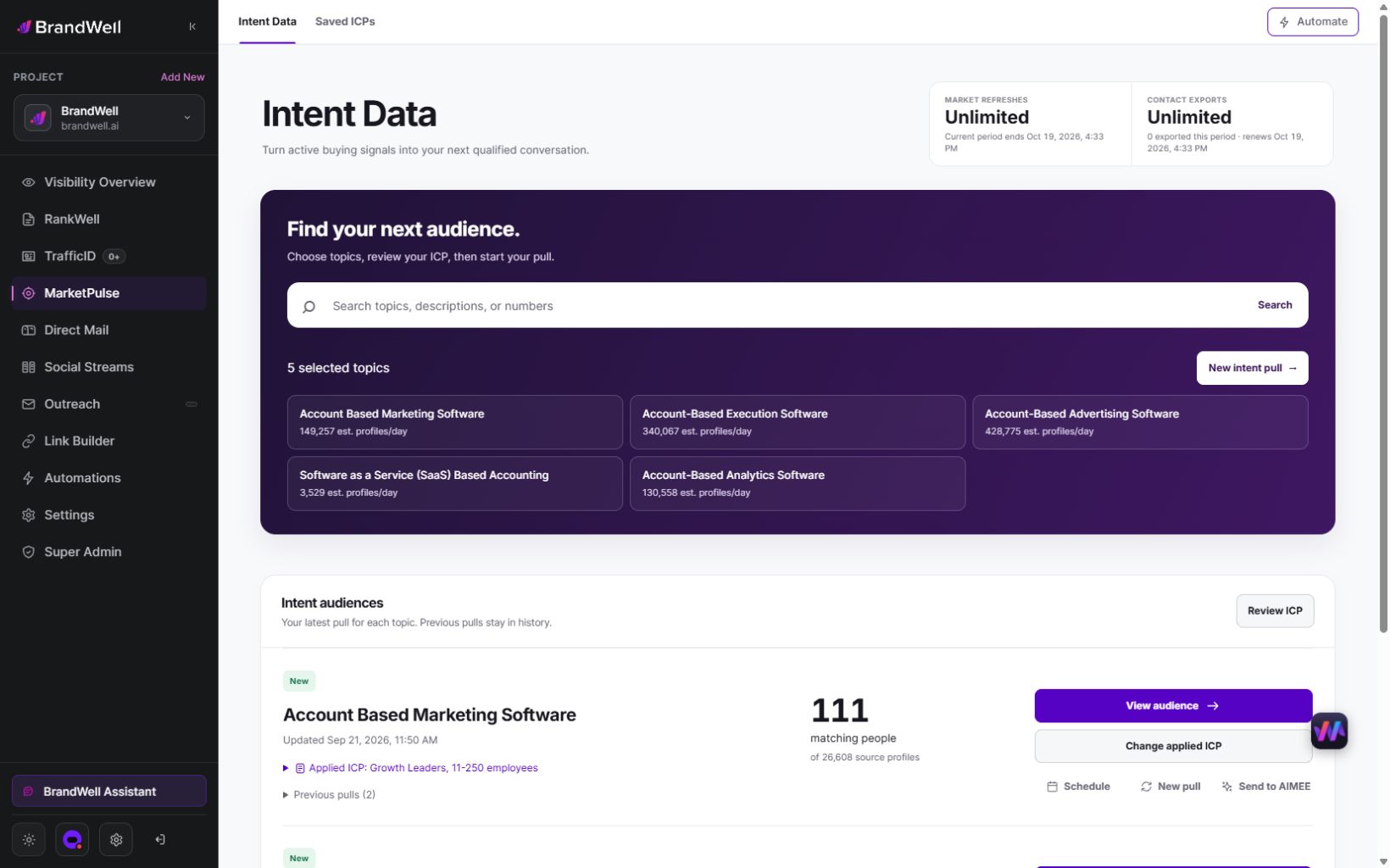
MarketPulse plans are starting at $500/mo. Verify current package scope and offers on the product page.
| Plan | Topics and refreshes | Monthly exports |
|---|---|---|
| Starter | 1 topic, weekly | 25,000 contacts |
| Growth | 3 topics, daily | 100,000 contacts |
| Scale | 10 topics, daily | Unlimited contacts |
Swipe the table to see all columns.
A pull retrieves available data from the previous 24 hours for one topic. Daily use across all included topics provides 90 Growth pulls or 300 Scale pulls in a 30-day month. Weekly Starter pulls vary by calendar month. Available audience size and contact fields vary, and audiences may overlap. Refreshes stop at the plan limit without overage charges.
- Find and qualify: search the topic catalog, save your ICP, and review the people and companies that match.
- Act on the research: export qualified contacts or prepare an Outreach or Direct Mail workflow. Connected products, channel usage, and fulfillment may cost extra.
- Get help from AIMEE: Growth and Scale include AIMEE for the initial user to research accounts and prepare the next step through connected tools.
Agencies and other service businesses can build client deliverables around their available Intent Scans and exports. Keep each client’s scope, permissions, and service fees clear. A subscription is not a promise of a white-label platform or exclusive access to a market.
Explore MarketPulse and watch the demo or compare plans starting at $500/mo. Any early-access discount is a separate, time-limited offer shown to an eligible recipient.
Define the client promise and operating layer
Start with one client decision and one recurring deliverable. A topic-intent service might help an account team review companies researching an approved set of themes. A visitor identification service might help route qualified first-party activity into an approved account workflow. Define the identity states, qualification, action, owner, cadence, and evidence before adding modules.
Separate the service into two layers. The client experience contains the agency’s promise, branding, reports, portal, meetings, recommendations, support, and invoice. The operating layer contains source data, module access, client configuration, tenant controls, review queues, integrations, delivery receipts, corrections, and wholesale costs. Each layer needs a named owner.
Define first value as an accepted branded delivery that the client can understand and act on. Do not define it as a guaranteed meeting or revenue event. Repeatability comes from using a common operating stack while giving each client its own purpose, topics, audience, rules, users, destinations, and approvals.
Choose a narrow launch package with a bounded setup, a recurring cadence, and explicit exclusions. The service can grow after the agency has evidence about delivery minutes, client adoption, exceptions, and willingness to pay.
Copyable reseller service blueprint
Record the agency promise, ideal client, revenue event, client deliverable, included modules, topic scope, identity states, wholesale allocation, retail package, setup work, recurring work, support owner, client dependencies, approval points, evidence fields, renewal trigger, and exit method. Attach the current provider terms instead of copying unstable details into the blueprint.
Design the sales experience alongside delivery. The agency needs discovery questions, a sample with clear limitations, a proposal structure, objection handling, implementation requirements, and a next step. Sales material must match the operating charter. If the demo implies instant named buyers but delivery provides reviewed account signals, the service begins with an expectation defect.
Map owners, controls and handoffs
The nine-layer white-label service stack
- Promise: state the client decision, deliverable, frequency, fit, and limitation.
- Brand: configure agency identity, client-facing language, portal or report, and support route.
- Entitle: assign modules, topic scope, users, destinations, contract limits, and any available exclusivity.
- Charter: approve client purpose, audience, identity states, qualification, retention, and actions.
- Configure: set topics, sources, filters, suppressions, validation, routing, and evidence fields.
- Validate: run positive, negative, edge, tenant, identity, destination, and rollback tests.
- Deliver: review, approve, release under the agency brand, and capture acceptance.
- Operate: maintain signals, handle exceptions, support the client, reconcile outcomes, and control changes.
- Renew: review adoption, cost to serve, evidence, scope, pricing, entitlements, and exit options.
Use the intent-service procurement checklist to clarify platform, agency, and client responsibilities before signing. An SLA should measure controllable service events such as accepted-delivery timing, correction acknowledgement, support response, or incident escalation. It should not promise pipeline or revenue.
Quality must cover both layers. Confirm the client sees the right brand, scope, data, explanations, and support path. Confirm the operating layer uses the right tenant, credentials, rules, identity states, destination, retention, and evidence. A polished report is still defective when the underlying configuration is wrong.
Map support before launch. Decide which questions the agency answers, which incidents escalate to the platform, what evidence is required, who communicates with the client, and when a service clock pauses. Keep wholesale credentials, internal pricing, and other clients out of client-facing tickets. A branded service needs a branded resolution path, not only branded onboarding.
Evaluate the complete service lifecycle
Evaluate providers by the operating model they enable. A complete agency-reseller platform should support agency branding, client separation, configurable modules, topics and filters, reports or portals, permissions, usage or entitlement controls, integrations, support operations, wholesale visibility, and evidence. A raw data API is best for a technical agency willing to build those layers. A managed partner is best when the agency prefers to sell and advise while another team operates delivery.
MarketPulse supplies topic audiences and saved ICP filtering. An agency may use available pulls and exports in appropriately scoped client deliverables. Branded portals, separate client logins, a custom API, routing and support require their own supported implementation and confirmed contractual rights; a subscription does not automatically provide a white-label platform.
- Choose an agency-reseller platform when branding, multi-client controls, sales enablement, and recurring delivery are central.
- Choose APIs and a custom stack when the agency has engineering capacity, unique workflow requirements, and appetite for ongoing maintenance.
- Choose a managed partner when the agency values operational delegation more than direct control of the platform.
- Choose a narrow specialist tool when one capability matters and the agency already has the rest of the service system.
Run the same demonstration script with every option: create a client, apply brand settings, configure scope, enforce an entitlement, test an excluded record, route an approved output, revoke a user, export evidence, and simulate termination. A provider should be evaluated on the full service lifecycle, not a single reveal.
Compare build, reseller and managed delivery
| Approach | Best fit | Agency gains | Agency accepts |
|---|---|---|---|
| Custom build | Technical agency with distinctive product requirements | Maximum control over experience and logic | Engineering, data contracts, security, maintenance, support, and roadmap burden |
| Reseller platform | Agency seeking faster launch and client ownership | Reusable modules, branding, controls, and wholesale economics | Platform boundaries, contracted capabilities, and vendor dependency |
| Managed partner | Agency prioritizing sales and strategy | Lower delivery workload | Less operating control and a larger coordination boundary |
Swipe the table to see all columns.
Compare total operating burden, not only subscription price. Custom build includes product management, engineering, hosting, observability, security, data sourcing, integration maintenance, user support, and compliance coordination. Reseller platforms reduce that build burden but require careful entitlement, support, and contract review. Managed partners reduce day-to-day operations but can make differentiation and client responsiveness dependent on another team.
A hybrid service can combine supported topic-data access with the agency’s research, reporting, strategy and separately supported integrations. Make the ownership, permission, support and maintenance boundary visible to the client.
Score each option across launch time, client experience, tenant controls, source fit, identity transparency, configuration, integrations, evidence, sales enablement, support, total cost, maintenance, contract terms, and exit. Weight the criteria before seeing a sales demonstration. Otherwise, a visually strong feature can displace the operating requirements that determine whether the service survives renewal.
Model setup and recurring cost
Setup cost includes offer design, agency branding, client charter, modules, topics, qualification rules, integrations, test cases, reports, support setup, training, and acceptance. Recurring cost includes wholesale platform expense, review, exception handling, reporting, maintenance, client support, changes, sales enablement upkeep, and a risk reserve.
Wholesale-to-retail service model
Monthly cost to serve = wholesale allocation + operator time + exceptions + reporting + support + maintenance + risk reserve.
Contribution estimate = collected client fee – monthly cost to serve – amortized acquisition and setup recovery – expected credits or rework.
Capacity gate = available review and support minutes – committed minutes – incident reserve – approved change work.
Do not promise the service will be profitable merely because a client verbally likes it. Estimate delivery effort, collect payment under your own terms, monitor actual cost to serve, and define what happens when custom work exceeds the package.
Measure delivery and client adoption
Time to value can be measured from approved client charter to first accepted branded delivery. Quality metrics include configuration accuracy, required-field completeness, correct tenant routing, validation, exception aging, correction rate, on-time delivery, and successful destination receipts. Brand quality includes correct client-facing identity, explanations, and support ownership.
Adoption includes report review, portal use, accepted records, assigned owners, client feedback, and completed approved actions. Operational health includes setup hours, recurring minutes, exception load, support volume, change requests, and incidents by tenant.
Record what the agency delivered and what the client reviewed, accepted or acted on. Client adoption is a dependency to measure, not an outcome the agency controls. Distinguish source association, observed progression and any stronger attribution supported by an appropriate evaluation.
Adapt the package to client readiness
A low-maturity client often needs a report-first package with a named action owner and regular review. A client with dependable CRM processes can use structured delivery and feedback. A mature RevOps team may support multiple modules, destinations, approval-aware automations, and outcome reconciliation.
Use a package ladder based on client decision and operating burden. A monitoring package can provide branded topic insight. A qualification package adds ICP, enrichment, validation, and action-ready states. An activation-support package adds approved alerts, research, advertising review, or outreach drafts. A client should not buy the next layer until it can govern and use the current one.
Keep the shared agency method stable while varying topics, sources, identity depth, cadence, destinations, reporting, support, and custom work. This protects differentiation without turning every account into a new product.
Preserve evidence through activation
A useful service may combine third-party topic activity, first-party website activity, company enrichment, business contact data, validation, and client CRM context. Preserve each source and timestamp. Label company, possible person, validated contact, qualified account, and action-ready states separately.
Build activation from the client’s approved play. Options can include account research, owner alert, advertising audience review, content recommendation, personalized outreach draft, or a client planning report. Do not let a generic automation decide that every signal deserves contact.
Outcome evidence should connect source signal, account, identity state, qualification, action approval, delivery, and client result with durable identifiers. This is the foundation for improving the service and explaining value without overstating causation.
Verify rights, security and expectations
Risks include promising unsupported modules, confusing the wholesale provider with the agency, cross-client exposure, weak access control, unpriced customization, identity overstatement, inappropriate activation, excessive retention, failed destinations, undocumented support, and unrealistic outcome claims.
Define source and module availability, permitted use, tenant controls, identity states, access, retention, security roles, incident handling, corrections, integrations, support, client dependencies, service clocks, changes, billing, termination, export, and deletion. Confirm requirements for each jurisdiction and use with qualified professionals.
Do not promise exclusive audience access or territory rights from a standard topic subscription. Any additional commercial rights must be established in the actual written agreement before being marketed.
Agent-ready white-label launch packet
Role: Prepare a draft agency-branded service launch packet from approved inputs.
Inputs: agency brand rules, client charter, module entitlements, approved claims, topic scope, identity states, workflow, pricing inputs, support boundary, evidence, and current written terms.
Tasks: draft the offer summary, client report narrative, responsibility map, onboarding checklist, sales discovery questions, approved workflow instructions, and risk register.
Never: invent proof, promise outcomes, state unconfirmed exclusivity, set final price, publish, contact prospects, configure production, or expose wholesale credentials.
Stop when: a capability, topic, entitlement, price, use, identity claim, or approval is unclear.
Output: draft packet for human review in Claude, ChatGPT, or AIMEE.
Human approval: required before proposal, pricing, client delivery, configuration, outreach, or public use.
Maintain the recurring service package
Include a defined promise, ideal-client criteria, branded portal or report, client charter, selected modules, entitlements, maintained topics and filters, identity-state language, QA, delivery cadence, approved activations, support, change allowance, evidence reporting, setup fee, recurring fee, renewal review, and exit process. Map it to one of the agency intent-data service models so ownership is explicit.
MarketPulse supplies topic audiences and saved ICP filtering. An agency may use available pulls and exports in appropriately scoped client deliverables. Branded portals, separate client logins, a custom API, routing and support require their own supported implementation and confirmed contractual rights; a subscription does not automatically provide a white-label platform.
MarketPulse supplies topic audiences and saved ICP filtering. An agency may use available pulls and exports in appropriately scoped client deliverables. Branded portals, separate client logins, a custom API, routing and support require their own supported implementation and confirmed contractual rights; a subscription does not automatically provide a white-label platform.
Set a monthly operating review before the first client starts. Review entitlements, topic changes, delivery quality, exceptions, support, client adoption, cost to serve, invoicing, and evidence. Decide whether to maintain, expand, reprice, narrow, or end the package. A recurring service can be managed toward sustainable contribution through disciplined review, but profit is not assured by the operating model or label.
Keep one signed-off service blueprint per package and version. Sales, delivery, support, and renewal should all work from the same operating promise. Preserve the approval evidence.
Build the business layer before adding more data
Choose one service promise, map the operating layers, test the proposed delivery model and price its real workload. A branded service needs supported rights, accountable delivery and a defined exit, as well as a client-facing identity.
Branding does not establish client isolation
OWASP’s authorization guidance distinguishes sign-in from permission to access resources and calls for checks on every request. A logo, separate navigation or hidden link is not evidence that another client’s records are inaccessible.
For a proposed custom client portal, create an authorized test plan using synthetic records. Check whether Client A can read, export or modify Client B’s report by changing a resource reference, whether revoked users retain access, and whether shared download links expose restricted material. Record expected denials and actual results. These are agency implementation checks, not a claim that BrandWell includes or has certified a custom portal.
Worked example: include the whole delivery layer
A fictional service has $1,000 in shared monthly software and infrastructure, plus $600 in review, reporting and support for each client. Four clients paying $1,200 each produce $4,800 in fees. Defined cost is $1,000 + (4 × $600) = $3,400. The remaining $1,400 is 29.2% of fees before excluded acquisition, general overhead, tax and financing costs.
If one client adds eight unpriced support hours at $75, costs increase by $600 and the remaining amount falls to $800, or 16.7%. These inputs are invented, not BrandWell wholesale terms, typical results or a complete service quote. Add setup recovery and other applicable costs before assessing profitability.
Suppose the review team has 40 hours available monthly, ordinary delivery uses seven hours per client, and ten hours are reserved for incidents and changes. Four clients use 28 hours, leaving two beyond the reserve. A fifth would use 35 hours and exceed the 30-hour routine-work allowance. A positive financial estimate does not create the missing capacity.
Start with a report before promising a portal
Review a relevant MarketPulse topic and apply the saved client ICP. Prepare a permitted, reviewed brief showing the topic window, fit, available fields, uncertainty and next research step. Keep clients’ files and delivery destinations separate. Add custom access, branding or automation only after rights, implementation and testing support the promise.
Frequently asked questions
Does MarketPulse include a white-label client portal?
A topic subscription supplies its stated audience and export allowances. A custom branded portal and client access require separately confirmed capability, implementation and rights.
Can a branded report replace source evidence?
No. Preserve the source, timing, identity state, interpretation and approval behind the report.
Does a client login prove data isolation?
No. Authorization must protect the specific resources and actions, including exports and shared links.
What is a practical first package?
A scoped, reviewed report with clear client responsibilities, costs, correction process and exit terms.
Evaluate the topic-data input: explore MarketPulse and its current plans.
Reviewed and updated October 3, 2026.

Written by