On this page
- Current MarketPulse research input
- Who this is for
- The five-part proposal framework
- Copy-and-adapt intent data scope of work template
- The most useful proposal tools and resources
- Compare four delivery models before you scope
- Price for contribution margin, not software markup
- Metrics that show whether the scope is working
- Best-fit clients and disqualifiers
- Signal, identity, activation, and outcome must stay separate
- Where BrandWell fits in the proposal
- Final scope review before signature
- Frequently asked questions
- Copyable acceptance and change record
An effective buyer intent data service proposal does two jobs at once: it makes the client’s decision easy and makes the agency’s delivery boundary hard to misunderstand. Lead with the outcome, define exactly which signals and actions are included, assign every approval and data-use responsibility, attach measurable acceptance criteria, and price the exceptions that would otherwise erode margin. The scope of work should sell a controlled operating system – not an unlimited stream of “intent leads.”
Strong intent service proposals and scopes of work make signals, deliverables, responsibilities, measurement limits, commercial terms, and change control explicit before delivery begins.
Current MarketPulse offer: intent-data plans start at $500/mo. See the product, demo, and current plans. Updated October 3, 2026.
Current MarketPulse research input
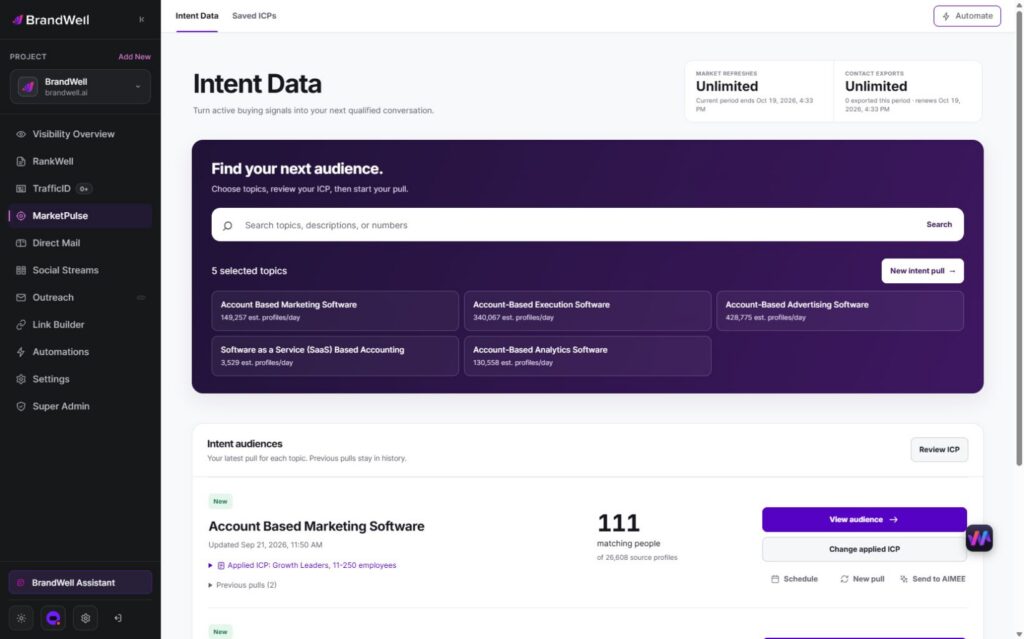
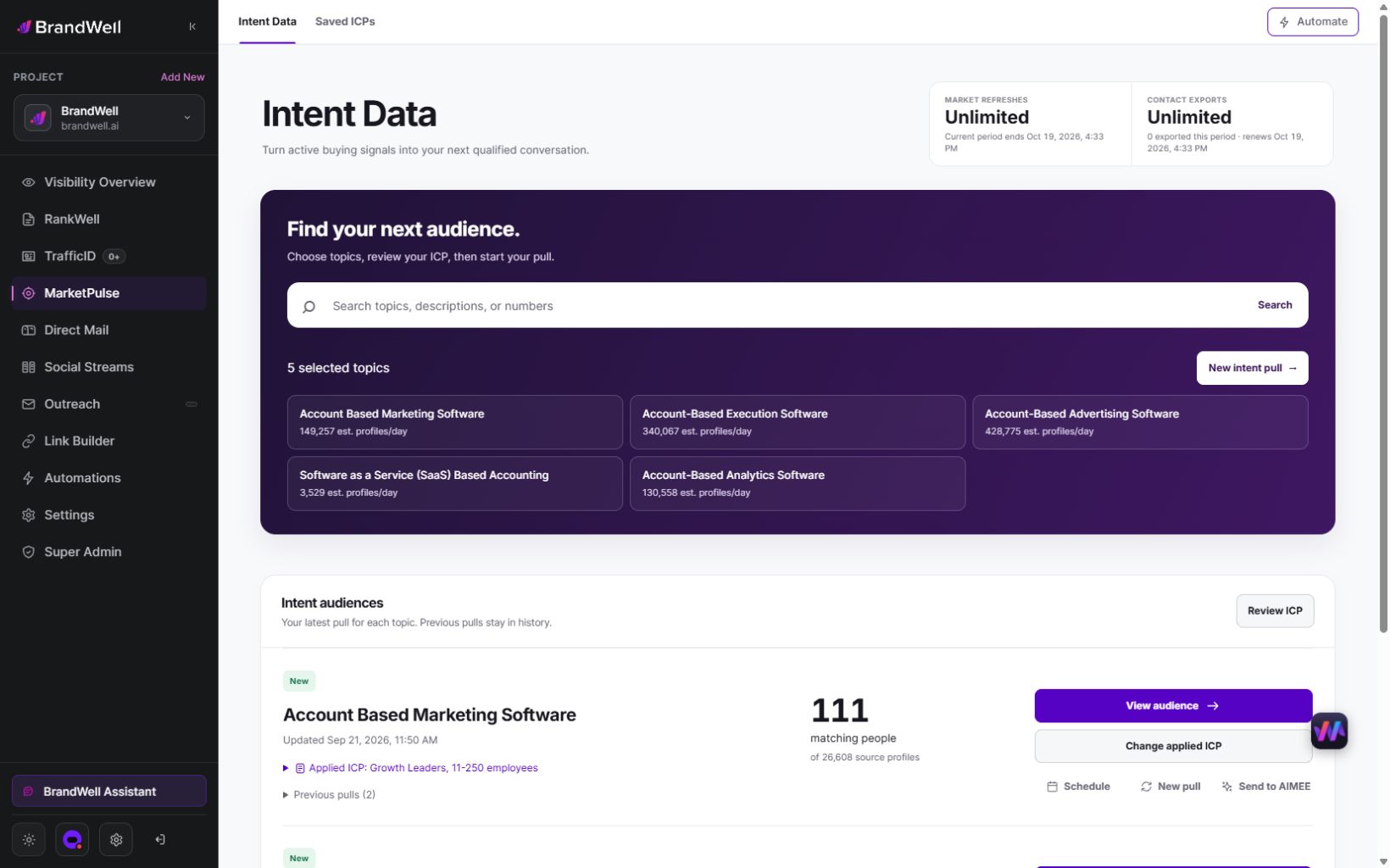
MarketPulse research is starting at $500/mo. Review relevant topics, saved ICP filters and available match details. Separately verify each intended action and custom delivery obligation.
| Plan | Topics and refreshes | Monthly exports |
|---|---|---|
| Starter | 1 topic, weekly | 25,000 contacts |
| Growth | 3 topics, daily | 100,000 contacts |
| Scale | 10 topics, daily | Unlimited contacts |
Swipe the table to see all columns.
A pull retrieves available data from the previous 24 hours for one topic. Daily use across all included topics provides 90 Growth pulls or 300 Scale pulls in a 30-day month. Weekly Starter pulls vary by calendar month. Available audience size and contact fields vary, and audiences may overlap. Refreshes stop at the plan limit without overage charges.
- Find and qualify: search the topic catalog, save your ICP, and review the people and companies that match.
- Act on the research: export qualified contacts or prepare an Outreach or Direct Mail workflow. Connected products, channel usage, and fulfillment may cost extra.
- Get help from AIMEE: Growth and Scale include AIMEE for the initial user to research accounts and prepare the next step through connected tools.
Agencies and other service businesses can build client deliverables around their available Intent Scans and exports. Keep each client’s scope, permissions, and service fees clear. A subscription is not a promise of a white-label platform or exclusive access to a market.
Explore MarketPulse and watch the demo or compare plans starting at $500/mo. Any early-access discount is a separate, time-limited offer shown to an eligible recipient.
Who this is for
- Agency owners productizing buyer intent, audience, prospecting, paid-media, or RevOps services.
- Client services and operations leaders who need a reusable intent data proposal template.
- GTM consultants translating topic research, visitor identification, enrichment, and activation into deliverables.
- Buyers reviewing an intent-data managed service and trying to separate useful scope from attractive promises.
This guide is a commercial and operational template, not legal advice. Adapt it with counsel for the data sources, channels, clients, and jurisdictions involved. Intent and identity are probabilistic. A well-written SOW cannot guarantee that a company will buy, reply, enter pipeline, or produce incremental revenue.
The five-part proposal framework
The strongest proposal can be summarized in five numbered decisions. Put these before detailed legal language so an executive buyer can understand what is being purchased.
1. Define the business decision
Name the decision the service will improve. Examples include which accounts enter weekly seller research, which topics influence a content plan, which qualified accounts enter an ad audience, or which existing customers receive an expansion-risk review. “Provide intent data” is not an outcome.
State the baseline and the decision owner. If the current process is a monthly cold list, record list size, acceptance rate, time to action, and downstream results. If there is no baseline, the first delivery period should establish one rather than promising a lift that cannot be measured.
2. Define an eligible signal
Specify the signal source class, topic or behavior, observed time, geography, account or person identity level, freshness window, and minimum fit requirements. Keep observation separate from interpretation. Research activity around a topic is evidence of activity, not proof of budget, authority, timing, or purchase readiness.
The proposal should say what happens to weak, stale, duplicated, suppressed, or unresolved records. An exception queue is a deliverable. Silently dropping difficult records makes the service look cleaner than it is and prevents the agency from improving it.
3. Define the action and approval boundary
For each accepted signal, state the permitted next action: report inclusion, CRM task, account research, audience creation, nurture branch, approved outreach draft, or another bounded play. Name who approves a new audience, message, budget, field write, or external communication.
Define which proposed actions need human approval and which reviewed, reversible tasks can run through configured tools. Verify actual permissions, access, acknowledgements and recovery. A draft or AI instruction does not prove execution.
4. Define evidence and acceptance
Attach acceptance criteria to every deliverable. A report can be accepted when required fields reconcile to the source, reason codes are present, duplicate rules pass, and the client owner can take the named action. An audience can be accepted when eligibility, suppression, destination policy, and matched-size checks pass.
Do not let “number of signals delivered” stand alone. Record usable records, accepted records, completed actions, time to action, exceptions, outcome evidence, and the method used to connect activity with pipeline or revenue.
5. Define commercials and change control
Separate actual platform allocation, setup, direct labor, support, connected tools and media. Show unspent contingency as a budget reserve rather than incurred delivery cost. Define included scope and obtain approval before added custom work.
This is the margin-protection layer. “Reasonable requests included” is not a scope. A request is either included, an exchange for another included item, or a priced change.
Copy-and-adapt intent data scope of work template
Use this structure as the drafting spine for an agency proposal. Replace brackets with verified client-specific terms.
1. Purpose and outcome
Purpose: Agency will operate a buyer-intent service to help [client team] make [named decision] for [market/use case]. The target operational outcome is [measurable action], not a guaranteed sales or revenue result.
Baseline: During [baseline window], client currently produces [volume], accepts [rate or count], acts within [time], and records [outcome fields]. If a reliable baseline is unavailable, the first period establishes it.
2. Covered scope and exclusions
- Market, territory, and client entity: [define].
- Topics/categories/competitors/products/services: [list or attach taxonomy].
- Use case: [seller prioritization, audience, reporting, customer risk, content, or other].
- Exclusions and suppression: [industries, accounts, people, geographies, sensitive contexts].
- Term and availability: [start/end, hold, activation, renewal, release].
- Delivery surface: [standard portal, API-only, custom portal, export, dashboard, or combination].
MarketPulse supplies topic research and available match context. Custom client workspaces, branding, reporting, API connectors and managed delivery require separately verified implementation, entitlements, rights, scope and fees.
3. Inputs and prerequisites
Client supplies a current ICP, account exclusions, suppression lists, approved domains, destination access, field definitions, campaign or seller owners, brand assets, approval contacts, and lawful-use instructions. Agency supplies the topic map, event schema, qualification rules, report or portal configuration, play cards, QA plan, and operating calendar.
No production activation begins until required access, permissions, data roles, and approvals are documented. Missing prerequisites extend the schedule under the change process rather than forcing the agency to absorb recovery work.
4. Signal and qualification rules
Define required fields such as client ID, event ID, source, observed time, topic, company domain, geography, identity level, confidence, fit fields, freshness, consent or use flags, suppression status, and reason code. Define accept, reject, hold, investigate, and expire states.
Version qualification rules. A threshold change must state the owner, rationale, effective time, records affected, rollback method, and evaluation window. An AI agent may recommend a change but should not rewrite and deploy eligibility rules without review.
5. Deliverables and cadence
List each artifact, format, owner, due time, acceptance check, and revision allowance. Possible deliverables include:
- weekly qualified-account report with source timestamps and reason codes;
- branded topic report for client presentation;
- portal workspace and named client users;
- CRM research tasks or approved field updates;
- audience file or destination sync after approval;
- exception and suppression report;
- monthly decision review and quarterly commercial review;
- agent-ready workflow instructions with inputs, allowed tools, output schema, evidence, and escalation conditions.
Avoid the phrase “real time” unless the contract defines latency from observation to availability and from availability to action.
6. Roles and service levels
| Stage | Agency owner | Client owner | Acceptance or SLA evidence |
|---|---|---|---|
| Topic and market definition | Strategy lead | GTM executive | approved taxonomy and exclusions |
| Data intake and normalization | Data operations | RevOps | schema completeness and timestamps |
| Qualification and enrichment | Service strategist | Sales/marketing owner | reason codes, fit, confidence, suppression |
| Approval and activation | Channel specialist | named approver | approval record and destination result |
| Reporting | Client success | executive sponsor | reconciled counts, actions, exceptions, outcomes |
| Optimization | Service owner | steering group | versioned change and evaluation decision |
Swipe the table to see all columns.
The service level must include dependencies. The agency cannot meet an action deadline when the client approver or destination access is unavailable. Define pause, escalation, and expiry behavior.
7. Measurement and evidence
Report four layers: time-to-value, data quality, adoption, and business outcome. Label each outcome as descriptive, platform-attributed, modeled, or experimental. When an incrementality test is feasible, define the hypothesis, treatment, comparison group, duration, conversion lag, decision threshold, and limitations before launch.
Keep evidence for objective and implied performance claims before putting them in proposals or client reports. Label modeled and attributed outcomes and retain their assumptions.
8. Data use, security, and compliance
Attach a data-flow diagram and responsibility schedule. Address permitted purpose, roles, instructions, confidentiality, security, subprocessors, retention/deletion, access, audit evidence, individual rights and opt-outs, incident handling, and end-of-service return or deletion.
Verify the actual data roles, permitted purposes, instructions, recipients, safeguards, retention, deletion, incident handling and support obligations for the implementation. A checklist or contract alone does not prove an operating control.
Resolve the actual jurisdiction, recipient, channel and opt-out requirements before activation. Assign sender review, suppression, approval and monitoring responsibilities for the implemented workflow.
9. Fees, usage, and change orders
State setup fee, recurring fee, included modules, topic and client capacity, usage allowance, agency review hours, reports, destinations, support window, taxes, overages, third-party spend, and payment terms. Exclude custom creative, CRM cleanup, bespoke integrations, legal review, media, and unlimited revisions unless priced.
Use a change request containing: request, reason, dependency, impact on fee, impact on schedule, risk, acceptance criteria, approvers, and effective date. Work begins after written approval.
10. Pilot, renewal, and exit
Define pilot inputs, branded output, expiry, evaluation meeting, success criteria, data disposition, and the separate acceptance that creates paid service. Define renewal notice, review date, topic continuation or release, export/deletion, destination disconnection, credential revocation, and transition support.
The most useful proposal tools and resources
A reusable proposal system needs five artifacts, not an oversized slide deck:
- Discovery worksheet: outcome, baseline, market, topics, sources, destinations, owners, data restrictions, and disqualifiers.
- Scope configurator: modules, capacity, usage, cadence, service levels, dependencies, exclusions, and price impact.
- Signal dictionary: every field, source, timestamp, meaning, confidence, retention, and permitted use.
- Play-card library: trigger, qualification, evidence, proposed action, owner, approval, expiry, and outcome fields.
- Evidence ledger: delivery, adoption, exceptions, costs, outcomes, attribution method, and claim-support status.
Use the performance-work-statement approach as a drafting analogue: specify actual outputs, measurable acceptance and operating constraints. Federal procurement rules do not automatically govern a private agency engagement.
Compare four delivery models before you scope
| Model | Simplicity | Agency margin risk | Client control | Best use |
|---|---|---|---|---|
| Report-only advisory | High | analyst time and subjective revisions | client activates | early discovery or narrow executive insight |
| Managed signal-to-action | Medium | exceptions and destination support | shared | repeatable qualified plays with clear owners |
| Client-owned platform implementation | Lower | change management and integration labor | high | mature client with internal RevOps and licenses |
| Custom branded managed service | Medium | over-customization and unused capacity | agency-controlled experience | agencies standardizing delivery across clients |
Swipe the table to see all columns.
Choose the least complex model that can improve the actual decision and return feedback. Report-only work needs a client action owner. Custom branded delivery requires separately verified separation, rights, implementation and support; confirm costs before expanding.
Price for contribution margin, not software markup
Model monthly delivery cost as:
Incurred platform and usage + direct labor + integration maintenance + client support + delivery media or tools. Count each cost once and show unspent contingency separately in the budget.
Then calculate contribution margin:
(Client recurring fee – incurred delivery cost) / client recurring fee. Define included delivery costs and excluded overhead; this is a scoped contribution margin, not company net profit.
Setup should fund market mapping, taxonomy, data and access review, portal or report configuration, play design, destination setup, QA, baseline, and training. Recurring fees should fund enabled capacity, monitoring, reports, optimization, and the agreed support window.
Margin protection comes from operational controls: record or audience bands, topic and client limits, revision caps, named destinations, exception allowances, response windows, and priced changes. Track manual minutes per accepted action. A low platform fee paired with endless data repair is not an affordable service.
For package tiers and retail pricing mechanics, keep this SOW focused and refer readers to BrandWell’s guides to buyer intent service package design and what agencies should charge.
Metrics that show whether the scope is working
Use a balanced scorecard:
- Delivery: on-time outputs, schema completeness, duplicate rate, source latency, destination success, exception backlog.
- Quality: accepted-signal rate, sampled false positives, identity/enrichment yield, suppression accuracy, freshness distribution.
- Adoption: records reviewed, actions accepted, action completion, time to action, report/portal usage, rejection reasons.
- Outcome: qualified responses, meetings, opportunities, pipeline, won revenue, retained revenue, or media outcomes – with denominator and evidence method.
- Economics: setup recovery, platform utilization, direct labor, support burden, contribution margin, expansion revenue, and churn risk.
A proposal improves revenue quality when fewer unqualified records consume time and more eligible signals receive the intended action. It improves profitability when that happens within the agreed labor and capacity model.
Best-fit clients and disqualifiers
The best fit has a defined market, meaningful economic value per opportunity, observable topic or website behavior, a reachable owner, a timely action, destination readiness, and enough volume to learn. It also has permission to use the data for the planned purpose and a CRM or evidence process capable of recording outcomes.
Pause or narrow the scope when the client requires a promise of a fixed lead outcome, has no ICP, cannot provide suppressions, lacks an action owner, expects automatic person-level outreach, treats identity as certain, wants sensitive consequential use, or cannot agree on a baseline. A small manual discovery project is safer than a broad recurring promise.
Signal, identity, activation, and outcome must stay separate
Build a chain of evidence:
- Observed signal: what happened, where, and when.
- Fit: why the organization belongs in the client’s market.
- Identity: what account or person could be resolved and with what confidence.
- Freshness: whether the evidence is still relevant to the planned action.
- Activation: what the agency or client actually did.
- Outcome: what happened later and how it was measured.
The SOW should never allow a downstream report to erase gaps in that chain. “Pipeline influenced” should point to the signal cohort, accepted action, opportunity record, time window, and attribution rule.
Where BrandWell fits in the proposal
Verify current MarketPulse product scope and guarantee conditions separately from agency service promises. A research subscription does not imply exclusive topic rights or a protected market.
Evaluate a relevant MarketPulse topic with an approved ICP and actual available fields. AIMEE can organize supplied context through configured tools. Named owners approve exports, messages and writes; measure useful review work and actual delivery effort before expansion.
Test whether the scoped workflow reduces actual review or delivery effort. Research does not guarantee coverage, buyer qualification, incremental pipeline, revenue or compliant activation.
Final scope review before signature
Before an agency sends the proposal, ask ten questions:
- Is the client buying a named decision and action rather than a feed?
- Are signal, identity, freshness, fit, and suppression rules explicit?
- Does every deliverable have an owner, cadence, acceptance check, and revision limit?
- Are automated, reviewed, and prohibited actions separated?
- Are delivery dependencies and client delays reflected in service levels?
- Are costs, included capacity, overages, and custom work visible?
- Can the agency measure adoption, outcomes, and gross margin with denominators?
- Are privacy, security, permitted use, retention, and opt-out duties assigned?
- Does the pilot have a defined end and a separate paid-conversion act?
- Can both sides explain renewal, topic release, data exit, and transition?
If any answer is “we will figure it out later,” convert it into a discovery deliverable, an assumption, or an exclusion. That is how an intent data SOW protects client trust and agency margin at the same time.
Frequently asked questions
How should an agency approach an intent-service proposal?
Start with the client decision, baseline, and named action. Then define eligible signals, approval boundaries, evidence, costs, and change control. The proposal should make value understandable while the SOW makes delivery testable. Avoid selling an undefined quantity of “high-intent leads.”
What inputs and review cadence are required?
Require the actual ICP, topics, exclusions, suppressions, destinations, fields, owners, permitted uses and baseline. An illustrative cadence is weekly launch exceptions and monthly adoption review. Adjust it to the actual service obligations, notice dates and signal lifetime.
Which template or system is most useful?
Use a linked set: discovery worksheet, scope configurator, signal dictionary, play cards, and evidence ledger. A generic proposal template can format the document, but these operational artifacts prevent ambiguity. Keep the accepted Order Form, data-flow diagram, responsibility schedule, and rule versions with the engagement record.
How do report, managed, client-owned and custom branded approaches compare?
Report-only work relies on a client action owner. Managed delivery adds operational work. A client-owned implementation needs verified internal capacity. Custom branded delivery adds separately tested access, reporting, rights and support requirements; it is not an assumed MarketPulse entitlement.
What cost drivers belong in an intent-data proposal?
Include actual platform allocation, implementation, capacity, enrichment, destinations, labor, support and delivery tools. Show an unspent contingency separately from incurred cost. Price added integrations, CRM cleanup, creative, remediation, revisions and faster service windows through approved changes.
Which KPIs show revenue quality and profitability?
Track usable and accepted signal rate, time to action, action completion, exceptions, qualified responses and opportunities, pipeline or revenue with the evidence method stated, direct labor, utilization, support time, and contribution margin. Always include denominators and distinguish attributed from incremental results.
Which clients and contract types fit best?
The best fit has a defined market, sufficient economic value, observable behavior, an owner who can act quickly, and systems that record outcomes. A recurring order works when the workflow repeats. Use paid discovery or a bounded pilot when the topics, volume, action, permissions, or baseline remain uncertain.
Which signal and identity evidence matters most?
Preserve source, timestamp, topic or behavior, account resolution, person resolution if permitted, confidence, fit, freshness, suppression status, action, and outcome. Do not merge account-level research with person-level identity. The SOW should state which level is required for each activation.
What risks most often damage margin or trust?
Unlimited revisions, vague “real-time” promises, missing client dependencies, bad CRM data, unsupported match-rate expectations, automatic outreach, unclear data roles, unmanaged overages, platform-policy violations, and inflated ROI claims are common failures. Convert each risk into a prerequisite, acceptance check, cap, approval, or exclusion.
How should a recurring managed-service SOW change?
Document the actual service scope, implemented client separation, branding responsibilities, reports, billing, support, renewal, exit and cross-client controls. Route added work through written change approval.
Copyable acceptance and change record
Deliverable: [Actual output, owner and date.] Acceptance: [Fields, reconciliation, permissions and acknowledgement.] Dependencies: [Client access and approvals.] Exception: [Hold, correction owner and revised deadline.] Change: [Added work, fee, schedule, approvers and effective date.] Outcome: [Mature observation and measurement limit.]
Write measurable output requirements
FAR 37.602 uses required results and measurable performance standards. FAR 8.405-2 lists work, place, period, deliverables and standards for applicable federal orders. These are drafting analogues, not rules automatically governing private contracts.
Received is different from accepted
A fictional 100-record delivery has 80 complete records, 60 approved records and 45 acknowledged CRM writes. Record the 20 completeness gaps, 20 further approval gaps and 15 unacknowledged writes separately. A file arriving on time is not proof that every record passed acceptance or every action executed.
Budget reserves and actual costs have different roles
A fictional $3,000 recurring agency fee has $2,100 incurred delivery cost. Scoped contribution is $900, or 30%, before excluded overhead and taxes. An unspent $300 contingency stays separate from incurred cost. An approved $600 additional obligation would reduce contribution to $300 unless the fee or scope changes.
Do not silently approve a new destination
A fictional SOW includes a reviewed report, but a client requests an automated CRM sync. Confirm field mapping, access, eligibility, acknowledgement, recovery, labor and support before pricing and approving the change. The research subscription does not establish that the connector is implemented.
Review current research: explore MarketPulse and current plans.
Reviewed and updated October 3, 2026.

Written by