On this page
- Current MarketPulse workflow
- Define the partner and client promise
- Build nine delivery and governance steps
- Choose tools for the partner motion
- Build, resell, refer or decline
- Price delivery and partner work
- Measure opportunity evidence
- Qualify clients and partners
- Use signals without bypassing ownership
- Manage access and client-experience risks
- Define the recurring package
- Worked example: separate registrations and service economics
- Make incentives understandable
- Frequently asked questions
Direct answer: Use channel partnerships to extend a defined agency offer through governed partner roles, not to outsource growth to a vague network. A working model specifies partner type, market boundary, account ownership, referral or resale rights, enablement, billing, support, conflict rules, evidence, and exit terms before the first shared opportunity.
Current MarketPulse offer: intent-data plans start at $500/mo. See the product, demo, and current plans. Updated October 3, 2026.
Who this is for: Agency owners and partnership, revenue, GTM, or service-line leaders building non-project recurring revenue with referral, reseller, co-sell, or delivery partners.
A channel is a set of rights and responsibilities, not a logo page. The partnership earns its place when both parties know which accounts qualify, what each party may say, who controls the client relationship, and how a disputed lead or service failure is resolved.
Current MarketPulse workflow
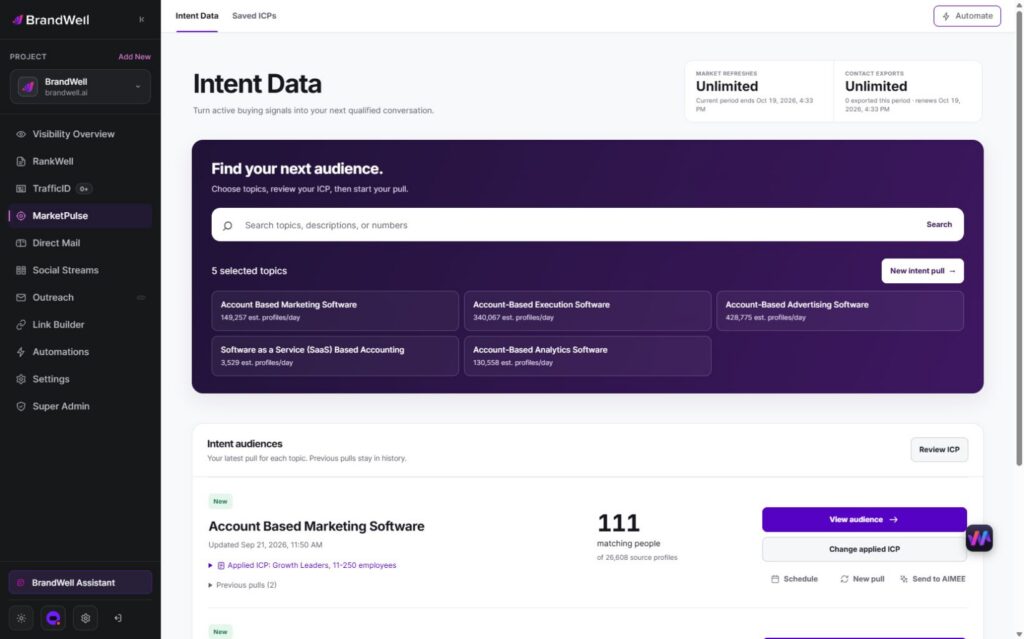
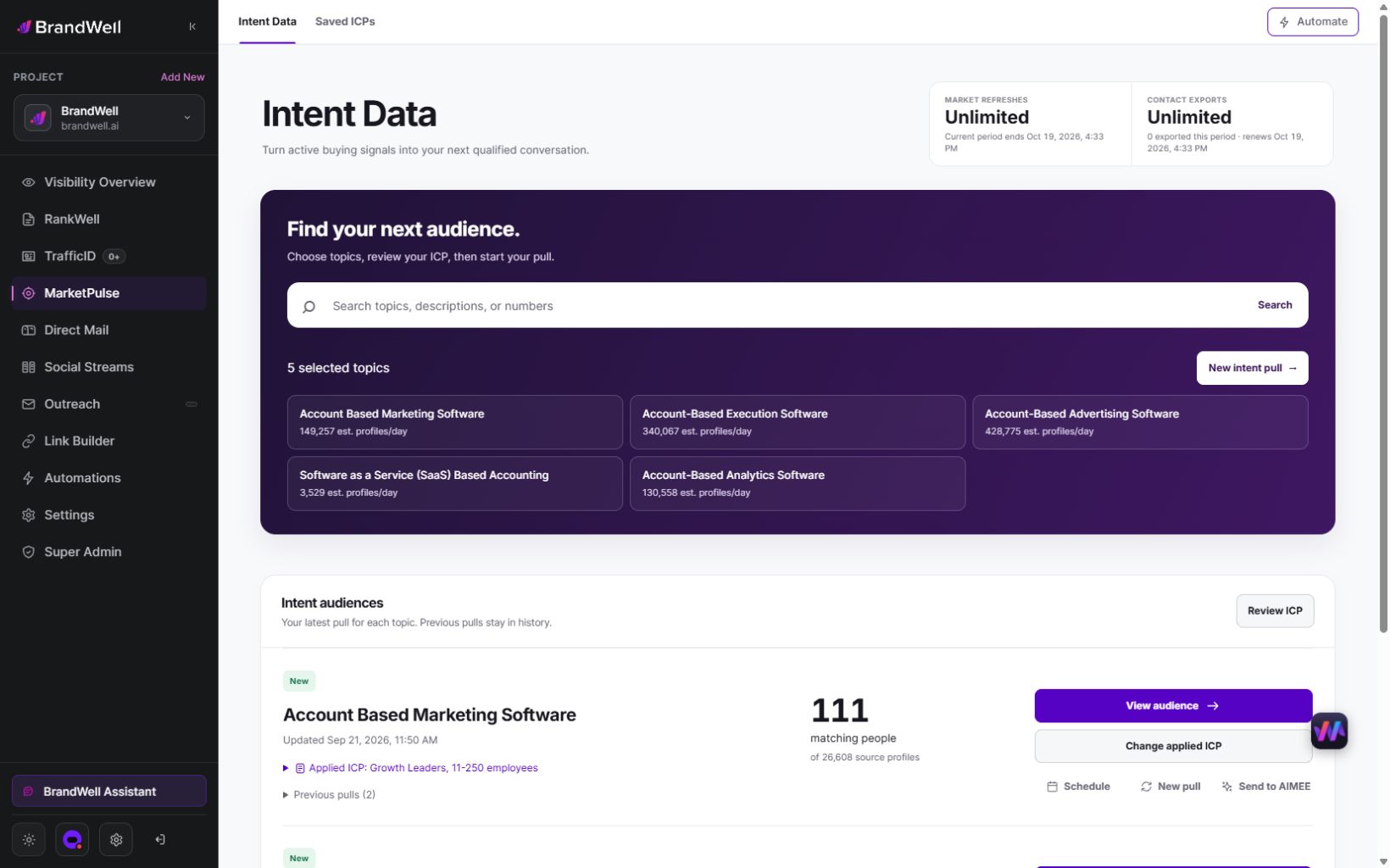
BrandWell MarketPulse: intent data starting at $500/mo. Find people researching topics relevant to what you sell, apply saved ICP filters, and review available contact details before taking action.
MarketPulse plans are starting at $500/mo. Verify current package scope and offers on the product page.
| Plan | Topics and refreshes | Monthly exports |
|---|---|---|
| Starter | 1 topic, weekly | 25,000 contacts |
| Growth | 3 topics, daily | 100,000 contacts |
| Scale | 10 topics, daily | Unlimited contacts |
Swipe the table to see all columns.
A pull retrieves available data from the previous 24 hours for one topic. Daily use across all included topics provides 90 Growth pulls or 300 Scale pulls in a 30-day month. Weekly Starter pulls vary by calendar month. Available audience size and contact fields vary, and audiences may overlap. Refreshes stop at the plan limit without overage charges.
- Find and qualify: search the topic catalog, save your ICP, and review the people and companies that match.
- Act on the research: export qualified contacts or prepare an Outreach or Direct Mail workflow. Connected products, channel usage, and fulfillment may cost extra.
- Get help from AIMEE: Growth and Scale include AIMEE for the initial user to research accounts and prepare the next step through connected tools.
Agencies and other service businesses can build client deliverables around their available Intent Scans and exports. Keep each client’s scope, permissions, and service fees clear. A subscription is not a promise of a white-label platform or exclusive access to a market.
Explore MarketPulse and watch the demo or compare plans starting at $500/mo. Any early-access discount is a separate, time-limited offer shown to an eligible recipient.
Define the partner and client promise
Yes, if the agency has a repeatable offer, clear target market, delivery capacity, and partner value beyond a referral fee. Promise clients coordinated access to a defined service with transparent ownership and support. Do not promise partner reach, deal volume, exclusivity, pipeline, revenue, margin, or renewal. Those depend on partner behavior, market fit, client decisions, and delivery quality.
The client outcome should be narrower than “more leads.” Examples include a governed intent-data service delivered through a trusted adviser, a consistent handoff between signal and activation specialists, or a coordinated plan that reduces role confusion. The promise must match the actual partner agreement.
Build nine delivery and governance steps
Name an executive owner, partner manager, service owner, sales owner, operations or finance owner, and escalation contact on each side. Onboarding should cover positioning, qualification, permitted claims, account registration, data sharing, consent or privacy responsibilities, pricing authority, support, and incident handling. The client handoff must name the relationship owner and explain which entity bills and supports each component.
- Choose the partner motion. Distinguish referral, affiliate, reseller, co-sell, integration, and subcontract delivery.
- Define the market boundary. Specify geography, segment, use case, named accounts, excluded accounts, and any contract-scoped exclusivity.
- Allocate rights. Document who may market, quote, discount, contract, access data, deliver, subcontract, and renew.
- Register opportunities. Set required evidence, timestamps, acceptance, expiry, duplicate treatment, and conflict escalation.
- Enable honest selling. Provide approved language, discovery questions, qualification criteria, demo boundaries, and prohibited claims.
- Design handoffs. Name the owner, artifacts, SLA, client communication, support tier, and rollback path.
- Reconcile economics. Define billing, referral or wholesale treatment, refunds or credits where applicable, taxes, and disputed attribution.
- Review performance. Track accepted registrations, handoff quality, activation, support, client outcomes, and policy breaches.
- Renew or exit. Set review dates, data return or deletion, open-opportunity treatment, client continuity, and termination communication.
An SLA should cover acceptance decisions, handoff completion, support routing, and incident acknowledgment within each party’s control. It should not turn expected partner behavior into guaranteed client outcomes.
Choose tools for the partner motion
Select tools by the motion. Core capabilities may include partner records, enablement content, opportunity registration, duplicate and conflict logic, approval workflows, deal-room collaboration, billing reconciliation, permissions, audit history, and renewal tasks. For an intent-data reseller motion, also assess tenant isolation, branded delivery, topic scope, data rights, and agency-controlled retail pricing.
No platform is the universal best. A simple controlled workspace may be enough for a small referral program, while a multi-tier resale channel needs stronger entitlements and reconciliation. Verify current primary product documentation and written terms before trusting a capability, integration, or price.
Build, resell, refer or decline
Build program operations when the agency’s partner method is distinctive and it has capacity to govern it. Resell when the partner brings a contracted wholesale service the agency can responsibly package. Refer when the agency should not own delivery or billing. Avoid channel expansion when the core offer is still changing, delivery quality is unstable, rights are unclear, or direct and partner teams cannot resolve account conflict.
Compare alternatives across speed, control, enablement load, legal rights, client ownership, support exposure, economics, data access, and exit complexity. The intent-data service models for agencies guide helps clarify whether a partner motion should be referral, managed service, reseller, or another structure.
Price delivery and partner work
Price the client service first, then allocate economics under the actual role. Include partner acquisition and enablement, account review, co-selling time, wholesale modules, delivery labor, support, billing administration, disputes, compliance, and channel management. Do not treat a referral percentage or wholesale discount as pure margin.
Stress-test quick acceptance, duplicates, heavy support, partner error, cancellation and termination with open opportunities. Define costs included in any reported margin. The agreement should specify who can price the service, issue credits or change scope.
AIMEE can help prepare internal briefs and assigned work through configured connected tools. Confirm supported actions and the actual destination result. It does not supply unrestricted execution or decide a partner agreement.
Use an available MarketPulse topic and a defined ICP to review relevant matches. AIMEE can prepare an account brief through configured connected tools. Scope agency services, partner access and commercial rights separately from the software subscription.
Measure opportunity evidence
Use an evidence ladder: registered opportunities, accepted opportunities, qualified joint discovery, approved proposal, activated service, client adoption, and client-recorded downstream outcomes. Keep direct, partner-sourced, partner-influenced, and disputed records separate. Attribution policy should precede compensation, not be invented after a deal closes.
Review rejection reasons, handoff delay, enablement gaps, support incidents, client satisfaction signals, and renewal decisions. A channel can be operationally valuable without a guaranteed pipeline or revenue result. Any commercial claim needs the client and partner evidence chain plus attribution limits.
Qualify clients and partners
Good-fit clients value coordinated expertise, accept the partner model, have a clear buyer and use case, and can follow an approved activation path. Good-fit partners serve the same market without creating destructive conflict, can explain the offer accurately, and will follow registration and data-use rules. Exclude parties demanding hidden markups, unsupported exclusivity, unrestricted data access, or claims the service cannot support.
Qualification should test market overlap, reputation, delivery history, financial and support capacity, security or privacy needs, client ownership expectations, and exit feasibility. A partner with reach but weak operational discipline can increase risk faster than revenue.
Use signals without bypassing ownership
Buyer intent can help prioritize approved accounts, website behavior can add first-party context, identity can support routing where permitted, and enrichment can help assign a partner or segment. Use these signals to focus review, not to bypass account registration or claim that a company is ready to buy. Partners should see only the data allowed for their role.
MarketPulse supplies topic audiences and saved ICP filtering; TrafficID addresses eligible visitors to a connected website. Either can inform a separately scoped client service. A product subscription does not establish resale, white-label, exclusivity or unrestricted partner-data rights. Confirm the actual permitted use and commercial agreement.
Manage access and client-experience risks
Risks include duplicate claims, misleading positioning, cross-partner leakage, overbroad access, hidden incentives, pricing conflict, unsupported exclusivity, failed handoffs, and client abandonment after termination. Controls include role-based access, registered evidence, approved collateral, disclosure rules, conflict escalation, delivery receipts, data minimization, and a client-continuity plan.
Require human approval before any partner or prospect action drafted by automation. Preserve a record of incentive, source, account claim, reviewer, and final communication. Transparency is especially important when a recommendation may benefit the referring party.
Partner charter worksheet
Create a one-page charter before full contracting. Include partner type, ideal client, excluded accounts, geography, named-account boundary, approved offer, client promise, prohibited claims, opportunity evidence, registration expiry, ownership, pricing authority, billing party, data access, enablement, support, escalation, reporting, renewal, and exit. The charter does not replace the agreement. It makes operational ambiguity visible early.
Add a client-experience map for discovery, qualification, proposal, contracting, onboarding, delivery, support, renewal, and termination. At each stage, name the party the client sees, the party accountable behind the scenes, the evidence exchanged, and the fallback if the handoff fails.
Channel economics worksheet
Model partner recruitment, due diligence, enablement, partner management, co-selling, opportunity review, wholesale or referral cost, delivery, support, billing reconciliation, disputes, client credits, and termination. Separate a partner’s compensation from the agency’s service margin. Run scenarios for direct-origin opportunities, accepted partner-origin opportunities, disputed overlap, late registration, and renewals.
Do not let compensation define attribution. First write the evidence policy, then apply it consistently. If both parties influenced the same account, preserve both contributions and follow the written commercial rule.
Common channel partnership mistakes
- Recruiting partners before the offer, qualification rules, and handoff are repeatable.
- Using one agreement for referral, resale, co-sell, and subcontract delivery even though duties differ.
- Promising exclusivity without a territory, topic, client, term, performance condition, and conflict rule.
- Sharing account or intent data before role-specific access and permitted purpose are approved.
- Counting every introduction as pipeline and every partner touch as sourced revenue.
- Ignoring client continuity when a partner leaves or the upstream service changes.
Partner scorecard
Review fit, enablement completion, accepted registrations, rejection reasons, handoff timeliness, positioning accuracy, client adoption, support incidents, policy exceptions, evidence quality, and renewal readiness. Do not rank partners only by booked revenue. A high-volume partner that creates disputes, unsupported claims, or service failures can damage the channel.
Channel partnerships examples should specify the motion. An adviser referral, wholesale agency resale, specialist co-sell, and delivery subcontract are not interchangeable. Clarity here improves comparison and reduces template leakage across partner programs.
Enablement that protects the client promise
Give partners a compact approved kit: ideal client, disqualifiers, discovery questions, service boundary, implementation prerequisites, evidence examples, pricing authority, prohibited claims, data-use rules, and handoff template. Test comprehension with realistic scenarios. A partner should be able to explain when the offer is not appropriate, not only repeat benefits.
Update the kit when product terms, service modules, data sources, pricing guidance, or support change. Record who received the new version and retire outdated collateral. A shared folder without version ownership is not a channel enablement system.
Conflict and exit playbook
When two parties claim an account, pause compensation decisions, preserve registration evidence, check timestamps and required proof, identify existing relationships, apply the written rule, and record the decision. Do not let the loudest party win. Escalate exceptions to named owners who are not compensated by the disputed outcome when feasible.
At exit, identify open opportunities, active clients, credentials, data, collateral, support duties, invoices, and renewal dates. Agree what clients will hear and who keeps serving them. Revoke unnecessary access and complete return or deletion under written terms. A clean exit is a channel capability, not a legal footnote.
Launch a bounded partner pilot
Start with one partner type, a small named-account or segment boundary, an approved offer, and a short operating review. Test registration, discovery, claim accuracy, handoff, access, support, evidence, and billing before adding tiers or broad recruitment. The goal is to validate coordination, not announce a large program.
At the review, classify failures as offer, enablement, partner fit, process, system, or client-fit problems. Repair the cause before adding incentives. A bigger commission cannot fix unclear rights or weak delivery.
Renewal decision
Continue when clients receive consistent service, partners follow rules, evidence is usable, conflicts are manageable, and economics support the work. Re-scope when markets, rights, support, or data access change. Exit when the client promise, transparency, or control cannot be maintained.
Governance cadence: Hold a short operating review for new registrations, rejected accounts, handoff status, support, policy exceptions, and upcoming renewals. Use a less frequent executive review for market boundary, economics, partner fit, and program changes. Do not bury urgent client or data incidents in a scheduled meeting.
Document disclosure language for referrals, incentives, white-label delivery, and subcontractors wherever the client needs it. The partner program should make commercial relationships understandable, not conceal them behind the agency brand.
Keep client feedback separate from partner self-report. Interview accountable client owners at key handoffs so the scorecard reflects the service received, not only activity logged by the channel team.
Define what evidence a partner must preserve for every claim about implementation, source, capability, or result. Unsupported claims should trigger coaching, correction, and, when repeated or material, suspension under the written program rule.
Define the recurring package
A recurring package can include partner qualification, contracting inputs, enablement, opportunity registration, co-sell support, delivery coordination, evidence reporting, billing reconciliation, conflict resolution, quarterly review, and renewal or exit management. The client-facing service should have its own scope, while the partner program governs how that service reaches market.
Copyable agent-ready channel workflow: Give Claude, ChatGPT, or AIMEE the approved partner type, market boundary, account rules, registered opportunities, allowed claims, enablement materials, data permissions, and handoff template. Ask it to identify conflicts, draft internal briefs, and propose next steps. It must not contact a partner or prospect, register an account, share data, quote pricing, or change rights. Require human approval for every external action. Stop when ownership is disputed, consent or data rights are unclear, exclusivity may apply, an incentive is undisclosed, or the request conflicts with written terms.
Make renewal an evidence review, not an automatic extension. Use the intent-service renewal strategy to assess client value, partner conduct, open obligations, and scope changes before continuing. Start with one motion, one partner type, and a small account set.
Worked example: separate registrations and service economics
A fictional partner registers 30 distinct opportunities in one period. Twenty meet the written account and ownership rules, and five become customers. Registration acceptance is 20 / 30 = 66.7%. Conversion is 5 / 20 = 25% among accepted registrations, or 5 / 30 = 16.7% among all registrations. Report the time window and unresolved opportunities; do not silently exclude open cases.
Assume one customer pays a $1,000 monthly service fee. Delivery costs $500, the agreed partner compensation is $150 and account support costs $100. The defined remainder is $250, or 25% of revenue, before overhead, taxes and other excluded costs. Compensation itself is not margin, and these invented figures are not BrandWell partner rates.
Record the sourcing decision using the agreed evidence policy. A partner touch does not automatically make the full customer revenue partner-sourced, and two partners influencing a deal does not create two separate sales.
Make incentives understandable
For US endorsements, 16 CFR 255.5 addresses clear disclosure of material connections that an audience does not reasonably expect and that can affect endorsement credibility. Review the actual recommendation and relationship with qualified advice; a referral charter is not a legal determination.
Frequently asked questions
Are referral and reseller agreements interchangeable?
No. Billing, delivery, client ownership, permissions and compensation can differ. Specify the actual motion.
Does a subscription include partner resale rights?
Do not assume it does. Confirm the current written commercial scope before offering client or partner access.
How should a disputed opportunity be handled?
Preserve the registration and existing-relationship evidence, apply the written rule and escalate to the named reviewer before resolving compensation.
What is the first pilot?
One partner type, a bounded account set, an approved offer and tested handoffs. Expand only after delivery, ownership and economics work.
Keep software and partner responsibilities clear: explore MarketPulse and use the five-model service comparison before designing the commercial arrangement.
Reviewed and updated October 3, 2026.

Written by