On this page
Chiara Brancato’s historical account describes using an AI-assisted draft to reduce the work involved in publishing her arts-marketing blog. She still edited, personalized and reviewed the article. Her reported experience is a customer account from the Content at Scale era, not an independently audited productivity study or a promise of current RankWell results.
The customer and the original challenge
The original case study describes Chiara as the founder of The Museum Creative, working on content for art institutions and creative entrepreneurs. Its descriptions of her experience, business and writing process refer to the original publication period.
She reported that producing a single article could take more than a week, including editing and optimization. Researching dependable sources and developing the first draft were difficult parts of the process. Writing for an international audience in English added another consideration.
The account also describes frustration and reduced creative energy. Those are reported personal experiences, not a clinical assessment. A writing tool should not be presented as a treatment for burnout or a guarantee of improved well-being.
What she tried
According to the original account, Chiara began a Content at Scale subscription in February 2023 after an introduction from Julia McCoy, who was associated with the product at that time. These are historical names and roles, not current BrandWell leadership claims.
Her first article concerned ways to help an art brand get noticed online. She supplied the topic and desired scope, then used a generated draft as a starting point. She reported that parts needed editing and personalization before publication.
Watch the video referenced by the original case study. The recording is preserved as historical material. Its narration has not been independently audited as evidence of current results.
The work that remained editorial
- Check the source: verify the facts, names, dates and supporting research rather than assuming the draft is correct.
- Personalize the explanation: add the institution’s context, examples, audience and voice.
- Improve the structure: organize headings and paragraphs around the reader’s actual questions.
- Review search elements: write a descriptive title and description, inspect relevant terms and add useful links.
- Preview and publish: check the final article, images, formatting and destination.
The older interface used color-coded optimization suggestions and a checklist. Those screenshots and labels should not be assumed to describe the current product. Making every suggestion green is not proof of quality or a ranking guarantee.
Google’s title-link guidance favors concise, descriptive titles and explains that display truncation typically depends on device width. It does not prescribe a universal 60-character title limit. A suggested title remains an editorial choice to review.
What the original account reported
Chiara reported publishing two blogs per week, feeling less overwhelmed and having more time for other work. She also described greater confidence in her writing and more creative energy. These are her reported outcomes, not typical results established for other customers.
The case study said the first article was ready after three days. It did not establish an audited task-time comparison or show that all of those days were spent writing. The former suggestion that it could have been published in three hours was speculative and should not be treated as a measured result.
The original article also described a search position shortly after publication. That historical position is not a current ranking, and the original account does not supply enough dated query, location, device and search-performance evidence to validate an ongoing ranking claim. Productivity, search visibility and business revenue are separate outcomes.
Apply the useful parts in RankWell today
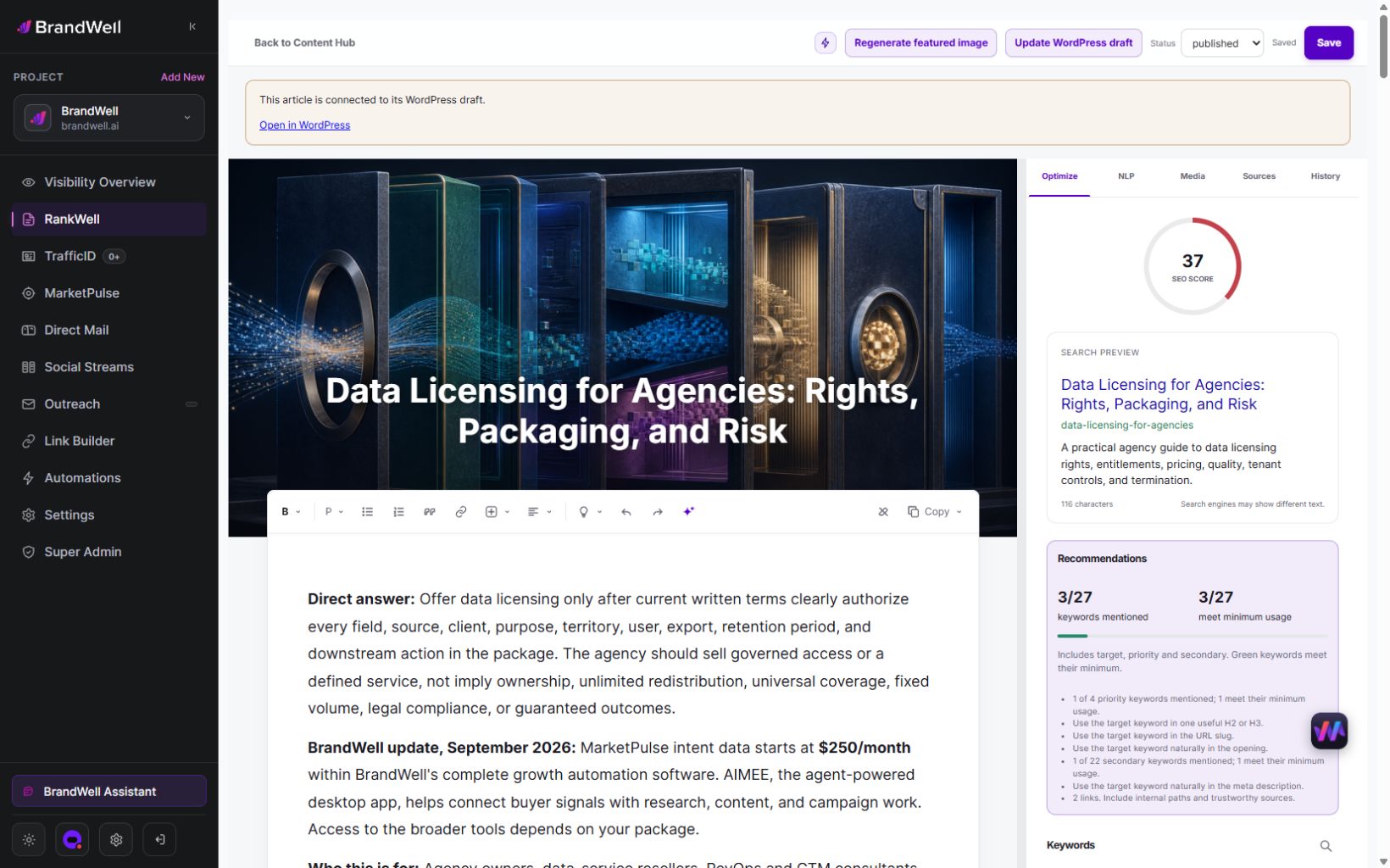
RankWell is BrandWell’s current writing and SEO product. Start with the reader, topic, approved evidence and intended article structure. Prepare a draft, then use the editor to refine the explanation and verify the sources before previewing and publishing through a supported connection.
For an arts-marketing article, an editorial brief might name the institution, intended audience, offer, approved examples and questions the article must answer. Include any image permissions and sources that need checking. Do not let a generated suggestion substitute for the institution’s real experience or an artist’s attribution.
Measure your own process across comparable assignments. Record research, drafting, editing, fact checking, image preparation and publishing time. Keep the article’s scope and reviewer requirements consistent enough to interpret the comparison. Count corrections and quality requirements as well as output.
What this case can and cannot show
The useful lesson is a division of work: use a draft to reduce blank-page effort while retaining human research and editorial review. The historical account can illustrate that approach. It cannot establish a causal ranking gain, a universal doubling of output, a cure for burnout or a current product-performance benchmark.
Explore RankWell and watch the current demo or browse BrandWell’s current products.
Reviewed and updated October 3, 2026.

Written by
Julia McCoy has contributed articles to BrandWell on content marketing, writing, and search engine optimization. This archive retains her original bylines; individual articles may be updated by the BrandWell editorial team.