On this page
- Separate search history from current claims
- Understand what E-E-A-T does and does not mean
- Audit the evidence behind the article
- An original audit example for an IT services guide
- Use images and video to show something verifiable
- Review and maintain the page in BrandWell
- Measure value without inventing attribution
- Frequently asked questions
Generative search can summarize information and link to sources, but an attributed link does not guarantee a visit, lead or sale. A publisher’s practical task is to make its expertise inspectable: explain who created the content, what evidence supports it and what useful work the reader can do next.
That requires more than adding an author bio or publishing more articles. This guide shows how to audit an article for real expertise, useful evidence and a relevant next step in the current BrandWell workflow.
Separate search history from current claims
Google introduced Search Generative Experience as an experiment in 2023. Its current public AI-search page describes AI Overviews and AI Mode. When discussing a particular result, identify the feature actually observed and the date of the observation.
Do not assume that an old demonstration predicts today’s placement or your traffic. A source link, a search impression, a click and a conversion are separate observations. Advertising revenue or a platform’s stated intentions cannot prove that a particular publisher will receive more visitors.
Understand what E-E-A-T does and does not mean
E-E-A-T refers to experience, expertise, authoritativeness and trustworthiness. Google’s December 2022 explanation added experience to its quality-rater framework and emphasized that the relevant kind of experience depends on the topic.
Google’s quality-rater update explains that ratings evaluate search systems and do not directly influence rankings. Treat the framework as a way to assess content, not a score you can raise to buy an AI citation.
For example, a firsthand product walkthrough and a medical recommendation require different evidence and qualifications. An entertaining personal story cannot substitute for specialist review where the advice could affect health, finances or safety.
Audit the evidence behind the article
Make a claim inventory before editing. For each important statement, identify its source, date, scope and reviewer. Distinguish firsthand observations from researched facts and illustrative examples.
- Product facts: check the actual current interface, plan and configuration.
- Research findings: read the primary source and preserve its sample, timeframe and limitations.
- Customer results: retain the underlying records and permission to publish. State the period and method.
- Personal experience: name the actual contributor and describe what they did.
- Examples: label invented scenarios and calculations as hypothetical.
Remove a claim if you cannot establish it. Do not replace an unsupported statistic with another unsourced number or put a generated anecdote in an author’s voice.
An original audit example for an IT services guide
Suppose an IT services business drafts an article about preparing for a backup review. The first draft says, “Our process eliminates downtime and saves every client 40%.” Neither claim has supporting records.
A defensible revision could explain the actual review: confirm which systems are covered, who owns recovery decisions, when restore testing last occurred and which unresolved issues need follow-up. It should state that recovery outcomes depend on the customer’s systems and agreed plan.
The evidence checklist could include an approved process document, a dated screenshot of the relevant settings, and a real specialist’s review. Use sanitized examples; do not expose customer credentials or sensitive infrastructure.
A useful next step might be “Prepare these questions for your backup review” or a request for a consultation. It should follow from the article’s task rather than promise a guaranteed business result.
Use images and video to show something verifiable
Add media when it explains a step or substantiates an observation. A current screenshot with an honest caption is more useful than an unrelated stock image. Include readable text, appropriate alt text and a clear distinction between sample data and customer evidence.
For a video walkthrough, name the actual workflow and keep the written instructions consistent with it. Provide a text explanation so the reader can find the key step without watching the entire recording. Recheck the video when the interface changes.
A video does not establish expertise merely because someone appears on camera. The content, relevant qualifications and supporting evidence still matter.
Review and maintain the page in BrandWell
Use Visibility to investigate search questions relevant to the audience. Choose a topic the business can answer with evidence. A keyword opportunity is a research input, not a claim that a page will rank.
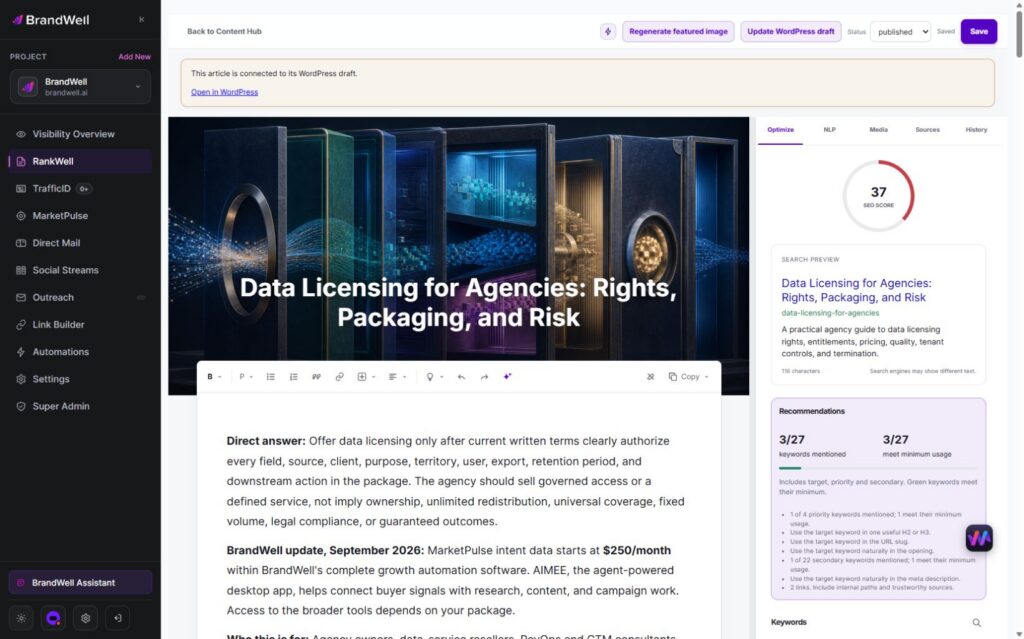
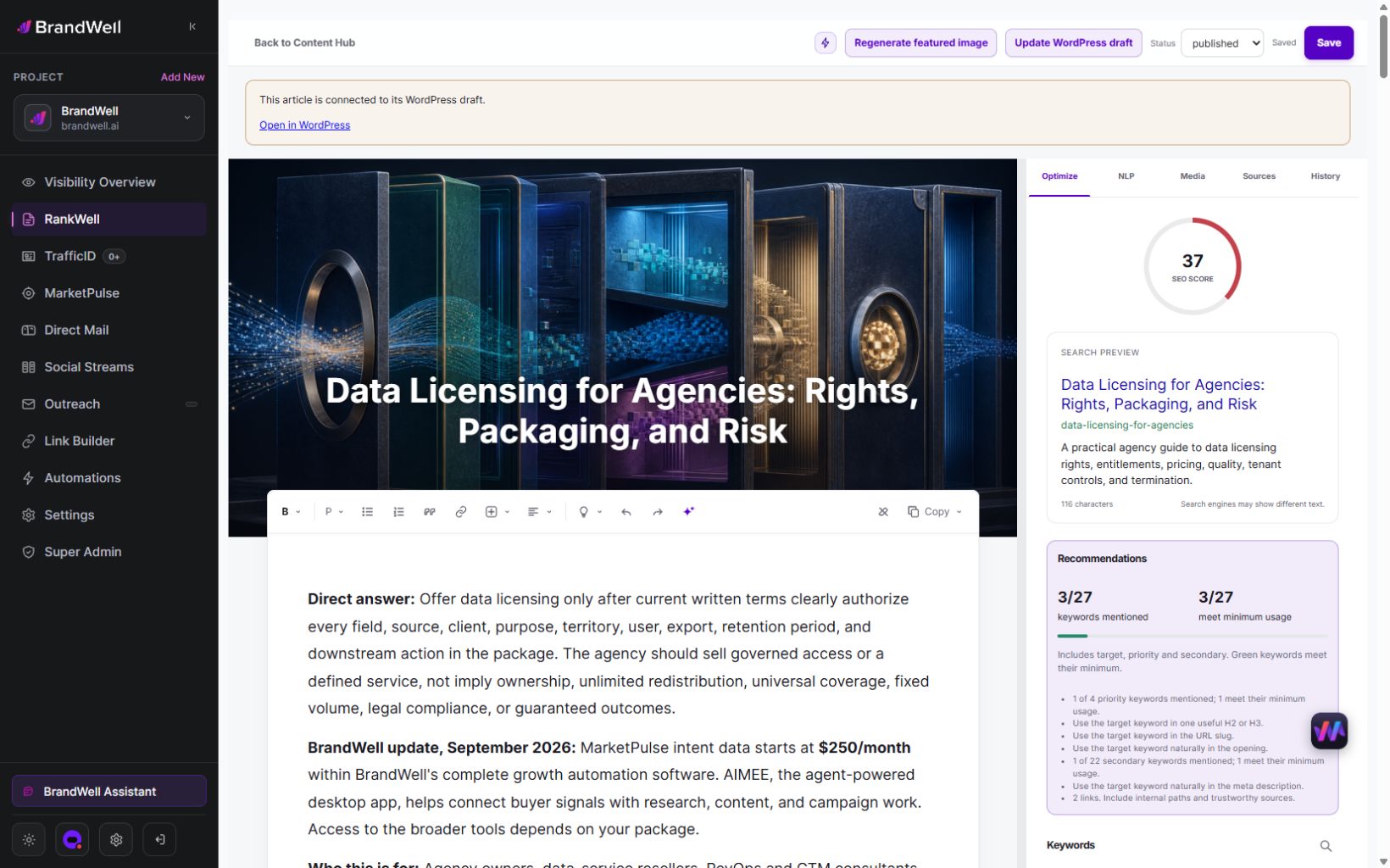
Use RankWell for article preparation and review. Its current Content Hub organizes articles, strategy, queue and calendar work. In the editor, examine the content, search preview, recommendations, media, sources and history.
Add the actual expert’s contribution and approved media. Assign someone to verify facts, pricing and product references, then approve configured publication. Record the update and revisit the page when its sources or product steps change.
Keep BrandWell’s current growth products distinct. RankWell supports content work; MarketPulse provides intent-topic data with plans starting at $250/month. Intent signals do not prove purchase intent or automatically validate an article’s claims.
Measure value without inventing attribution
Preserve the page’s pre-edit search data, then compare later periods using consistent filters. Also examine the reader actions relevant to the page: completing a checklist, requesting information or purchasing are different outcomes.
Hypothetical example: a guide receives 600 visits and 12 consultation requests. That is a 2% request rate. If four meet the business’s agreed qualification criteria, the qualified-request rate is approximately 0.67% of visits. Neither rate proves that AI-search citations caused those requests.
If you want to understand influence, review the available referral and journey records while acknowledging missing attribution. Do not describe ordinary before-and-after movement as a controlled experiment.
Frequently asked questions
Can an author bio guarantee an AI citation?
No. A truthful bio helps readers assess the contributor, but it does not guarantee selection by a search system.
Should every article claim firsthand experience?
No. Use that claim only when it is true. A researched explanation can identify its sources and reviewer without pretending the author performed every activity.
Does using AI remove the need for an expert?
No. A generated draft does not supply firsthand knowledge or specialist accountability. Use an appropriate reviewer for consequential claims.
Explore RankWell to organize articles around evidence, expert review and a useful next step in the current BrandWell portal.
Reviewed and updated October 3, 2026.

Written by
Julia McCoy has contributed articles to BrandWell on content marketing, writing, and search engine optimization. This archive retains her original bylines; individual articles may be updated by the BrandWell editorial team.