On this page
Google’s May 10, 2023 generative-search announcement introduced an experiment called Search Generative Experience (SGE). It did not mean that every search immediately used a completely rebuilt engine. Today, Google’s public AI-search offering includes AI Overviews and AI Mode. For content teams, the useful response is to publish clear, verifiable answers and measure actual visits and outcomes.
This article distinguishes the original announcement from the current search experience, then outlines a practical content review in BrandWell. No formatting tactic, software tool or reference file guarantees inclusion in an AI answer.
What Google actually announced in 2023
In its May 10, 2023 announcement, Google described SGE as an early Search Labs experiment. It presented AI-generated summaries, links for further exploration and follow-up questions. Initial availability was described for English-language users in the US, through Chrome desktop and the Google app.
Those were launch conditions, not today’s universal eligibility rules. The announcement also described existing search systems and additional guardrails. It should not be summarized as replacing all search results overnight.
Its shopping example said listings were refreshed, not that billions of entirely new products were added every hour. Historical inventory figures are not a current measure of shopping coverage or a forecast of traffic to your business.
How the current terminology differs
Google’s current AI in Search page describes AI Overviews as topic snapshots with links and AI Mode as an experience for deeper exploration and follow-up questions. These are the terms to use when discussing current features, while SGE belongs in the history of the experiment.
A feature’s existence does not establish that it appears for every query, account or market. When examining an actual result, record the query, date, location, device and signed-in context. Treat a screenshot as an observation at that time, not a permanent layout.
What changes for an article’s job
A reader may encounter a summary before visiting your page. Give the page a reason to be opened: a useful explanation, original example, clear method, current product detail or evidence they can inspect. Avoid padding an answer with general introductions that repeat the title.
- Answer the question early: explain the central distinction in a short opening paragraph.
- Show your evidence: link claims to primary sources and identify dates, scope and limitations.
- Add something original: provide a worked example, reviewed checklist or real product workflow.
- Make details readable: use descriptive headings, short paragraphs and accessible images.
- Keep the next step relevant: connect the answer to the reader’s task.
These are editorial choices intended to make the page useful. They are not proof that a search engine will cite it, rank it higher or send more traffic.
An original example: a payroll migration question
Suppose a payroll software business wants to explain what a customer should prepare before switching systems. A generic article about the benefits of software gives little help with that task.
A more useful page could begin with a checklist of employee records, current pay schedules and information to confirm with the implementation team. It could then show an illustrative migration timeline, explain which checks depend on the customer’s circumstances and link to current authoritative guidance where specific requirements are discussed.
Label hypothetical timelines as examples. Do not present generated requirements as legal or tax advice, claim integrations the product lacks, or invent a customer outcome. Use an actual product screenshot only where it explains a verified step.
Review the article in BrandWell
Use Visibility for keyword research and opportunity investigation. Check the search question against the actual audience and product. An impression count indicates exposure in search data; it does not prove purchase intent.
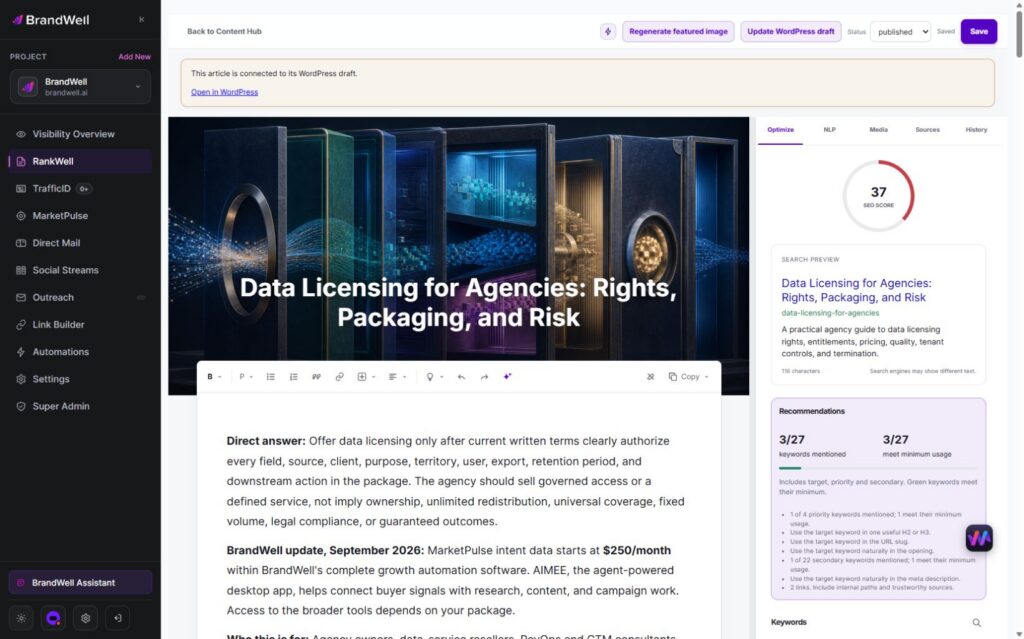
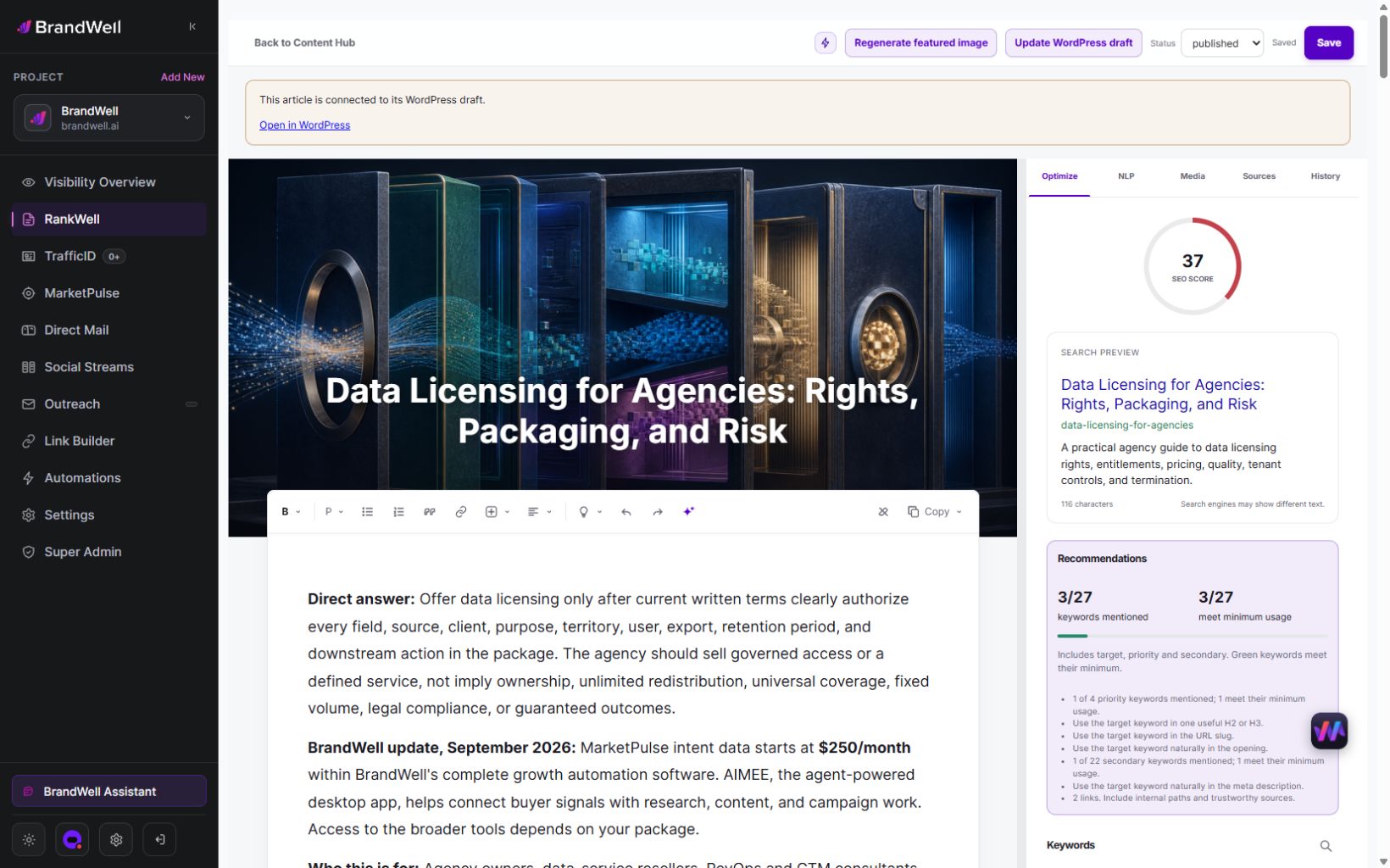
Use RankWell to prepare and review the article. The current Content Hub organizes articles, strategy, queue and calendar work. In the editor, check the draft alongside search preview, recommendations, media, sources and history.
Add verified product details and your original example. Remove unsupported statistics and stale interface instructions. Assign an owner to approve facts, links and images before configured publication. BrandWell helps with the workflow; the business remains responsible for the published claims.
Measure the page after a change
Save the pre-edit search baseline for the exact URL: impressions, clicks, CTR and average position. Keep the reporting period and filters consistent when comparing later data. Review query relevance, device and market differences rather than treating an aggregate change as a diagnosis.
Hypothetical comparison: a page receives 1,000 impressions and 10 clicks in one period, then 1,200 impressions and 18 clicks in another. CTR moves from 1% to 1.5%. That is a 0.5 percentage-point change. It does not establish that an AI feature or the editorial update caused the difference.
Also check meaningful on-site outcomes. A visit to a useful guide, a requested demo and a completed purchase are different events. Keep their definitions stable and avoid counting a click as revenue.
Frequently asked questions
Is SGE still the right name for current Google AI search?
Use SGE when discussing the original experiment. Google’s current public page uses AI Overviews and AI Mode for its AI-search features.
Does being quoted in an AI answer guarantee more visitors?
No. A citation is not the same as a click or conversion. Inspect actual referral and search data before drawing conclusions.
Should we stop creating website articles?
Evaluate your audience’s needs and the page’s actual contribution. Useful documentation, examples and product explanations can support customers beyond a single search result. Measure their outcomes rather than assuming a universal traffic trend.
Explore RankWell to keep article preparation, evidence review and publication work organized in the current BrandWell portal.
Reviewed and updated October 3, 2026.

Written by
Julia McCoy has contributed articles to BrandWell on content marketing, writing, and search engine optimization. This archive retains her original bylines; individual articles may be updated by the BrandWell editorial team.