On this page
- Confirm the client problem before pitching
- Use seven pitch-preparation steps
- Preserve the versioned decision log
- Build seven parts of the pitch
- Current MarketPulse research workflow
- Separate product and agency responsibilities
- Explain scope and full service costs
- Review claims and permission boundaries
- Copyable assistant pitch-preparation brief
- Answers to ten sales-pitch questions
- Review a bounded research workflow
- A copyable pitch based on the client’s actual workflow
- Frequently asked questions
An intent-data pitch should connect a confirmed client prioritization problem to a research input, a reviewed action and a defined evaluation. Sell the actual service scope: how available research will be examined, who can act and how outcomes and costs will be recorded. Claims of faster decisions, better targeting or guaranteed buyers require their own supporting evidence.
Who this is for: Agency founders, new-business teams, account directors, and sales enablement leaders creating a repeatable pitch for intent-data services.
Define the decision intent data is intended to inform. It should never be presented as proof that a person is ready to buy or as permission for an unreviewed action.
Current MarketPulse offer: intent-data plans start at $500/mo. See the product, demo, and current plans. Updated October 3, 2026.
Confirm the client problem before pitching
The pitch should earn the next discovery or validation step. Lead with the client’s current cost of broad targeting, invisible website demand, or untimed outbound. Explain how fit and available research inform a review queue, show what uncertainty remains, and ask whether the client can act and return outcomes.
Use seven pitch-preparation steps
- 1. Open with the client’s current prioritization problem.
- 2. Quantify the cost of the status quo using approved client evidence.
- 3. Explain the signal-to-action workflow in plain language.
- 4. Show a representative evidence card and its limitations.
- 5. Tailor the use case to paid media, outbound, website, ABM, or reporting.
- 6. Present the paid validation, scorecard, non-guarantee, and stop rule.
- 7. Ask for the smallest next commitment needed to verify fit.
Preserve the versioned decision log
Maintain one versioned record from the first client question through the final commercial decision. Record the eligible market, topic definition, signal source, observed time, identity state, validation state, fit decision, suppressions, reviewer, approved next action, downstream disposition, and fully loaded cost. Do not overwrite rejected, expired, duplicated, or corrected evidence. Preserve the original record and add a reason-coded disposition so the agency can explain what changed. Review the log with the client at an agreed cadence, then use the evidence to tighten qualification, remove noisy topics, revise service scope, and decide whether to stop or expand. This operating record is also the source for renewal reporting, exception handling, and any claim about adoption or outcomes. A polished dashboard without this audit trail can hide weak process quality instead of improving it.
The first control for this workflow is: Open with the client’s current prioritization problem. The final control is: Ask for the smallest next commitment needed to verify fit. Those bookends keep the service tied to a buyer decision rather than raw signal volume.
Add a short review note whenever the policy, topic definition, client scope, source, identity rule, activation path, or outcome definition changes. The note should identify who approved the change, which records or clients it affects, and whether earlier results remain comparable. This helps expose process changes that might otherwise be mistaken for performance improvements. It also gives account teams a plain-language explanation when volume, acceptance, cost, or outcomes move between reporting periods.
Build seven parts of the pitch
1. Problem
Name the missed decision, not a generic need for more leads.
Watch-out: Use the prospect’s evidence rather than an invented pain.
2. Status quo cost
Show wasted review, audience, or seller time using a transparent model.
Watch-out: Do not present an estimate as audited fact.
3. Signal
Explain what is observed, from which category of source, and how fresh it is.
Watch-out: Interest is not automatically purchase intent.
4. Identity and fit
Show how account or person context may be added and where uncertainty remains.
Watch-out: Never imply universal person identification.
5. Action
Name the approved next step and human owner.
Watch-out: Avoid automation as the value proposition by itself.
6. Proof plan
Define baseline, scorecard, outcome return, and attribution limits.
Watch-out: A dashboard is not proof.
7. Next step
Offer the bounded paid validation or a qualification workshop.
Watch-out: Do not force a full-plan commitment before evidence.
Current MarketPulse research workflow
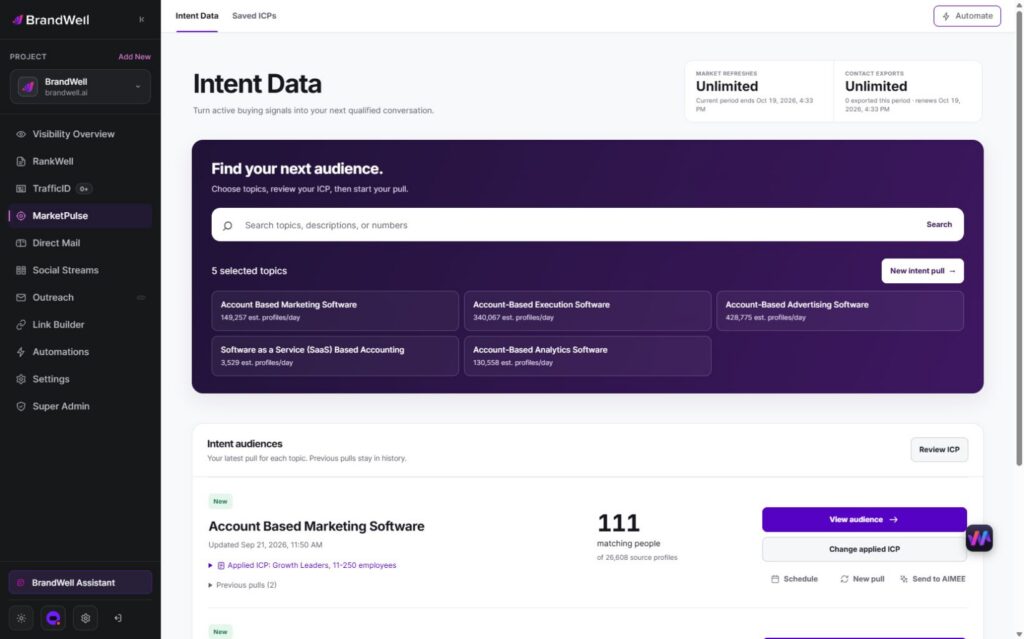
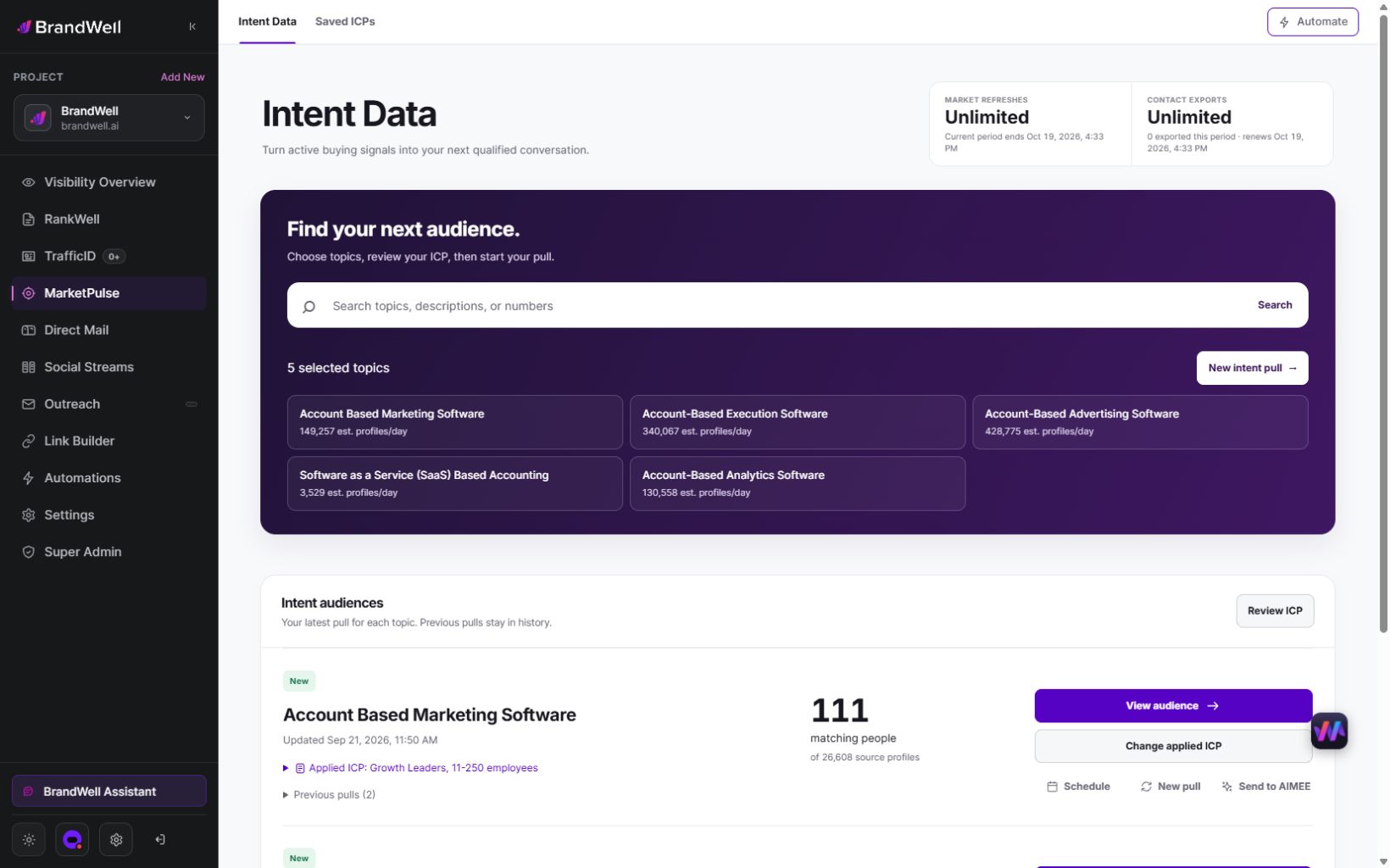
BrandWell MarketPulse: intent data starting at $500/mo. Find people researching topics relevant to what you sell, apply saved ICP filters, and review available contact details before taking action.
MarketPulse plans are starting at $500/mo. Verify current package scope and offers on the product page.
| Plan | Topics and refreshes | Monthly exports |
|---|---|---|
| Starter | 1 topic, weekly | 25,000 contacts |
| Growth | 3 topics, daily | 100,000 contacts |
| Scale | 10 topics, daily | Unlimited contacts |
Swipe the table to see all columns.
A pull retrieves available data from the previous 24 hours for one topic. Daily use across all included topics provides 90 Growth pulls or 300 Scale pulls in a 30-day month. Weekly Starter pulls vary by calendar month. Available audience size and contact fields vary, and audiences may overlap. Refreshes stop at the plan limit without overage charges.
- Find and qualify: search the topic catalog, save your ICP, and review the people and companies that match.
- Act on the research: export qualified contacts or prepare an Outreach or Direct Mail workflow. Connected products, channel usage, and fulfillment may cost extra.
- Get help from AIMEE: Growth and Scale include AIMEE for the initial user to research accounts and prepare the next step through connected tools.
Agencies and other service businesses can build client deliverables around their available Intent Scans and exports. Keep each client’s scope, permissions, and service fees clear. A subscription is not a promise of a white-label platform or exclusive access to a market.
Explore MarketPulse and watch the demo or compare plans starting at $500/mo. Any early-access discount is a separate, time-limited offer shown to an eligible recipient.
Separate product and agency responsibilities
BrandWell MarketPulse is topic-based intent-data software for businesses and agencies. Choose relevant research topics, apply saved ideal-customer-profile filters, review available names, roles, companies and contact details, and export the audience or prepare a connected workflow. Plans start at $500/mo. TrafficID identifies visitors to your own website and is a separate product. A MarketPulse subscription does not by itself promise a white-label portal, custom API implementation, exclusive topics, or managed client delivery.
Review an available MarketPulse topic, saved ICP and actual preceding-24-hour matches for the agreed research purpose. AIMEE can organize supplied company context through configured tools. Agency outreach, custom CRM work, campaign operation and managed delivery require separately verified scope, permissions and fees.
Use the current plan table above for standard topic, refresh and export allowances. Eligible early-access pricing is separate. Put actual agency setup, review, delivery, usage and support costs into a separate client service quote.
Scope the implementation around defined inputs, human review, a client action and actual outcome return. MarketPulse supplies research. Custom CRM joins, managed outreach and branded delivery require separate implementation; a product subscription does not establish those agency capabilities.
Explain scope and full service costs
State the actual setup scope, recurring service fee, tool allowance, usage, review hours, support and exclusions. Separate software, agency services and channel spending. Show assumptions and an agreed cost ceiling; projected margin or saved time is not an audited client result. Define the pilot outcome, observation period, required feedback and stop rule before asking for a full plan.
Use a stop-or-expand scorecard
Sales metrics include qualified discovery, pilot purchase, objection themes, written commitments, pilot-to-plan conversion, sales-cycle time, and expected margin. Client metrics begin after activation: acceptance, SLA, meetings, opportunities, corrections, adoption, and renewal.
Important: Intent signals are probabilistic evidence. They do not prove identity, consent, need, authority, budget, stage, qualification, purchase, pipeline, or revenue. Report association and uncertainty honestly.
Review claims and permission boundaries
Avoid claims of universal buyer identification, guaranteed pipeline or blanket compliance. Describe any exclusivity only when actual written rights support the exact claim. A strong pitch explains where human judgment and client responsibility begin.
Review actual source rights, necessary fields, access, retention and destination permissions for the offered service. FTC advertising substantiation policy addresses support before objective claims are disseminated. A planned pilot cannot substantiate an improvement claim already made in the pitch.
- Preserve source, observed time, identity state, confidence, and validation status.
- Separate known people, candidate people, companies, domains, and unresolved visitors.
- Apply customer, employee, competitor, duplicate, geography, consent, and opt-out suppressions before action.
- Require a named human approval before CRM writes, audience uploads, spend, or outreach.
- Give clients correction, export, deletion, escalation, and offboarding paths.
Copyable assistant pitch-preparation brief
AIMEE can prepare an approved prospect brief through configured connected tools. Keep actual source facts, hypotheses, missing information and proposed terms separate. A named owner approves any personalized message, external sending or change to the offer.
Objective: Draft a pitch from approved prospect evidence, positioning, product truth, written terms, and the planned use case. Label facts, hypotheses, and unknowns. Prepare objection responses and a next-step question. Do not send, personalize with private behavior, or alter terms without approval.
Inputs: approved ICP, topic dictionary, signal source and time, identity state, CRM lifecycle, suppressions, permitted-use policy, and current written commercial scope.
Rules: preserve provenance and uncertainty; never infer budget, authority, consent, or purchase readiness; never expose private behavior in messaging; stop before external action.
Output: decision, reason codes, missing evidence, recommended next step, and audit log.
Keep approved sources, actual capabilities, missing evidence, proposed terms and reviewer together. Reconcile every factual promise against the current product and client scope. An assistant draft is not evidence of buyer need or approval to send.
Answers to ten sales-pitch questions
What should an agency decide before pitching an intent-data service, and what client outcome can it responsibly promise?
The pitch should earn the next discovery or validation step. Lead with the client’s current cost of broad targeting, invisible website demand, or untimed outbound. Explain how fit and available research inform a review queue, show what uncertainty remains, and ask whether the client can act and return outcomes.
What workflow, owners, SLA, quality checks, approvals, and client handoff does an intent-data sales pitch require?
Assign a named agency owner, client owner, operator, and technical or CRM owner. The operating sequence is: 1) Open with the client’s current prioritization problem. 2) Quantify the cost of the status quo using approved client evidence. 3) Explain the signal-to-action workflow in plain language. 4) Show a representative evidence card and its limitations. 5) Tailor the use case to paid media, outbound, website, ABM, or reporting. 6) Present the paid validation, scorecard, non-guarantee, and stop rule. 7) Ask for the smallest next commitment needed to verify fit. Set the response SLA, log exceptions, preserve uncertainty, and require a client handoff with permitted next steps and ownership.
Which platforms, tools, templates, calculators, and integrations best support pitching an intent-data service?
Start with the operating resources described in this guide: Problem, Status quo cost, Signal, Identity and fit, Action, Proof plan, Next step. Support them with a qualification scorecard, topic dictionary, evidence card, cost model, proposal, CRM disposition fields, client report, and approval checklist. Software should support the workflow rather than define it.
How do outcome-led, consultative, feature-led, data-led, and proof-first approaches compare for pitching an intent-data service?
An outcome-led opening names the client decision and desired measure without guaranteeing the result. A consultative opening asks how the client currently prioritizes and acts. A feature-led opening explains actual topic, refresh and export capabilities. A data-led opening shows a representative evidence record and its uncertainty. A proof-first opening presents substantiated results with the actual cohort, method and limitations. Choose the opening for the prospect question; finish each with scope, approval, costs and a bounded next step.
How should the pitch explain the paid pilot, recurring price, cost drivers, client economics, and agency margin without promising results?
State the actual setup scope, recurring service fee, tool allowance, usage, review hours, support and exclusions. Separate software, agency services and channel spending. Show assumptions and an agreed cost ceiling; projected margin or saved time is not an audited client result. Define the pilot outcome, observation period, required feedback and stop rule before asking for a full plan.
Which pitch, pilot, adoption, meeting, opportunity, pipeline, and margin metrics should the agency discuss?
Sales metrics include qualified discovery, pilot purchase, objection themes, written commitments, pilot-to-plan conversion, sales-cycle time, and expected margin. Client metrics begin after activation: acceptance, SLA, meetings, opportunities, corrections, adoption, and renewal.
Which clients are ready for an intent-data sales pitch, and which prospects should the agency exclude?
Agency founders, new-business teams, account directors, and sales enablement leaders creating a repeatable pitch for intent-data services. Best-fit clients also have a clear ICP, sufficient addressable market or qualified traffic, relevant commercial topics, a named action owner, measurable CRM outcomes, conservative economics, and privacy readiness. Exclude clients demanding guaranteed leads, universal identity, prohibited use, or automation without review.
Which signal sources, identity checks, qualification rules, activation steps, and outcome evidence matter most for an intent-data sales pitch?
Combine relevant topic or first-party behavior with fit, recency, recurrence, identity state, enrichment and validation, suppressions, human acceptance, an approved activation path, and outcome return. Keep every evidence type separate so an inference does not become a false fact.
Which data-quality, privacy, security, scope, billing, delivery, and client-trust risks must the agency control for an intent-data sales pitch?
Avoid claims of universal buyer identification, guaranteed pipeline or blanket compliance. Describe any exclusivity only when actual written rights support the exact claim. A strong pitch explains where human judgment and client responsibility begin.
What should the pitch ask the buyer to commit to next, and what should happen before a full plan?
A recurring package should connect the client decision to the operating path described in seven parts of a consultative intent-data sales pitch. Define the eligible market, topics, signals, identity states, qualification policy, branded deliverable, portal or export, action SLA, approvals, usage, pricing, scorecard, governance, support, change control, and offboarding. Expand only after the client uses the first module well.
Review a bounded research workflow
Assess the audience and the operating cost before expanding the service. Explore MarketPulse with the data, tools, and client delivery scope you need.
A copyable pitch based on the client’s actual workflow
How are you deciding which accounts your team should review this week? We can start with one relevant MarketPulse topic and your agreed customer profile, then examine available previous-24-hour matches and public company context. Your team approves which contacts and channels are appropriate. We will record accepted research, actual actions, returned outcomes and the time and cost of the work. The first step is a bounded review of whether this fits your process; we will define the fee and stop rule before expanding.
Replace the opening with the client’s own stated problem, not an inferred private browsing claim. For own-site demand, describe TrafficID separately. AIMEE can organize supplied context through configured tools; do not promise an unverified custom portal, integration or autonomous campaign. Use the actual plan table and written scope rather than implying every prospect receives early-access pricing.
Worked example: time released is not cash saved
Assume a fictional team reviews 100 accounts at ten minutes each: 1,000 minutes. A proposed research workflow would review those accounts at six minutes each: 600 minutes. The difference is 400 minutes, or six hours and 40 minutes. At a $60 hourly planning rate that is $400 of potential capacity value, not demonstrated savings. Until comparable work is timed, the six-minute assumption is unverified; if payroll stays fixed, released time does not automatically reduce cash expense.
If the workflow separately costs $250 in software allocation, three preparation hours at $60 and $70 in support, total cost is $500. Against the assumed $400 capacity value, the difference is negative $100 even before acquisition, general overhead, tax and financing. Additional client outcomes may matter, but measure them rather than claiming that time alone pays for the service. These invented inputs are not typical BrandWell results or agency fees.
Keep proposal and outcome cohorts separate
Suppose 20 qualified discoveries produce eight pilot proposals, four paid pilots and three recurring-service purchases within the stated window. Proposal rate is 40% of discoveries; paid-pilot rate is 50% of proposals or 20% of discoveries; recurring purchase is 75% of pilots or 15% of discoveries. Report these counts with actual dates and terms. They do not demonstrate that a particular pitch caused the purchases or that the client pilot improved pipeline.
Frequently asked questions
Is estimated time value the same as cash savings?
No. Verify comparable work and actual cost changes separately.
Should a pitch describe private research as a known buyer fact?
No. Preserve source meaning and uncertainty.
Does a pilot promise a guaranteed improvement?
No. Define the evaluation, fee, outcomes and stop rule.
Is an agency service fee included in a MarketPulse plan?
Do not assume that. Quote the actual service scope separately.
Review the research product: explore MarketPulse and current plans.
Reviewed and updated October 3, 2026.

Written by