On this page
- Current TrafficID workflow
- Define the decision and identity states
- Assign owners, tests and handoffs
- Choose tools that preserve uncertainty
- Compare manual, assisted and branded delivery
- Price installation and recurring review
- Measure the state reached
- Adapt the package to client readiness
- Preserve website and enrichment sources
- Control data, delivery and expectation risks
- Maintain the recurring visitor service
- Explain tracking without promising universal identification
- Worked example: do not mix visit and account units
- Frequently asked questions
Direct answer: Package website visitor identification as an identity-state and action-readiness service. Keep observed activity, company match, possible person match, validated contact, qualified account, and approved action as separate states. Deliver the strongest state the evidence supports, not the most exciting label a salesperson might infer.
Review current TrafficID plans, eligible identified-visitor volume and the selected fixed or dynamic billing mode before budgeting. TrafficID and MarketPulse have separate product scope. Verify current allowances and included tools on the product page.
The agency’s value is not merely revealing profiles. It is creating an honest, governed path from first-party site activity to a client-approved decision, while handling notice, access, retention, suppression, correction, and jurisdiction-specific requirements.
Who this is for: Agencies, RevOps consultants, and demand generation teams offering visitor identification, account intelligence, or signal-to-outreach services. It is not a substitute for legal advice, a client’s privacy program, or proof that a named person viewed a specific page.
Current TrafficID workflow
TrafficID identifies available website visitors and captures submitted form identities. Review their company and page context, apply account suppressions and keep additional Stakeholder Audience contacts distinct from observed visitors.
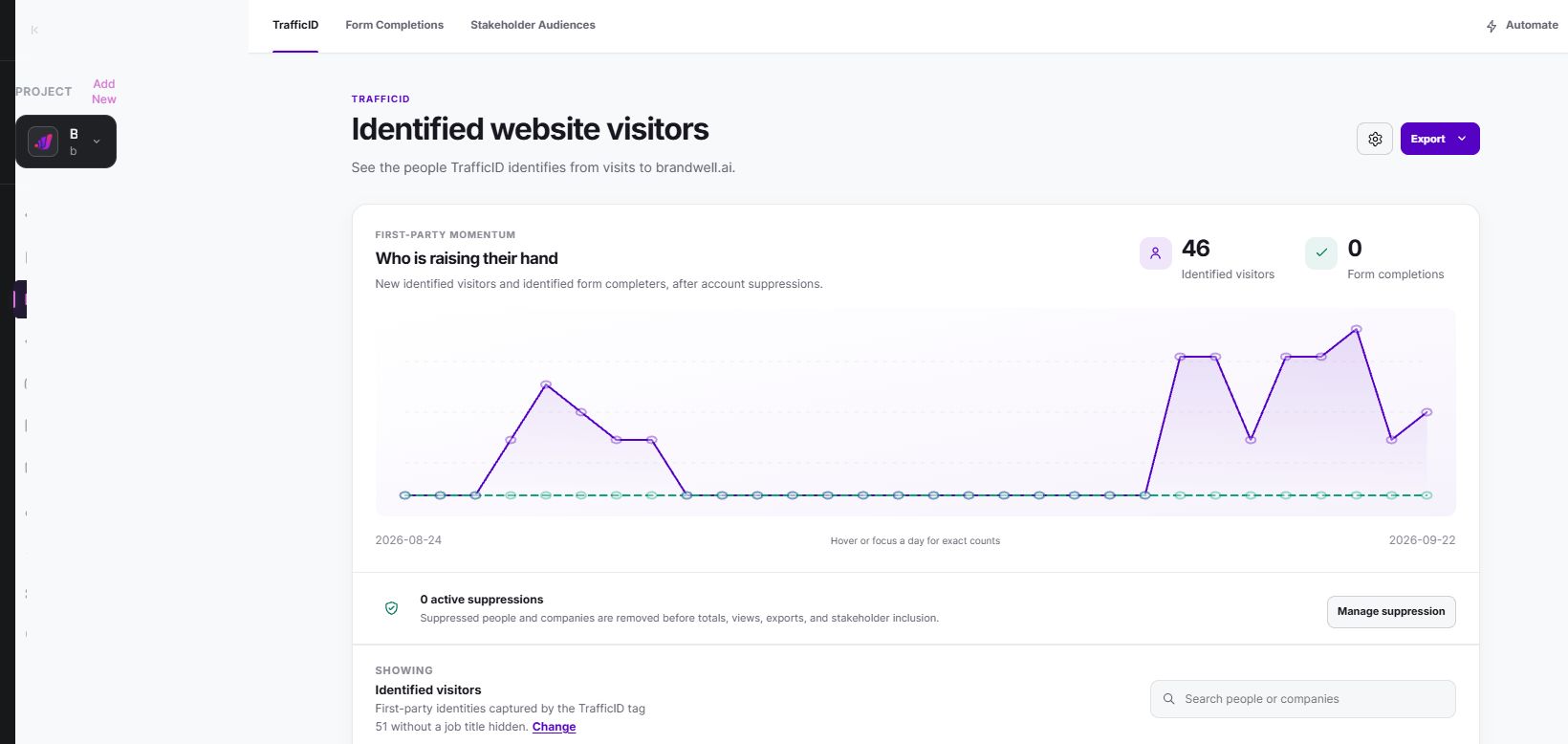
Review current TrafficID plans, eligible identified-visitor volume and the selected fixed or dynamic billing mode before budgeting. TrafficID and MarketPulse have separate product scope. Verify current allowances and included tools on the product page.
Identification depends on available matching data and site conditions; not every visitor is identified. Supported exports and connected workflows need the appropriate access. Direct Mail requires eligible verified addresses, approved creative and an authorized budget. Channel usage and fulfillment can cost extra.
Explore TrafficID and current pricing. MarketPulse topic audiences are a separate source for research into your market, not evidence of visits to your own site.
Define the decision and identity states
Choose one approved client decision. Examples include alerting an account owner about a qualified company visit, preparing a research task, reviewing an account for advertising, or drafting a message for human approval. Do not begin by sending every possible identity into a CRM. That creates noise, ambiguity, and unnecessary data handling.
Define the identity-state ladder before installation. A site event can exist without a company match. A company match can exist without a person match. A possible person match can exist without a validated business contact. A validated contact can still be outside the client’s ICP or prohibited from a proposed use. These distinctions need visible fields in the service output.
Set first value as an accepted delivery whose state, source, qualification, and next action the client understands. The initial sample should include matched, unmatched, ambiguous, suppressed, and rejected cases. A repeatable service shows how each case is handled instead of displaying only the strongest examples.
Copyable identity-state receipt
Record tenant ID, event ID, source page category, observed time, eligible-event rule, company state, possible person state, contact validation, account-fit result, suppression result, permitted action, destination, client owner, reviewer, delivery receipt, retention trigger, and correction status. Include a plain-language limitation that can remain attached to the record downstream.
Decide what the service will not do. Examples might include identifying employees, using sensitive page categories, activating possible person matches, exporting unvalidated contacts, or contacting anyone without client approval. Explicit exclusions make training, testing, and sales conversations easier.
Use the agency visitor identification launch process to align installation, client purpose, audience, destinations, and approval. Do not enable an activation merely because the technical connector works.
Assign owners, tests and handoffs
The eight-state identity and action ladder
- Observe: record an eligible first-party site event with approved context and timestamp.
- Match company: associate the event with a company where supported, preserving uncertainty.
- Resolve possible person: label a possible person association only when available and never upgrade it silently.
- Validate contact: check required contact fields and validation state for the approved use.
- Qualify: apply client ICP, customer, partner, competitor, employee, geography, suppression, and intent rules.
- Approve action: choose a permitted client play and require the designated human approval.
- Deliver: route the record with its identity state, source, evidence, owner, and delivery receipt.
- Correct or suppress: handle client feedback, data subject processes, incidents, and future suppression.
Assign an installation owner, privacy or policy owner, operations reviewer, client business owner, destination administrator, and action approver. Define SLA clocks for eligible-event review, delivery, correction acknowledgement, urgent suppression, and incident escalation. Pause the clock when a required client approval or client-owned system is unavailable.
Quality sampling should cover every identity state, not just resolved records. Test a wrong domain, shared network, employee visit, customer visit, competitor, bot-like pattern, duplicate, stale event, invalid contact, suppressed person, revoked destination, and missing tenant context. Record the expected and actual result.
Run an incident rehearsal before live delivery. Simulate a cross-tenant route, a mistaken person association, a client request for urgent suppression, and a destination that accepted the wrong fields. Confirm who can pause service, how evidence is preserved, how downstream copies are located, who communicates with the client, and what must pass before resumption.
Choose tools that preserve uncertainty
The service stack needs first-party event capture, company identification, optional person or contact resolution, validation, client qualification, approved delivery, and a correction ledger. Evaluate components by the states and controls they preserve, not only by the number of records they can return.
- Installation register: site, approved purpose, owner, tag version, environments, notice review, and rollback.
- Identity-state receipt: event ID, observed time, company state, possible person state, contact validation, confidence or limitation, and source lineage.
- Qualification rules: ICP, customers, employees, partners, competitors, geography, exclusions, frequency, and action readiness.
- Review queue: separates eligible, ambiguous, suppressed, stale, duplicate, invalid, and incident states.
- Delivery connector: uses client-scoped credentials, approved fields, destination receipts, retry controls, and rollback.
- Governance log: records access, changes, approvals, retention, corrections, deletion, and incidents.
A client portal should show what is known, what is inferred, and what remains unavailable. Hiding uncertainty behind a single profile card makes the service easier to demo but harder to govern. The best template is one that helps an account owner decide what to do without overstating who did what.
Compare manual, assisted and branded delivery
A manual review service is appropriate for a first deployment, a sensitive client, or a low-volume site where context matters. Rules-assisted automation can normalize events, apply exclusions, validate fields, and prepare a review queue. A white-label managed service gives the agency a branded recurring client experience while retaining back-office controls.
| Approach | Strength | Best fit | Primary risk |
|---|---|---|---|
| Manual review | Context and careful interpretation | Discovery, low volume, or higher sensitivity | Slow delivery and operator inconsistency |
| Rules-assisted | Repeatable filtering and faster handoffs | Stable identity states and approved rules | Silent errors if monitoring is weak |
| White-label managed | Branded service with recurring operations | Agencies owning review, support, and reporting | Unclear accountability behind the branded surface |
Swipe the table to see all columns.
Automate deterministic checks before probabilistic or policy-sensitive decisions. A system can test a required field or approved suppression rule. A person should review ambiguous identity, new uses, sensitive categories, legal or policy conflicts, external messaging, and changes to the client’s promise.
Price installation and recurring review
Setup includes discovery, site and tag work, purpose and notice review, identity-state design, qualification rules, destination mapping, negative testing, branding, client training, and acceptance. Recurring delivery includes platform allocation, event and identity review, validation, exceptions, reporting, support, corrections, governance, and integration monitoring.
Visitor identification cost worksheet
Setup cost = discovery + technical installation + policy review coordination + rules + testing + training.
Recurring cost = platform allocation + review + validation + exceptions + reporting + support + governance + risk reserve.
Change cost = new site or use + rule update + notice and policy review + testing + documentation + approval.
Price through operational drivers such as sites, traffic bands where applicable, identity depth, qualification, cadence, destinations, customization, support, and governance. The visitor identification pricing guide helps separate installation from monthly service.
Measure the state reached
Measure time from approved installation to a tested eligible event, and from that event to the first accepted delivery. Report event eligibility, company match state, possible person state, contact validation, account-fit acceptance, suppression, duplicate rate, exception age, correction rate, delivery success, and unresolved incidents.
Do not present one blended identification rate when identity states differ. Show the denominator and the state reached. Separate technical capture, company association, possible person association, validated contact, qualified account, and action-ready delivery. A lower count with honest states can be more useful than a larger count that cannot support the client’s action.
Adoption includes reviewed records, assigned owners, feedback, approved actions, and resolved corrections. Downstream replies, meetings, opportunities, and revenue belong in a separate outcome layer with the client’s definitions, time window, and attribution caveats.
Adapt the package to client readiness
For a client with limited RevOps capacity, begin with a curated company-level report and a weekly review. For a client with reliable CRM routing and suppression, add structured qualification and destination delivery. Add possible person or contact workflows only when the client has a supported purpose, approved policy, clear identity language, and a capable action owner.
A useful package ladder is visibility, qualification, and activation support. Visibility explains eligible company activity and limitations. Qualification adds ICP, customer, territory, exclusion, and owner logic. Activation support prepares approved research, account alerts, audience review, or outreach drafts for human approval.
Do not use maturity as a reason to remove controls. Every package needs a client purpose, state labels, scoped access, retention, suppression, correction, incident handling, owners, and evidence. Higher maturity adds integrations and actions, which increases the need for reliable controls.
For each package, publish an input and output contract. State which sites and events are eligible, which identity states may appear, which fields can be delivered, what the agency reviews, what the client must approve, and what happens when evidence is insufficient. This is more useful than a vague promise to identify website visitors.
Preserve website and enrichment sources
First-party site activity is the starting event. Company identification, possible person association, business-contact data, email or phone validation, CRM context, and third-party topic activity are separate evidence sources. Preserve their timestamps and lineage. Do not merge them into a claim that a named person visited unless that claim is actually supported and approved.
Use company fit and action capacity before person-level enrichment. A qualified account alert may be enough for research or advertising review. When a person or contact is involved, validate the required fields, show the identity state, apply suppressions, and choose a permitted action. The safest default for an ambiguous identity is review or no action.
Connect outcome evidence through event, account, identity-state, delivery, action, and CRM identifiers. Store the client decision and later correction. This allows the agency to improve qualification without rewriting historical evidence.
Control data, delivery and expectation risks
Risks include unclear notice or purpose, unsupported identity claims, cross-client exposure, excessive collection or retention, unscoped access, sensitive uses, weak suppression, stale or invalid contacts, incorrect destinations, silent connector failures, and outcome guarantees. Laws and platform requirements vary by jurisdiction and use. Use qualified counsel for specific legal advice.
Maintain a written purpose, limited fields, client-scoped access, appropriate security, retention and correction responsibilities. Assess the actual jurisdiction, source terms and use with qualified reviewers. These proposed operating controls are not a universal compliance finding.
Build the client service around data minimization, least-necessary access, explicit retention, vendor and integration oversight, secure transfer, correction, deletion where applicable, and incident response. The broader agency intent-data compliance program should govern the service before activation begins.
Document the responsibility boundary in plain language. The agency should know which controls it operates, which platform controls it relies on, and which client decisions it cannot make. The client should know that using a record in advertising, outreach, scoring, or another workflow may create additional obligations. Review new data sources, destinations, and uses as changes, even when the original installation is unchanged.
Do not market the service with hidden tests or unsupported precision claims. Use representative examples, show multiple identity states, explain limitations, and keep evidence for statements about how the service works. Trust grows when a buyer can see both the useful capability and the boundary.
Agent-ready visitor-event triage
Role: Prepare a client-scoped visitor-event review without upgrading identity.
Inputs: approved purpose, event record, company state, possible person state, contact validation, ICP rules, suppressions, action policy, jurisdiction and policy notes, and destination status.
Tasks: preserve each state; apply approved qualification; flag ambiguity; propose no action, research, alert, audience review, or outreach draft; record evidence and limitations.
Never: infer identity beyond evidence, remove a suppression, expose another tenant, publish, contact a person, or claim compliance.
Stop when: purpose, notice, tenant, identity state, jurisdiction, sensitive use, authorization, or destination is unclear.
Output: draft decision receipt for human review.
Human approval: required before export, activation, outreach, configuration, or client claim.
Maintain the recurring visitor service
Include approved installation, client purpose, identity-state definitions, qualification and suppression, scoped access, branded delivery, human review, action policy, correction and deletion paths, incident handling, integration monitoring, support, evidence reporting, and renewal criteria. Make limitations part of the product, not a footnote.
AIMEE can help research a reviewed visitor record and prepare a proposed handoff through configured connected tools. Preserve the source and available visit context, and retain the designated approval for an external action.
TrafficID supports reviewed website activity and stakeholder research. Custom client portals, reporting, integrations and an agency-managed service need their own supported implementation and written scope. Do not present additional stakeholders as if they visited the website.
Review the identity-state definitions with sales and delivery together. The same language should appear in proposals, reports, training, and correction workflows.
Make identity state the center of the offer
Before sending a sample, document what each state means, run negative tests, and show the client which actions are permitted at each rung. Honest states create a service that can be improved instead of a reveal that must be defended.
Explain tracking without promising universal identification
The FTC’s 2017 cross-device report announcement highlights transparency, choice and security. It is historical guidance about a related practice, not a finding that a specific visitor-identification service complies with current requirements. Review the actual technology, notices, jurisdiction and planned use.
Explain the data path to the client: what event is observed, what identity is associated, what separate enrichment adds and which proposed action is permitted. A valid email field does not independently prove a visit, buying authority or permission for every channel.
Worked example: do not mix visit and account units
In a fictional period, a site records 1,000 eligible visits. Its output contains 250 distinct identified people associated with 100 candidate companies. After account qualification, 60 companies fit and the client accepts 40 for research. Fit is 60 / 100 = 60% of candidate companies; acceptance is 40 / 60 = 66.7% of fitting companies, or 40% of all candidate companies.
Do not call 250 people divided by 1,000 visits a visitor-identification rate: people and visits are different units, and people may return. To calculate an event-level match rate, separately count identified eligible visit events against all eligible visit events under the same definition and period.
Assume $99 in software, $400 in review and $100 in reporting and support. Defined cost is $599, or $14.98 per accepted company. These invented figures are not typical results or an all-inclusive service quote; setup, additional integrations, usage, fulfillment and other expenses can increase cost.
Build a reviewed visitor brief
Check the reported tracking-tag setup for the Company Project. Review identified visitors and captured forms in their separate views, apply suppressions, and research relevant company fit. If using a Stakeholder Audience, label added decision makers separately. AIMEE can help prepare the company brief through configured tools; the responsible owner decides whether a supported Outreach or eligible postcard workflow is appropriate.
Frequently asked questions
Does TrafficID identify every visitor?
No. Available matching data and site conditions affect identification.
Are enriched stakeholders confirmed visitors?
No. They are additional company contacts and must remain distinct from observed visitors.
Does a valid contact field prove permission to send?
No. Review the purpose, channel, suppression and applicable requirements separately.
Is a custom branded client portal included?
Custom client access and agency delivery need separately confirmed capability, implementation and rights.
Evaluate the website-data input: explore TrafficID and current plans.
Reviewed and updated October 3, 2026.
MarketPulse plans are starting at $500/mo. Review current package scope, usage and any separate product or service costs before purchase.

Written by