On this page
- Current MarketPulse workflow
- Choose a client decision to support
- Assign state and handoff owners
- Evaluate the supported dashboard stack
- Compare build, resell, refer and avoid
- Price delivery and exception work
- Preserve action and outcome evidence
- Choose clients with a recurring decision
- Keep signal and identity states separate
- Control access and expectation risks
- Maintain the recurring dashboard package
- Make status understandable without color alone
- Worked example: reviewed records are not dashboard conversions
- Frequently asked questions
Direct answer: Productize client-facing lead and intent dashboards only when each displayed signal has a defined identity state, owner, next action, evidence receipt, and correction path. Sell the governed workflow around the dashboard, not a collection of charts. A dashboard can organize evidence and decisions. It cannot prove that the service caused pipeline or revenue.
Current MarketPulse offer: intent-data plans start at $500/mo. See the product, demo, and current plans. Updated October 3, 2026.
The strongest client promise is operational: put eligible signals into a controlled queue, make uncertainty visible, assign action, and report what was delivered, accepted, corrected, and returned. If the screen has no accountable user or action, a scheduled report may be the better product.
Who this is for: Agencies deciding whether to build, resell, refer, or avoid a client-facing lead and intent dashboard offer. It is not for teams without tenant controls, client action owners, or a defined evidence-to-action workflow.
Current MarketPulse workflow
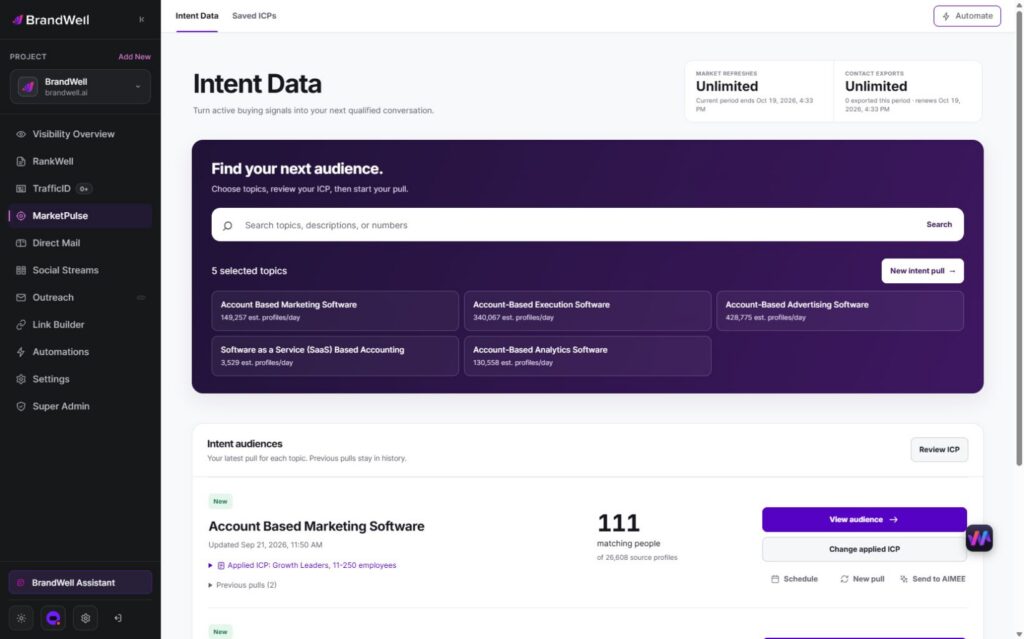
BrandWell MarketPulse: intent data starting at $500/mo. Find people researching topics relevant to what you sell, apply saved ICP filters, and review available contact details before taking action.
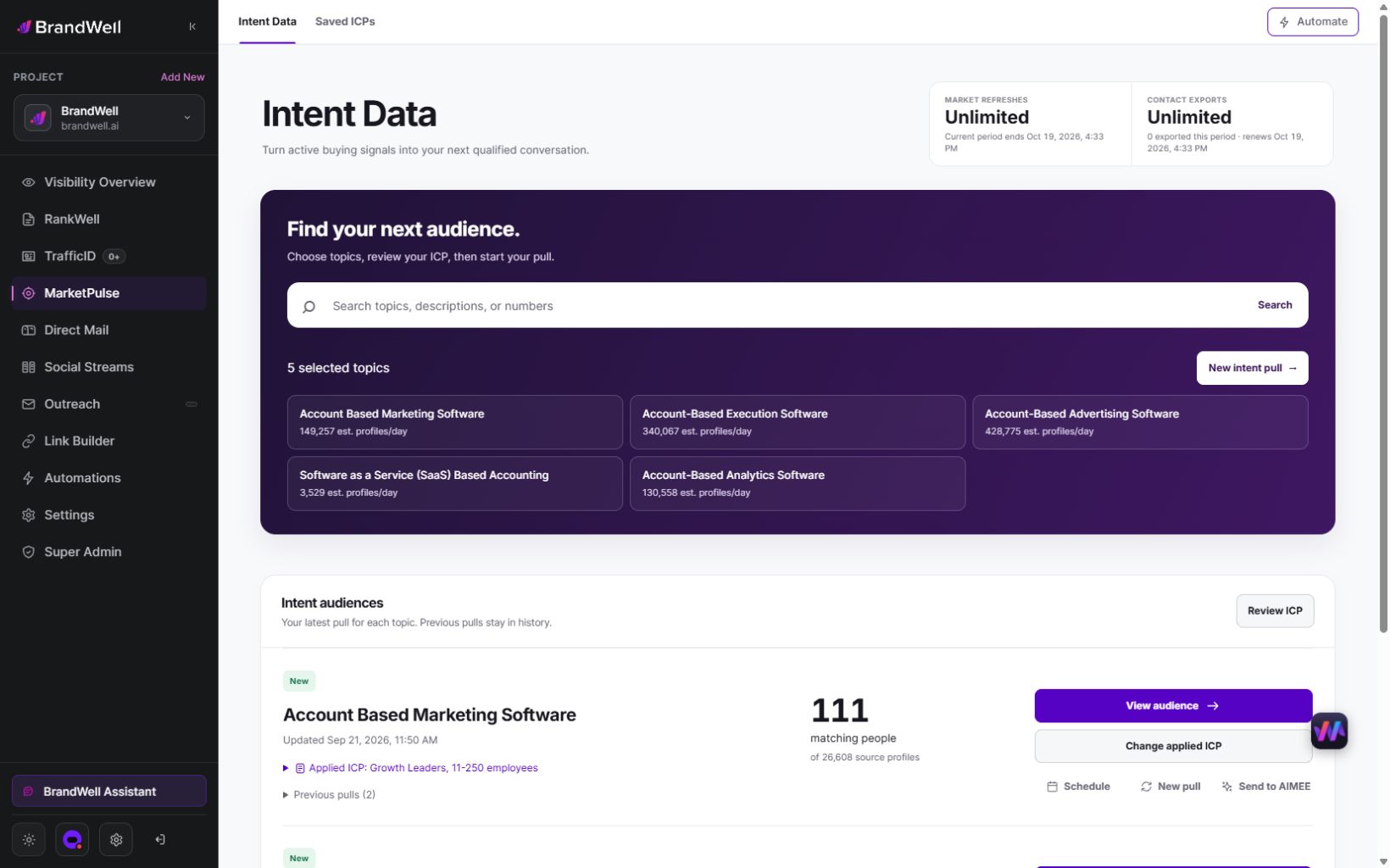
MarketPulse plans are starting at $500/mo. Verify current package scope and offers on the product page.
| Plan | Topics and refreshes | Monthly exports |
|---|---|---|
| Starter | 1 topic, weekly | 25,000 contacts |
| Growth | 3 topics, daily | 100,000 contacts |
| Scale | 10 topics, daily | Unlimited contacts |
Swipe the table to see all columns.
A pull retrieves available data from the previous 24 hours for one topic. Daily use across all included topics provides 90 Growth pulls or 300 Scale pulls in a 30-day month. Weekly Starter pulls vary by calendar month. Available audience size and contact fields vary, and audiences may overlap. Refreshes stop at the plan limit without overage charges.
- Find and qualify: search the topic catalog, save your ICP, and review the people and companies that match.
- Act on the research: export qualified contacts or prepare an Outreach or Direct Mail workflow. Connected products, channel usage, and fulfillment may cost extra.
- Get help from AIMEE: Growth and Scale include AIMEE for the initial user to research accounts and prepare the next step through connected tools.
Agencies and other service businesses can build client deliverables around their available Intent Scans and exports. Keep each client’s scope, permissions, and service fees clear. A subscription is not a promise of a white-label platform or exclusive access to a market.
Explore MarketPulse and watch the demo or compare plans starting at $500/mo. Any early-access discount is a separate, time-limited offer shown to an eligible recipient.
Choose a client decision to support
Offer the dashboard when the client has a recurring decision that current reports fail to support. Examples include deciding which eligible accounts need review, seeing why a record qualified, assigning follow-up, and returning an outcome. The dashboard should reduce ambiguity and handoff friction. It should not promise that viewing a card produces a sale.
Write the promise in workflow terms: “The service presents eligible signals with their source, entity state, confidence, qualification reason, owner, and evidence, then tracks approved action and correction.” That sentence can be tested. “The dashboard generates pipeline” cannot be isolated from the client’s targeting, offer, sales execution, timing, and other channels.
Choose a report instead when users only need a periodic summary. Choose CRM views when all work already happens in the CRM and a separate portal would duplicate state. Avoid the offer when the client has no data owner, no action owner, no identity definitions, or no way to handle correction and suppression.
Assign state and handoff owners
Begin with the client decision, then write a data contract for every state shown. Name the signal source, entity type, confidence, freshness, owner, permitted action, destination, correction, and retention rule. Configure the interface only after the contract is accepted. Run delivery through a documented intent-data delivery SOP so a visual change cannot silently change the underlying service.
Seven-state evidence-to-action dashboard model
- Signal: display what was observed, its source, observation time, and freshness rule.
- Company: resolve the organization and preserve the company-match confidence.
- Person or contact: keep person identity and contact validation separate from the company.
- Qualification: apply visible client rules and preserve the reason, version, and reviewer.
- Action: assign an owner, approved channel, due state, and stop condition.
- Receipt: record what was delivered, accepted, rejected, changed, or corrected.
- Outcome: record the downstream state without turning association into causal proof.
Staff the service with a data owner, workflow operator, QA reviewer, client action owner, integration owner, and account lead. Define the SLA around controllable transitions, such as eligible-to-reviewed or approved-to-delivered. Connect the controlled workflow to the client system through a planned CRM and marketing-stack integration, including retry, duplicate, field-map, authentication, and rollback tests.
The client handoff should include a data dictionary, role matrix, state definitions, sample accepted and rejected records, support path, correction process, export rules, and a signed acceptance test. Train users with real decision scenarios rather than a feature tour. A user should know when to act, when to ask for review, and when to stop.
Evaluate the supported dashboard stack
The best stack is the one that satisfies the client’s workflow, data, governance, and support criteria. This is not a company listicle. Evaluate capability layers with the same acceptance tests: signal and identity, data model, portal or embedded analytics, CRM action, access control, export governance, audit evidence, and support.
- Signal and identity: source, entity, confidence, freshness, validation, suppression, and correction.
- Data model: explicit state definitions, versioned rules, unique keys, history, and reconciliation.
- Portal or analytics: tenant-scoped views, client branding, accessible presentation, and sensible empty states.
- Action layer: owner assignment, approved destinations, receipts, retry, and human approval.
- Governance: least privilege, exports, retention, deletion, audit, and incident handling.
- Operations: provisioning, monitoring, support, change control, and offboarding.
Test with two tenants, two users with different roles, ambiguous identities, stale evidence, a broken integration, an export request, a correction, and an offboarding case. A polished screen that cannot expose a rule version, receipt, or correction is not sufficient. Verify every named capability and price against current first-party documentation and written terms.
Also test the empty state. It should explain whether no eligible signal exists, data is delayed, a filter excludes records, or the integration failed. Those conditions need different responses. A blank card without an operational reason invites the client to assume the system has no value or, worse, that unseen data is being hidden.
Compare build, resell, refer and avoid
Build when the workflow is strategically distinctive, the agency can support engineering and security, and client requirements justify control. Resell when a governed platform covers the required states and the agency’s differentiation is service design, activation, and client expertise. Refer when the client needs software but the agency does not want data and support responsibility. Avoid when another interface adds no useful decision.
| Path | Best fit | Agency still owns | Main limitation |
|---|---|---|---|
| Build | Distinct workflow and durable technical capacity | Engineering, security, support, uptime, and roadmap | Slow launch and ongoing maintenance |
| Resell | Repeatable branded service with a fitting platform | Scope, configuration, QA, client billing, and claims | Wholesale, usage, entitlements, and vendor dependency |
| Refer | Client wants software ownership | Honest recommendation and clean handoff | Less control over experience and recurring service |
| Avoid | Report or CRM view already solves the job | Explain the simpler alternative | No dashboard revenue, but less unnecessary complexity |
Swipe the table to see all columns.
Compare all four on launch effort, differentiation, workflow control, tenant isolation, integrations, support, change speed, data responsibility, recurring economics, and exit. There is no universal winner. A reseller option can be right for one client and a report right for another.
Price delivery and exception work
Charge from scope and cost to serve. Setup can include discovery, state definitions, tenant configuration, branding, integrations, acceptance testing, training, and launch support. Recurring scope can include platform and usage, data review, weekly triage, monthly reporting, QA, support, corrections, access administration, and change requests.
Dashboard pricing and margin worksheet
Record agency retail revenue; platform and usage; recurring operator, QA, support, and account-management hours; integration maintenance; exception reserve; credits; and direct delivery cost. Defined contribution percentage = (agency retail revenue – direct delivery cost) / agency retail revenue. Define what counts as direct delivery cost and run low, expected, and high usage and exception cases.
No gross-margin percentage is realistic for every client-facing lead and intent dashboard. The result changes with user count, topic count, sources, integrations, cadence, support, and custom work. The agency chooses and collects its retail price. Verify every wholesale or usage input in current written terms. If pricing is quote required, keep it quote required rather than manufacturing a market estimate.
Preserve action and outcome evidence
Prove the workflow first. Measure freshness compliance, company and person identity acceptance, contact-validation state, qualification acceptance, assignment, time to action, delivery receipts, user adoption, corrections, and outcome feedback. A dashboard that cannot show whether a record was seen, accepted, assigned, or corrected cannot support a credible business-impact discussion.
Then record opportunity and revenue association with a clear window, prior account status, other active channels, and the client source of truth. Show the denominator and missing outcomes. Compare cohorts only when definitions and observation windows match. Do not count an opportunity twice because it appears in both the CRM and dashboard.
A practical review separates leading service indicators from lagging business outcomes. The first group helps the agency fix delivery now. The second helps the client decide whether the workflow remains worth operating. Neither proves causation by itself. A dashboard is an evidence surface, not an experiment design, and it cannot guarantee pipeline, revenue, sales, or profit.
Keep a measurement specification beside the dashboard. For each metric, state the event, field, denominator, owner, inclusion and exclusion rules, reporting window, and late-data policy. When a definition changes, version it and avoid comparing the new series with the old one as if nothing changed. This makes the reporting reproducible.
Choose clients with a recurring decision
Best-fit clients have repeatable signal sources, a defined account market, clear identity and qualification rules, a CRM or other approved destination, named users, an accountable action owner, and a recurring decision that a dashboard can improve. They also accept data-use, access, export, retention, suppression, and correction controls.
Exclude or reduce scope for a client with no workflow owner, no accepted-record definition, mostly one-off needs, weak data rights, unmanaged exports, no response to corrections, or an expectation that a score proves buyer status. Also avoid creating a second source of truth when the client’s CRM already supports the required view and actions.
Use a short qualification check: What decision will the dashboard change? Who acts? Which system remains authoritative? Which fields may users export? What happens when identity is uncertain? Who corrects data? How is outcome feedback returned? Which users should lose access at offboarding? If the client cannot answer, start with a simple report and facilitated review.
Keep signal and identity states separate
The interface should keep signal, company, person, contact, score, action, receipt, and outcome states visibly distinct. Each state needs a source, observed time, freshness, confidence or validation status, allowed use, owner, and limitation. A score should expose its reason and rule version. A contact should not inherit intent merely because it belongs to a signaled company.
MarketPulse can supply topic research inputs for a separately scoped client service. Preserve its actual fields, pull window and allowed use. Verify the implementation of each dashboard state, identity link, connector, role and export before promising it; a subscription does not establish custom portal entitlements or public match rates.
Agent-ready weekly dashboard exception and action brief
In Claude, ChatGPT, or AIMEE, review the supplied tenant export in read-only mode.
Inputs: tenant ID, data dictionary, state definitions, confidence rules, owner directory, SLA, suppression and retention rules, and read-only export.
Group records by signal, identity, qualification, action, receipt, and outcome. Return exceptions, missing owners, stale evidence, corrections, and proposed next actions.
Do not write to the dashboard or CRM, merge tenants, send outreach, or label an association as causal proof.
Stop if tenant scope is ambiguous, a state or owner is missing, fields are unauthorized, freshness fails, or the request would modify an external system.
AIMEE can organize approved account evidence and prepare an exception brief through configured connected tools. Keep tenant scope and allowed fields explicit. A custom client portal, its permissions and integrations need their own reviewed implementation.
Control access and expectation risks
Risks include cross-tenant exposure, excessive privileges, unsafe exports, shared credentials, stale evidence, ambiguous entity states, silent rule changes, failed integrations, duplicate actions, hidden corrections, retention drift, misleading charts, and clients treating an identified record as a certain buyer. Each risk needs a prevention, detection, owner, stop action, and evidence record.
Keep tenant context, role boundaries, allowed exports, correction propagation and offboarding in the acceptance test. Qualified security, privacy and legal reviewers must assess the actual system. A test checklist does not certify tenant isolation.
Test access with every role, not only an administrator. Test export, cached views, browser history, shared links, API keys, retry queues, attachments, and offboarding. Freeze delivery if a tenant cannot be established, a user exceeds the written role, a field lacks permitted use, or a correction cannot propagate. Do not preserve an unsafe action merely to keep an SLA green.
Client expectations are also a control surface. Put definitions beside ambiguous fields, show confidence and freshness, explain why a record qualified, and expose an easy correction path. Train account teams to say “observed signal” rather than “buyer” unless the evidence truly supports the stronger word. Language can either preserve uncertainty or erase it.
Maintain the recurring dashboard package
A recurring package should include discovery, data contract, configured states and cards, client branding, integration, access setup, acceptance testing, user training, weekly action review, monthly evidence report, QA, SLA, support, correction, change control, and offboarding. Separate the weekly action and monthly intent-data reporting jobs so the client receives both timely work and a decision-quality review.
MarketPulse supplies topic audiences and saved ICP filtering starting at $500/mo. Use supported exports and configured connected tools within the approved client workflow. A separate client dashboard, custom API, tenant provisioning or white-label interface needs its own verified scope and fees.
MarketPulse plans are starting at $500/mo. Starter includes 1 topic, weekly refreshes, and 25,000 exportable contacts per month. Growth includes 3 topics, daily refreshes, and 100,000 exportable contacts. Scale includes 10 topics, daily refreshes, and unlimited contact exports. AIMEE for the initial user is included with Growth and Scale. Compare MarketPulse plans and current offers.
Productize the decision, not the screen
Start with one client action and the seven states needed to support it. If users cannot see the evidence, owner, correction, and stop condition, fix the operating model before adding more cards.
Make status understandable without color alone
W3C’s explanation of WCAG use of color describes providing visual information beyond color to convey meaning. For a dashboard, put a visible label such as “Needs review,” “Approved” or “Delivery failed” beside the status indicator. This design check is not a complete accessibility audit.
Pair each state with its observation time, freshness rule, owner and available next action. “No eligible records” differs from “Data delayed” or “Connection failed.” Avoid using an empty count or a green dot to hide an unavailable field. Check how the state reads at a narrow viewport and when the user cannot distinguish the chosen colors.
Worked example: reviewed records are not dashboard conversions
Suppose a fictional dashboard receives 200 eligible records, users view 120, review 90 and act on 30. View coverage is 120 / 200 = 60%; review completion is 90 / 200 = 45%, or 90 / 120 = 75% of viewed records. Action is 30 / 90 = 33.3% of reviewed records and 30 / 200 = 15% of eligible records. Label each denominator instead of calling every step a sales conversion.
If six opportunities are subsequently recorded among the 30 acted-on records, report 20% opportunity association among acted-on records or 3% of eligible records under the stated window. Preserve missing dispositions and other active channels. The dashboard displays the relationship; it does not prove the interface caused those opportunities.
Suppose the agency charges $1,500 per month and incurs $500 for research tools, $600 for review, $200 for support and $100 for maintenance. Defined cost is $1,400, leaving $100, or 6.7%, before acquisition, setup recovery, general overhead, tax and financing. Four unpriced review hours at $75 add $300, producing a $200 shortfall before those other expenses. That is $7 per eligible record or $46.67 per recorded action before the added hours. These are invented planning inputs, not provider terms or typical results.
Use BrandWell as the research input with clear boundaries
Review a MarketPulse topic with a saved client ICP and preserve each pull’s actual preceding-24-hour window. Record the available fields and client acceptance before any allowed export or activation. AIMEE can help draft a read-only exception brief through configured tools. A bespoke portal, role administration, tenant views and dashboard event instrumentation are separate implementation work; do not imply they appear automatically with a plan.
Frequently asked questions
Does a MarketPulse plan include a bespoke client portal?
Do not assume it. Confirm the specific interface and implementation separately.
Does viewing a lead card prove sales conversion?
No. Viewing, reviewing, acting and downstream outcomes are different states.
Can we rely on red and green status colors alone?
Provide another visible cue, such as a clear text label, and assess the wider accessibility requirements.
When is a scheduled report better?
When the client needs a periodic summary rather than an interactive recurring decision workflow.
Review the current research workflow: explore MarketPulse plans starting at $500/mo.
Reviewed and updated October 3, 2026.

Written by