On this page
- Current MarketPulse research workflow
- Define six audience planning decisions
- Compare fit, timing and platform reach
- Assign audience, data and channel owners
- Maintain five audience control points
- Compare signal, seed and baseline inputs
- Separate service cost and media spend
- Measure delivered cohorts and actual outcomes
- Qualify the client and campaign fit
- Preserve identity and approved treatment
- Review similarity and buying-readiness claims
- Scope recurring audience maintenance
- Copyable assistant audience review
- Keep product and campaign scope separate
- Make the comparison testable
- Worked example: distinguish response from causal lift
- Frequently asked questions
Direct answer: Observed research signals and platform lookalike audiences answer different questions. A permitted, reviewable topic signal can inform account research and prioritization. A seed-based platform audience can guide reach, with delivery depending on the platform and campaign settings. Neither establishes a verified buyer or a certain purchase. Define source, identity, permissions, actual targeting behavior and measurement before comparing them.
Current MarketPulse offer: intent-data plans start at $500/mo. See the product, demo, and current plans. Updated October 3, 2026.
Neither audience type identifies a certain buyer. The defensible promise is a better documented allocation decision, not guaranteed pipeline, revenue, or sales.
Who this is for: Paid-media agency owners, strategists, and client buyers deciding how to package audience intelligence without overstating what a signal or platform model can prove.
Current MarketPulse research workflow
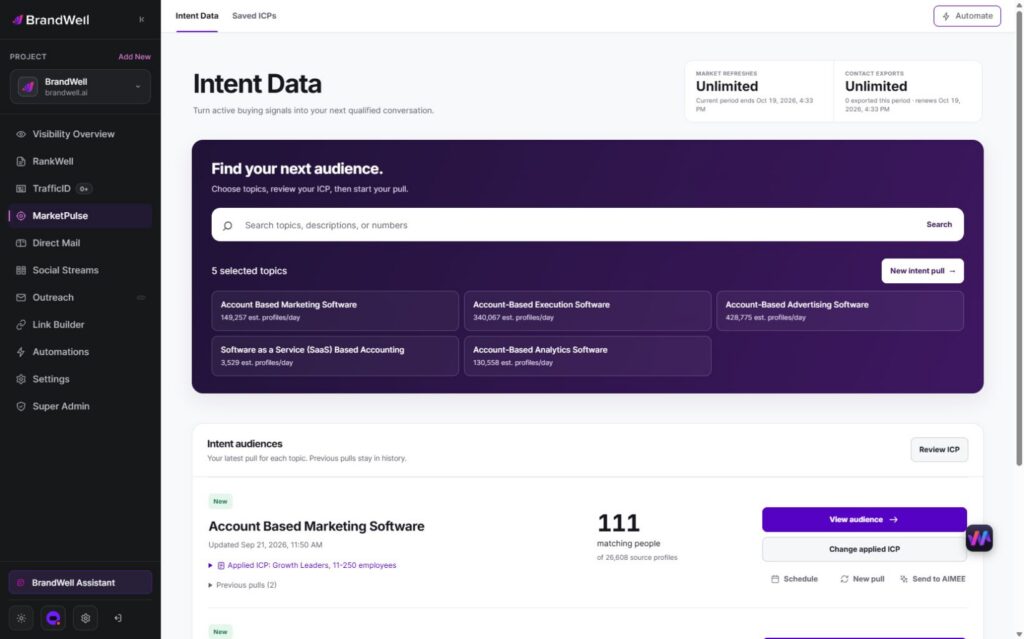
BrandWell MarketPulse: intent data starting at $500/mo. Find people researching topics relevant to what you sell, apply saved ICP filters, and review available contact details before taking action.
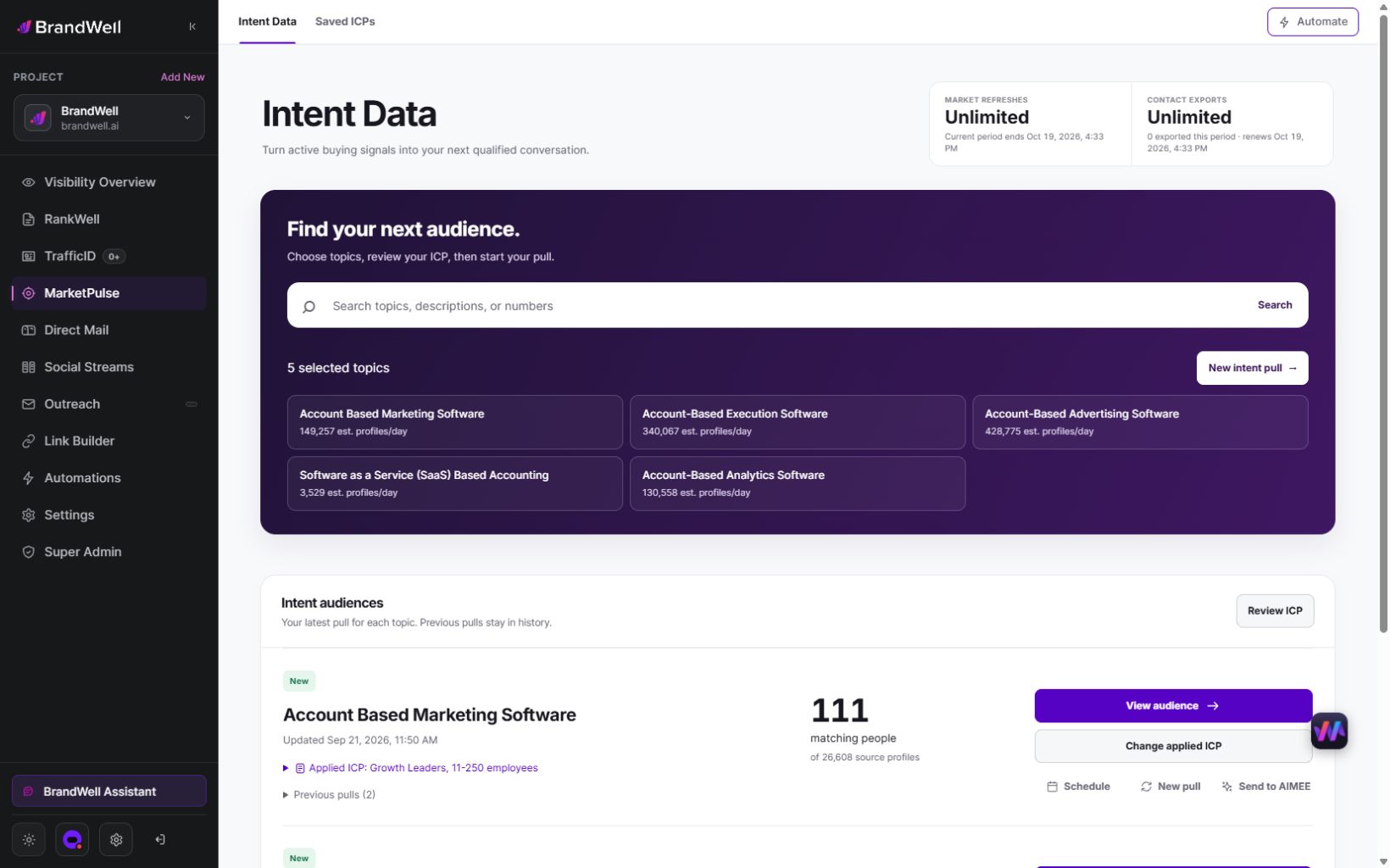
MarketPulse plans are starting at $500/mo. Verify current package scope and offers on the product page.
| Plan | Topics and refreshes | Monthly exports |
|---|---|---|
| Starter | 1 topic, weekly | 25,000 contacts |
| Growth | 3 topics, daily | 100,000 contacts |
| Scale | 10 topics, daily | Unlimited contacts |
Swipe the table to see all columns.
A pull retrieves available data from the previous 24 hours for one topic. Daily use across all included topics provides 90 Growth pulls or 300 Scale pulls in a 30-day month. Weekly Starter pulls vary by calendar month. Available audience size and contact fields vary, and audiences may overlap. Refreshes stop at the plan limit without overage charges.
- Find and qualify: search the topic catalog, save your ICP, and review the people and companies that match.
- Act on the research: export qualified contacts or prepare an Outreach or Direct Mail workflow. Connected products, channel usage, and fulfillment may cost extra.
- Get help from AIMEE: Growth and Scale include AIMEE for the initial user to research accounts and prepare the next step through connected tools.
Agencies and other service businesses can build client deliverables around their available Intent Scans and exports. Keep each client’s scope, permissions, and service fees clear. A subscription is not a promise of a white-label platform or exclusive access to a market.
Explore MarketPulse and watch the demo or compare plans starting at $500/mo. Any early-access discount is a separate, time-limited offer shown to an eligible recipient.
Define six audience planning decisions
Before an agency builds a segment, it should write the decision rule. This six-step SCOPE framework is a reusable planning guide for comparing observed research signals versus platform lookalikes without treating either source as truth.
- Specify the buying question. Decide whether the campaign needs reach, timing, account prioritization, buying-group coverage, or re-engagement. One campaign can have more than one objective, but every audience needs a primary job.
- Confirm the seed and signal. For lookalikes, document who is in the seed, why they belong, and what bias it may carry. For intent, document the signal source, topic, time window, account match, and exclusions.
- Outline the identity state. Separate known person, known account, probable account, anonymous visit, and platform-modeled user. Do not collapse them into one claim about a buyer.
- Plan activation. Name the destination, suppression rules, creative, budget owner, frequency controls, and the sales or nurture handoff after engagement.
- Evaluate with a comparison. Hold the offer, creative, geography, and conversion definition as steady as the channel allows. Record what cannot be held constant.
- Explain the result. Report audience delivery, quality, downstream movement, cost, and uncertainty in separate lanes. Recommend keep, change, expand, or stop.
Observed activity, modeled similarity and an actual buying decision are distinct. Some platform audience inputs act as suggestions that permit broader delivery. Preserve the actual platform behavior and delivered cohort rather than assuming a seed defines a fixed eligible population.
Compare fit, timing and platform reach
Start with a fit-and-timing portfolio rather than an audience winner. Define the client’s ideal account profile, excluded accounts, current customers, open opportunities, and target buying problems. Then create separate lanes: high-fit accounts with recent relevant signals, high-fit accounts without those signals, platform lookalikes built from a documented seed, and a simple manual or contextual baseline.
The agency’s job is not to declare one lane superior before evidence exists. It is to decide what each lane is allowed to do and compare movement under the same business definition. A high-fit signal account might enter account-specific ads and sales review. A lookalike may remain a reach audience. A manual list may protect strategic accounts that are too small for platform delivery.
Recurring revenue becomes credible when the service includes repeated topic review, audience refresh, exclusions, creative coordination, activation, evidence review, and client decisions. It does not become credible merely because the agency labels a list “in market.”
Assign audience, data and channel owners
Assign four owners. An audience strategist owns the hypothesis and segmentation rule. A data operator owns source permissions, matching, suppression, and refreshes. A channel operator owns platform setup, budget, creative, and delivery. A client revenue owner accepts or rejects sales handoffs and records outcomes. One person may hold two roles in a small agency, but each decision still needs a named owner.
Use a weekly operating loop for active campaigns: ingest permitted signals, apply fit and exclusion rules, review identity confidence, refresh eligible audiences, inspect delivery, route high-priority accounts, and log exceptions. Use a monthly decision review to compare lanes and update topics, seeds, creative, or spend. The client should approve material source changes, new destinations, sensitive segments, and budget shifts before activation.
Keep a source register, audience version log, approval record, destination map, and metric dictionary. Without those artifacts, the agency cannot explain why an account entered the audience or reproduce the prior month’s decision.
Maintain five audience control points
The best stack is the smallest one that preserves provenance from signal to decision. It usually needs five capabilities, not a particular vendor shortlist:
- Signal capture: first-party engagement and contracted third-party research inputs with clear source fields.
- Identity and enrichment: person, account, domain, and confidence states that remain distinguishable.
- Rules and storage: a CRM, warehouse, or controlled worksheet that records fit, exclusions, score inputs, and versions.
- Activation: approved audience destinations, suppression, expiration, and handoff controls.
- Evidence: delivery, engagement, opportunity-stage, cost, and exception views that do not imply unsupported attribution.
A useful template has columns for account, fit reason, signal type, signal time window, identity state, destination, creative treatment, approval, expiration, outcome, and analyst note. Before adding software, audit whether the client can maintain those fields. Agencies that need a broader channel decision can use this paid ads audience strategy guide as the adjacent planning step.
Compare signal, seed and baseline inputs
| Approach | Best job | Main input | Key limitation |
|---|---|---|---|
| Intent-led account audience | Prioritize known accounts by fit and recent relevant activity | Topics, timing, fit, identity, and exclusions | Activity and identity can be incomplete or misread |
| Platform lookalike | Find additional reachable users similar to a seed | Seed quality and platform modeling | Similarity does not show active buying research |
| Manual target-account list | Protect strategic coverage and human knowledge | ICP, territory, account plan, and seller input | Can become stale and miss new demand |
| Contextual or broad audience | Create reach where identity or seed data is weak | Topic, placement, creative, and geography | Less account-level control |
Swipe the table to see all columns.
Use the manual lane when named accounts matter regardless of current signal volume. Use a lookalike when the client has a credible seed and needs reach. Use intent when timing and prioritization can change the treatment. Use a blended design when every lane retains its label and can be evaluated separately. Do not pour all segments into one audience and then claim the result proves intent.
Separate service cost and media spend
Model the service in two layers. The delivery layer includes data access, setup, audience creation, match review, platform administration, analysis, client meetings, and rework. The media layer includes ad spend and platform delivery. Keeping them separate prevents media volatility from hiding service margin.
Use a worksheet with monthly wholesale inputs, operator hours by role, review time, expected rework, software overhead, media management, and a contingency for client-specific complexity. Then compare that delivery cost with the agency’s retail price. Do not model payback as certain. Create sensitivity cases for low, expected, and high audience delivery, match, adoption, and downstream movement. The purpose is to see where the package becomes uneconomic, not to manufacture an ROI promise.
Website identification can be an input to this model, but it needs its own identity and permission assumptions. This guide to website visitor identification service pricing helps separate that module from media execution.
Measure delivered cohorts and actual outcomes
Use a metric chain rather than a single success number. Start with source health: eligible accounts, freshness, match states, exclusions, and exception rate. Then measure activation: destination acceptance, reachable audience, delivery, frequency, and suppression accuracy. Next measure response: engaged accounts, qualified visits, accepted handoffs, and follow-up timing. Finally, review business movement: opportunity creation or progression under the client’s definitions, service delivery cost, defined delivery contribution, renewal decision, and reasons for expansion or cancellation.
Compare intent, lookalike, and baseline lanes where the data permits, but label observational attribution honestly. A higher conversion rate in one lane does not by itself prove causation if the lane started with stronger accounts. Record sample size, selection rules, window, and changes in creative or spend. The agency can then answer a better question: did the audience decision improve focus enough to justify the next cycle?
Qualify the client and campaign fit
This comparison fits paid-media, demand-generation, ABM, RevOps, and integrated GTM agencies serving B2B clients with definable accounts, meaningful consideration periods, and a team willing to act on account-level evidence. It is especially useful when the client already has a target-account view but needs a timing layer, or has a strong customer seed but needs controlled reach.
It is a weaker fit for very small addressable markets that cannot meet destination thresholds, clients without an approved offer or follow-up owner, short one-off campaigns that cannot establish a baseline, or teams that want a list but will not change treatment. Early-stage clients may begin with manual fit plus simple first-party engagement. More mature clients can test third-party topics, visitor identity, platform seeds, and coordinated seller handoffs. Fit is an operating decision, not a maturity badge.
Preserve identity and approved treatment
Use signals that can change an action: relevant page depth, repeated visits, content or event engagement, product or account activity where permitted, contracted topic research, and seller-confirmed account context. Record recency and frequency without pretending every action has equal meaning. For identity, retain separate states for verified person, matched account, inferred company, unresolved visitor, and platform-modeled audience member.
Preserve signal, fit, identity, qualification, approval, destination, treatment, expiration and outcome as separate states. Each transition requires a rule and permitted channel use. High fit or lower identity confidence does not itself authorize advertising or nurture. Hold unresolved records; apply the actual client exclusions and campaign rules before approved activation.
Outcome evidence should connect the audience version to delivery and the client’s accepted business events. A clear pipeline attribution plan for intent programs can establish definitions while preserving the difference between contribution and proof of causation.
Review similarity and buying-readiness claims
The largest strategic risk is calling modeled similarity or observed research a verified buying decision. Operational risks include stale seeds, weak topic design, audience overlap, incorrect identity joins, missing suppressions, destination drift, slow sales follow-up, and unlogged changes. Client-trust risk grows when a report hides those limitations behind a single score.
Review actual source rights, purpose, fields, identity boundaries, access, retention and destination approvals. A technically accepted audience is not proof of permitted use or buyer readiness. The client and agency must approve their actual data, channel and campaign configuration.
Also review platform rules before every activation. An audience that is technically uploadable is not automatically permitted, appropriate, or trustworthy.
Scope recurring audience maintenance
Sell a governed audience operating cycle, not a one-time file. A recurring package can include topic and seed review, signal intake, identity-state labeling, fit rules, exclusions, audience refresh, activation recommendations, campaign coordination, evidence reporting, and a monthly decision meeting. The recurring value is the controlled learning loop and the actions it enables.
Scope the retail package by the number of clients, topics, destinations, refresh cadence, analyst involvement, and approval complexity. Keep media spend and special integrations visible. Protect margin with limits on custom topics, backfills, destinations, exports, report versions, and out-of-cycle changes. A service should expand only after the client uses the current outputs and both parties can see what added scope would change.
Copyable assistant audience review
AIMEE can help compare approved audience specifications and flag missing evidence through configured connected tools. Preserve source windows, identity states and actual campaign settings. Human owners approve exports, targeting, spend and claims.
ROLE: Audience operations analyst.
INPUTS: approved ICP, account exclusions, permitted signal fields, identity-state definitions, audience versions, destination rules, campaign results, and client metric definitions.
TASK:
1. Separate records into intent-led, lookalike seed, manual account, and baseline lanes.
2. Flag missing source, time window, identity, permission, or exclusion fields.
3. Propose audience additions, removals, expirations, and tests with a reason for each.
4. Produce a comparison brief that separates delivery, response, business movement, and uncertainty.
5. Draft the client decision options: keep, change, expand, or stop.
DO NOT: upload an audience, change spend, contact a person, merge an uncertain identity, or make a performance claim.
HUMAN APPROVAL REQUIRED: data source and permitted use, identity rule, segment export, destination, creative, budget, outreach, public claim, and final client report.
Keep product and campaign scope separate
MarketPulse supports topic research and saved ICP review. Advertising campaign execution, custom client portals and agency implementation work are separately scoped commitments. Verify supported destinations, channel rules and permissions rather than presenting them as included BrandWell capabilities.
Start with supported MarketPulse research starting at $500/mo and preserve the actual topic, available fields and pull window. AIMEE can help organize an approved account brief through configured tools. The agency and client own any separately configured advertising test and service agreement.
Make the comparison testable
Write the SCOPE worksheet for one client and one campaign. If the agency cannot name the signal, seed, identity state, action, owner, and comparison before activation, pause the launch. A narrower audience test with honest boundaries is more useful than a larger segment nobody can explain.
Worked example: distinguish response from causal lift
Suppose two fictional campaigns each spend $1,000. A research-led lane records 100 clicks and 10 accepted inquiries; a platform-modeled lane records 200 clicks and 12 accepted inquiries. Accepted inquiries per click are 10% and 6%. Media cost per accepted inquiry is $100 and $83.33. The higher click-to-inquiry rate does not establish better economics or causal lift. These are invented numbers, not typical results or BrandWell performance claims.
If the agency spends $600 and $400 respectively on delivery, the fully specified media-plus-service costs are $160 and $116.67 per accepted inquiry. State what those totals include and keep agency fees separate from delivery cost. Different account selection, delivery expansion, attribution windows, creative and overlapping exposure can explain differences. Without a suitable experiment, report an observed comparison.
Check current platform delivery behavior
Google’s current Demand Gen lookalike guidance describes a phased 2026 transition to suggestion mode with reach beyond similarity thresholds. Check the actual account settings and supported controls before naming a comparison lane. This specific platform change does not establish how every other platform behaves or certify an external topic export as an eligible seed.
Use MarketPulse as a research input
Review an available topic with the saved ICP, preserve its actual preceding-24-hour window and inspect the available identities and fields. AIMEE can help prepare an approved comparison brief through configured tools. Human owners check source rights, platform policy, supported destination and experiment design before any advertising handoff.
Frequently asked questions
Does topic activity prove buying readiness?
No. Research evidence is not a purchase commitment.
Is a lookalike always a fixed audience boundary?
No. Check the actual platform, campaign and current settings.
Does the higher conversion rate win?
Not necessarily. Compare defined outcomes, total costs and uncertainty.
Can any topic export become an advertising seed?
Do not assume that. Source rights and destination policy must support the use.
Review the supported research product: explore MarketPulse and current plans.
Reviewed and updated October 3, 2026.

Written by