
On this page
Google does not treat AI use alone as a reason to reject a page. Its guidance focuses on useful content, factual review and avoiding scaled content abuse. Generating many pages without adding value can violate its spam policies, regardless of how the pages were produced.
The practical question is whether the finished page helps its audience and supports its claims. AI assistance is not a ranking advantage, a quality certification or a substitute for an accountable publishing process.
What Google’s current guidance actually says
Google’s generative AI content documentation identifies research and structure as possible uses and calls for manual fact-checking before publication. Review applies to the page and its metadata, including titles, descriptions and image text.
Do not read this as an endorsement of every generated draft. Evaluate the work itself: does it answer the question, preserve the evidence, reflect current facts and add something useful beyond a generic summary?
What is scaled content abuse?
Google’s scaled-content policy addresses pages produced primarily to manipulate rankings without helping users. There is no published universal “safe” number of AI articles per day. A small batch can be poor content; a large library still needs a reason for each page to exist.
Do not replace a review process with a numeric publishing limit. Avoid copying, lightly rewording or combining existing pages without a meaningful contribution. Assign an audience, purpose, evidence and reviewer to each article.
Is E-E-A-T a score or direct ranking factor?
E-E-A-T refers to experience, expertise, authoritativeness and trustworthiness. Google says E-E-A-T itself is not a specific ranking factor, and quality raters do not directly control page rankings.
For your article, translate those concepts into concrete evidence: an accurate author description, relevant experience, a documented method and sources that support the claims. Do not invent credentials, personal tests or customer results to give an article an appearance of expertise.
Original pre-publication review checklist
- Purpose: identify the reader and the question the page answers.
- Evidence: open the original sources and preserve their dates, scope and limitations.
- Contribution: add a relevant example, method, comparison or observation that you can support.
- Product facts: check the current interface, feature, price and availability.
- Attribution: distinguish quotations, source ideas and your own interpretation.
- Presentation: inspect headings, links, media and mobile behavior.
- Preview: ensure the title and description match the answer actually provided.
- Accountability: retain the reviewer, source record and publication decision.
Example: a marketing team drafts a guide to evaluating intent data. Instead of claiming that every identified person is ready to buy, it explains the topic, time window, available filters and limits of the signal. It labels fictional examples and links to the current product scope. That is an original editorial exercise, not a promise of traffic or sales.
Use RankWell with an evidence-led brief
Open the current BrandWell portal and use RankWell to prepare and review the content. Supply the reader’s question, verified sources, current product details and original material in the brief. Inspect the article, search preview, recommendations, media, sources and history before publishing through your configured workflow.
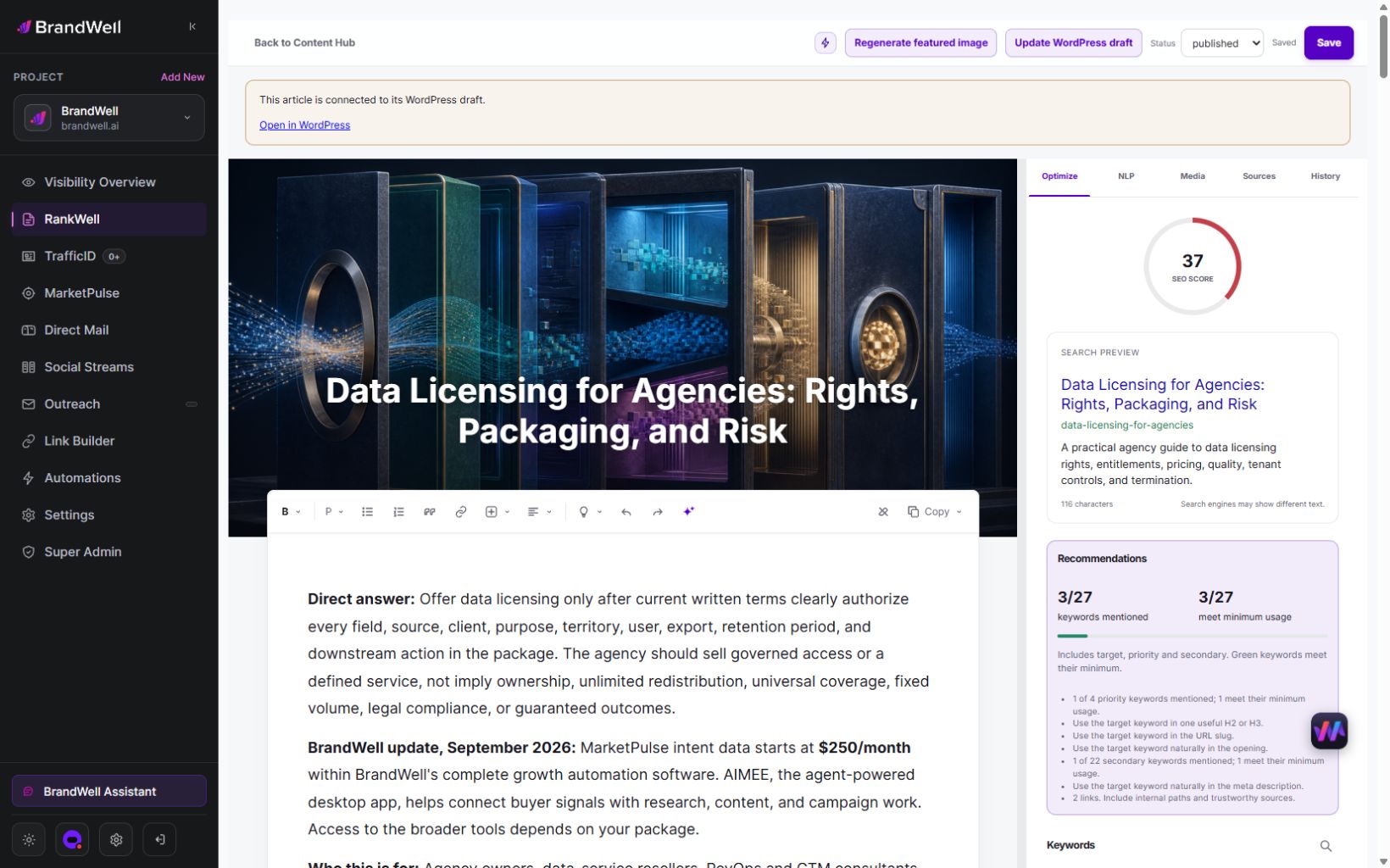
Keep product roles clear: RankWell supports the content workflow; MarketPulse intent data starts at $250 per month. Do not describe topic pulls as article generation or apply that starting price to every BrandWell capability.
AI Overviews need useful pages, not a special writing trick
Google’s AI discovery guidance does not require special AI markup or a particular sentence formula. Offer a clear answer with supporting evidence and usable navigation. No page format guarantees selection for an AI answer.
Measure the available Search Console reports with their scopes intact. Separate visibility from clicks and business outcomes, and do not attribute every change to the use of AI in drafting.
Common questions
Does a generated article automatically violate Google’s rules?
No. Review its purpose and value, and follow the current policies. AI use alone does not establish either compliance or a violation.
Will a disclosure guarantee that a page ranks?
No. Explain how content was created when it helps the audience, use accurate authorship information and follow applicable rules. Disclosure is not a ranking promise.
Can software guarantee that an article meets every requirement?
No such guarantee is made here. Keep source checking, product verification and publication approval in the workflow.
Reviewed and updated October 2, 2026.

Written by
Julia McCoy has contributed articles to BrandWell on content marketing, writing, and search engine optimization. This archive retains her original bylines; individual articles may be updated by the BrandWell editorial team.