On this page
- Current MarketPulse research workflow
- Choose a promise you can substantiate
- Design the promise and remedy together
- Assign delivery and exception owners
- Maintain the guarantee specification
- Compare commercial promise models
- Budget actual remedy exposure
- Measure delivery and remedy costs
- Choose a promise that fits the service
- Keep signal evidence and outcomes separate
- Review hidden conditions and unsupported claims
- Scope recurring accountability
- Copyable assistant guarantee review
- Separate agency promises from product terms
- Maintain versions and approved changes
- Guarantee work you can demonstrate
- Worked example: budget a defined remedy
- Frequently asked questions
Direct answer: An agency should not guarantee meetings, pipeline, revenue, sales, or profit when the result depends on the client’s offer, budget, creative, follow-up, sales process, market, and third-party systems. A defensible guarantee commits the agency to controlled work: defined deliverables, timing, quality checks, response standards, evidence, and a bounded remedy if it misses that commitment.
Current MarketPulse offer: intent-data plans start at $500/mo. See the product, demo, and current plans. Updated October 3, 2026.
Align the sales claim, evidence, eligibility and actual remedy. Do not advertise a broad outcome and hide a narrower promise in the contract. Qualified counsel should review the final agreement and advertising in the relevant jurisdictions.
Who this is for: Agency owners and buyers deciding whether a lead-generation or intent-service guarantee reduces risk honestly or creates an obligation the delivery team cannot control.
Current MarketPulse research workflow
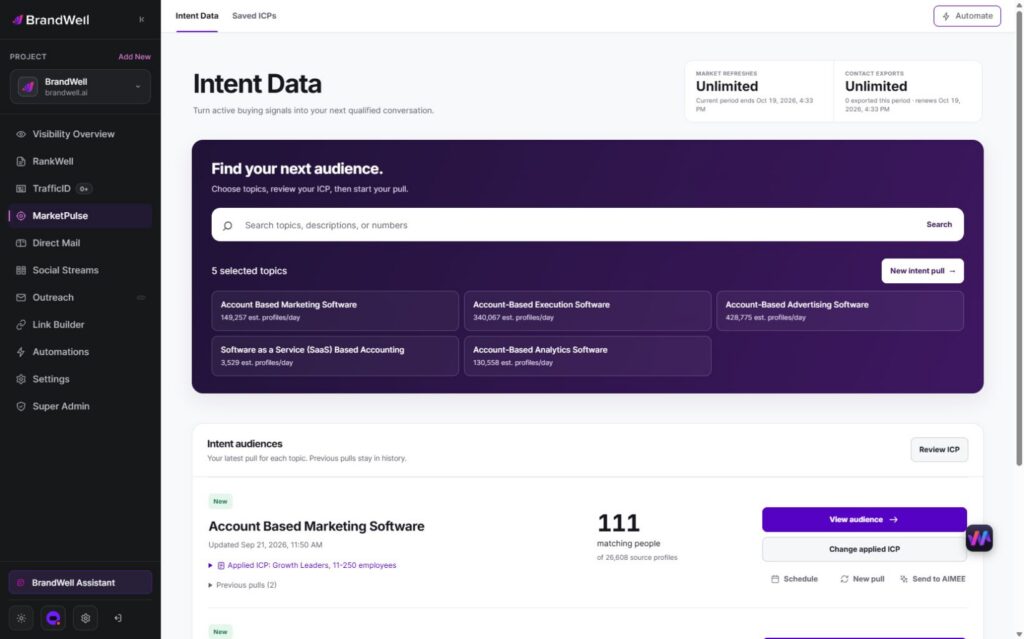
BrandWell MarketPulse: intent data starting at $500/mo. Find people researching topics relevant to what you sell, apply saved ICP filters, and review available contact details before taking action.
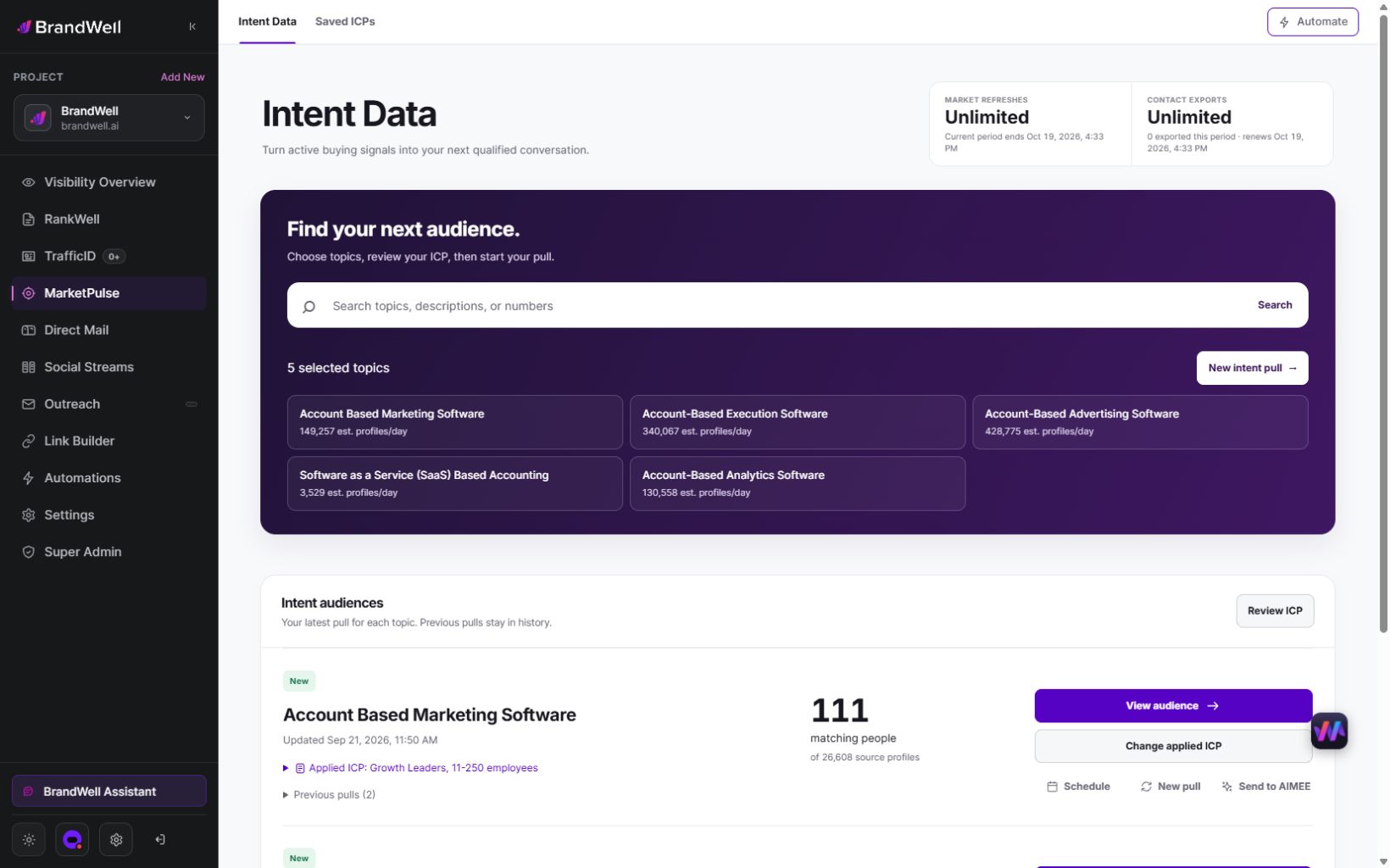
MarketPulse plans are starting at $500/mo. Verify current package scope and offers on the product page.
| Plan | Topics and refreshes | Monthly exports |
|---|---|---|
| Starter | 1 topic, weekly | 25,000 contacts |
| Growth | 3 topics, daily | 100,000 contacts |
| Scale | 10 topics, daily | Unlimited contacts |
Swipe the table to see all columns.
A pull retrieves available data from the previous 24 hours for one topic. Daily use across all included topics provides 90 Growth pulls or 300 Scale pulls in a 30-day month. Weekly Starter pulls vary by calendar month. Available audience size and contact fields vary, and audiences may overlap. Refreshes stop at the plan limit without overage charges.
- Find and qualify: search the topic catalog, save your ICP, and review the people and companies that match.
- Act on the research: export qualified contacts or prepare an Outreach or Direct Mail workflow. Connected products, channel usage, and fulfillment may cost extra.
- Get help from AIMEE: Growth and Scale include AIMEE for the initial user to research accounts and prepare the next step through connected tools.
Agencies and other service businesses can build client deliverables around their available Intent Scans and exports. Keep each client’s scope, permissions, and service fees clear. A subscription is not a promise of a white-label platform or exclusive access to a market.
Explore MarketPulse and watch the demo or compare plans starting at $500/mo. Any early-access discount is a separate, time-limited offer shown to an eligible recipient.
Choose a promise you can substantiate
Choose the lowest rung that resolves the buyer’s actual concern. A higher rung is not automatically a stronger offer. It may simply transfer more uncontrolled risk to the agency.
- Process transparency: commit to named owners, workflow, dependencies, and reporting.
- Delivery standard: commit to specified reports, refreshes, reviews, or handoffs within an agreed window.
- Quality standard: commit to a written acceptance test, sample review, and defined rework.
- Bounded remedy: offer a capped service credit or additional in-scope work after a verified miss.
- Outcome-linked fee: place a limited fee component at risk only where control, definitions, systems, economics, and counsel support it.
Choose a promise that fits the work you control and can document. Delivery or agreed service standards may be suitable where sales outcomes depend on client follow-up and buyer decisions. A research signal is not a certain business outcome.
Design the promise and remedy together
Start with the objection. If the buyer fears late reports, guarantee a delivery standard. If the buyer fears unusable records, define a quality test and rework. If the buyer fears shelfware, commit to enablement, review cadence, and an adoption checkpoint. Do not jump from those concerns to a revenue promise.
Write four boundaries before writing promotional copy. Eligibility states which clients and campaigns qualify. Control separates agency tasks from client and platform tasks. Evidence states how both parties will decide whether the commitment was met. Remedy caps the response to a verified miss. Put the same definitions in the proposal, order form, operating plan, and account script.
A guarantee can support recurring revenue by reducing ambiguity and showing operating confidence. It cannot make weak delivery economics healthy. If expected remedy exposure, evidence work, or disputes consume the margin, use a clear service level without a promotional guarantee.
Assign delivery and exception owners
Assign a commercial owner, delivery owner, evidence owner, and approval owner. The commercial owner may explain only approved language. The delivery owner manages the tasks and client dependencies. The evidence owner maintains timestamps, acceptance tests, exceptions, and remedy calculations. The approval owner authorizes credits, extensions, or contract changes. Add qualified legal, privacy, security, or finance review when the claim or workflow requires it.
At kickoff, confirm eligibility, inputs, systems of record, client response duties, exclusions, clock rules, and acceptance. During delivery, log agency work and client delays separately. Review open exceptions before the commitment window closes. At the end of each cycle, record met, missed, paused, disputed, and remedied states.
The systems can be simple, but they must be consistent: signed scope, dependency checklist, work log, delivery timestamp, acceptance record, issue register, approval matrix, and credit ledger. A dashboard does not resolve a dispute if the underlying definitions were never agreed.
Maintain the guarantee specification
The essential tools are contract-controlled records, not a guarantee software category. Use an eligibility form, responsibility matrix, service-level schedule, acceptance-test template, exception log, evidence folder, remedy approval form, and renewal review. Workflow or ticketing software can timestamp tasks. A CRM can record client handoffs. A portal can expose delivery and exceptions. Finance needs a clear way to reserve and approve credits.
Copyable guarantee specification
- Eligible scope: client, campaign, topics, sources, destinations, term, and start condition.
- Agency commitment: exact deliverable, standard, owner, and measurement window.
- Client duties: access, approvals, data, budget, follow-up, and response timing.
- Evidence: system of record, timestamps, sample, acceptance rule, and dispute path.
- Exclusions: platform outage, source change, client delay, invalid input, or unapproved scope.
- Remedy: rework, additional service, or capped credit with approval and expiry.
Align the specification with the agency’s intent-data delivery service levels. The template is an operating aid, not contract language or legal advice.
Compare commercial promise models
| Commercial model | What it promises | When it may fit | Main risk |
|---|---|---|---|
| No guarantee, clear scope | Defined work and standard contract remedies | Complex work with many client dependencies | May not answer a buyer’s specific delivery concern |
| Service-level commitment | Controlled timing, delivery, or response | Repeatable delivery with reliable evidence | Poor clock and dependency rules create disputes |
| Quality commitment | Written validation and bounded rework | Acceptance can be sampled and agreed in advance | Subjective “quality” becomes unlimited rework |
| Service credit | Capped remedy after a verified controlled miss | Economics can absorb a defined exposure | Uncapped or stackable credits damage margin |
| Meeting or revenue outcome | An event influenced by both parties and the market | Only rare cases with unusual control and review | Attribution, incentives, and liability can become misaligned |
Swipe the table to see all columns.
A manual or non-intent service can use the same ladder. Intent data does not make an outcome promise safer. It may improve prioritization, but signal relevance, identity, activation, offer quality, and follow-up still matter. Choose the model based on control and evidence, not on how bold it sounds in a proposal.
Budget actual remedy exposure
Add guarantee cost to the service model explicitly. Include eligibility review, extra documentation, monitoring, acceptance sampling, client communication, dispute handling, rework, possible credit, and counsel or finance review. Estimate exposure by asking how often a controlled commitment could be missed and what the maximum remedy would cost. Use ranges, not a false point forecast.
Price the base delivery first. Then decide whether guarantee administration is included, charged as a premium, or reserved from margin. Cap remedies by period and prevent multiple remedies for the same miss. State whether client delays pause the clock and whether out-of-scope changes reset it. Do not hide remedy cost in media spend or assume future revenue will repay it.
Run a stress case for source outage, client access delay, rejected records, destination failure, staff absence, and scope expansion. If the agency cannot remain operational under plausible misses, narrow the commitment before selling it.
Measure delivery and remedy costs
Track eligibility rate, commitment acceptance, on-time delivery, quality-test pass rate, exception count, client-delay hours, agency misses, disputes, remedy frequency, remedy cost, rework hours, and approval time. Add adoption: reports reviewed, handoffs accepted, actions completed, and feedback returned. These metrics show whether the guarantee is improving clarity and delivery discipline.
Agency metrics include defined delivery contribution before and after remedy cost, support load, sales-cycle movement, close reasons, renewal, and cancellation reasons. Do not interpret a signed contract as proof the guarantee caused the sale. Use proposal notes and buyer feedback to understand contribution.
Review the metrics by guarantee version. If a revised eligibility rule reduces disputes but also excludes most prospects, the agency may need a different risk-reversal message. The goal is a sustainable promise that the delivery team can keep, not the lowest possible claim rate.
Choose a promise that fits the service
Service-level and quality commitments fit agencies with standardized deliverables, controlled workflows, reliable timestamps, repeatable acceptance tests, and disciplined scope. They can help a buyer who has been disappointed by late delivery or unclear data quality. Existing clients with a stable operating history may be easier to qualify than new clients with unknown systems and behavior.
A guarantee is a weak fit for clients with untested offers, no follow-up owner, missing access, changing definitions, restricted use cases, tiny markets, or a demand for revenue certainty. It is also weak when the agency depends on an external platform without a contingency and cannot distinguish provider failure from its own work.
Before offering a guarantee, assess procurement, data use, security, and contracting readiness. This procurement-readiness guide for agency intent services helps identify dependencies that should be resolved first.
Keep signal evidence and outcomes separate
Guarantee only the parts of the signal-to-action chain the agency can inspect and influence. Record the source, topic, time window, fit rule, identity state, validation step, exclusion result, destination, delivery timestamp, and client acceptance. A person-level record and an account-level research signal need different standards.
For activation, distinguish prepared, approved, delivered, accepted, acted on, and outcome states. The agency may commit to preparing and delivering a qualified report within a window. It should not silently convert that commitment into a promise that the client will act or a prospect will respond. When client approval or access is late, the record should show whether the clock paused.
Outcome evidence is still useful. It helps both parties improve the service and renewal decision. It does not expand the guarantee unless the written terms say so. Keep attribution definitions and limitations visible.
Review hidden conditions and unsupported claims
The highest-risk mistake is an express or implied outcome claim the agency cannot support. Other risks include undefined “qualified” records, inconsistent sales language, hidden exclusions, subjective acceptance, retroactive rule changes, uncapped credits, double remedies, missing client duties, poor evidence, manipulated quality thresholds, and using data outside approved purposes.
FTC advertising substantiation policy requires a reasonable basis before disseminating claims. Review the actual promise and supporting evidence; this article is not legal approval of a particular offer.
Data controls still matter. Minimize fields, restrict access, document sources, set retention and deletion, review providers, and require approval for new destinations. Use qualified legal, privacy, security, and finance review before publishing or contracting the guarantee.
Scope recurring accountability
Use the guarantee to reinforce the operating cycle: agreed topics, defined refreshes, quality review, client handoff, evidence, and a decision meeting. A recurring commitment can apply to delivery windows, report completeness, exception response, or bounded rework. The standard should remain stable enough to measure and flexible enough to handle an approved methodology change.
Protect economics with eligibility, scope units, client duties, remedy caps, versioning, and renewal review. Remove or change a guarantee that no longer matches the service. Do not carry promotional language into renewal by inertia. The detailed intent-service guarantee design guide can support the contract and operations workshop.
Copyable assistant guarantee review
AIMEE can help compare an approved guarantee specification with delivery records through configured connected tools. Preserve missing evidence and proposed exceptions. Human owners approve advertising, agreements and remedies.
ROLE: Service-guarantee risk reviewer.
INPUTS: proposed headline, proposal language, scope, client duties, delivery workflow, evidence fields, acceptance test, exclusions, remedy, pricing model, and approval matrix.
TASK:
1. Extract every express and reasonably implied commitment.
2. Label each commitment controlled, shared-control, or uncontrolled.
3. Match controlled commitments to evidence, owner, clock, and remedy.
4. Flag vague terms, missing dependencies, uncapped exposure, conflicting documents, and unsupported outcome language.
5. Draft safer alternatives focused on delivery and quality.
DO NOT: approve legal language, change contract terms, promise an outcome, issue a credit, or publish copy.
HUMAN APPROVAL REQUIRED: commercial owner, delivery owner, finance, qualified counsel, privacy or security reviewer when relevant, and final client signatory.
Separate agency promises from product terms
MarketPulse supports topic research and saved ICP review. Agency service guarantees, custom client portals and implementation work are separately scoped commitments. Verify actual permissions, fields, destinations and terms rather than presenting them as included BrandWell capabilities.
Start with supported MarketPulse research starting at $500/mo and preserve the actual topic, available fields and pull window. AIMEE can help organize an approved brief through configured tools. The agency owns any separate service promise and client agreement.
Maintain versions and approved changes
Review a guarantee after any material delivery, source, platform, pricing, client-duty, acceptance, or remedy change. Version the claim and operating specification together. Test the revised standard on historical examples and a limited live period before sales uses it broadly. Train commercial and delivery teams from the same approved language, then sample calls and reports for implied promises that the written scope does not support.
At renewal, show commitment performance, exceptions, client delays, remedies, adoption, cost, and unresolved risk. Keep, narrow, replace, or remove the guarantee based on evidence. Do not treat a low claim rate as proof the offer caused a sale or that future outcomes are assured.
Keep the approved guarantee discoverable wherever a client may rely on it. Proposal templates, order forms, service pages, onboarding materials, and account reports should point to the same version. Retire old copy instead of leaving conflicting promises in circulation. Measure sales response and service health separately, then use both to decide whether the guarantee remains useful.
Guarantee work you can demonstrate
Take the proposed promise through the five-rung ladder and complete the specification. If the agency cannot name the owner, evidence, clock, dependency, and bounded remedy, the claim is not ready. A precise service commitment can reduce buyer risk without manufacturing certainty.
Worked example: budget a defined remedy
A fictional agency collects a $2,000 monthly fee and spends $1,200 on scoped delivery. Its $800 delivery remainder is 40% before acquisition, general overhead, tax and financing. Suppose its written agreement provides a $200 credit plus three hours of rework at a loaded $75/hour for a particular qualifying failure. That combined $425 remedy reduces the remainder to $375, or 18.75%. These are invented planning inputs, not typical results, legal terms or BrandWell service prices.
Across five such accounts, the $10,000 fee and $6,000 base cost leave $4,000. One qualifying $425 remedy leaves $3,575, or 35.75%; two separate qualifying remedies leave $3,150, or 31.5%. Determine from the actual agreement whether credits and rework combine, whether failures qualify separately and whether a disclosed aggregate cap applies. Do not count the same cost twice or invent a cap after a claim.
If 95 of 100 defined deliveries meet the agreed deadline, the on-time rate is 95% for that cohort. Report the five exceptions, eligibility decisions and actual remedies separately. A delivery rate does not show that customers achieved pipeline or revenue, or that the guarantee caused purchases.
Keep MarketPulse’s refund conditions explicit
The current MarketPulse offer is starting at $500/mo. Its satisfaction guarantee requires a refund request within three days (72 hours) of the first purchase, no exported data and no more than two Intent Scans. Check the linked product terms before purchase. This conditional refund policy does not guarantee meetings, revenue or an agency’s downstream work.
Document the actual research workflow
Review an available MarketPulse topic with the saved client ICP, preserve the preceding-24-hour window and inspect the actual fields. AIMEE can help organize delivery evidence through configured tools. Human owners verify source rights, approve next actions and keep the separate agency promise aligned with the supported work.
Frequently asked questions
Does intent data guarantee a sale?
No. Research activity is not a purchase commitment.
Can hidden eligibility terms narrow a broad headline promise?
Do not design the offer that way. Align the actual claim and prominently communicated conditions.
Should credits and rework both enter the cost model?
Include each actual cost once, according to the agreed remedy.
Is MarketPulse’s guarantee unconditional?
No. The first-purchase refund window has export and topic-pull conditions.
Review the supported research product: explore MarketPulse and current plans.
Reviewed and updated October 3, 2026.

Written by