On this page
- Use the five RENEW decision steps
- Current MarketPulse research workflow
- Renew from adoption and delivery evidence
- Assign the renewal clock and decision owners
- Maintain a source-linked decision record
- Compare proactive and reactive review
- Model expansion contribution and capacity
- Define adoption and renewal denominators
- Adapt the decision to client risk and maturity
- Reconcile the source-to-outcome chain
- Keep limitations beside the renewal claim
- Build business reviews into renewal preparation
- Copyable contract-renewal review
- Make the next decision observable
- Worked example: renewed contracts and retained revenue differ
- Frequently asked questions
Direct answer: Renew an intent-data agency contract by proving the service is used, useful, controlled, and economically sustainable. Build the renewal file during delivery, not at expiration. Then use one decision meeting to choose among four honest outcomes: renew the current scope, redesign it, downsize it, or end it.
Current MarketPulse offer: intent-data plans start at $500/mo. See the product, demo, and current plans. Updated October 3, 2026.
The contract should follow the evidence. Delivery activity alone is not proof of pipeline or revenue, and a larger package is not automatically the right renewal.
Use the decision frame below to preserve the difference between what the agency delivered, what the client used, and what the shared systems can substantiate. That distinction makes negotiation more useful and limits pressure to overstate results.
Who this is for: Account directors and agency owners who need a repeatable contract-renewal process for a recurring buyer-intent service.
Use the five RENEW decision steps
- Record: assemble contracted scope, delivery evidence, exceptions, client actions, and actual cost to serve.
- Examine: separate relevance, adoption, activation, and downstream outcome evidence.
- Normalize: remove one-off effects, reconcile definitions, and compare like periods and client segments.
- Evaluate: decide whether the next contract should renew, redesign, downsize, or end.
- Write: send a plain-language decision brief with scope, responsibilities, price, risks, and approval deadline.
The frame prevents a renewal deck from becoming an activity recap. It turns the meeting into a governed commercial decision.
Current MarketPulse research workflow
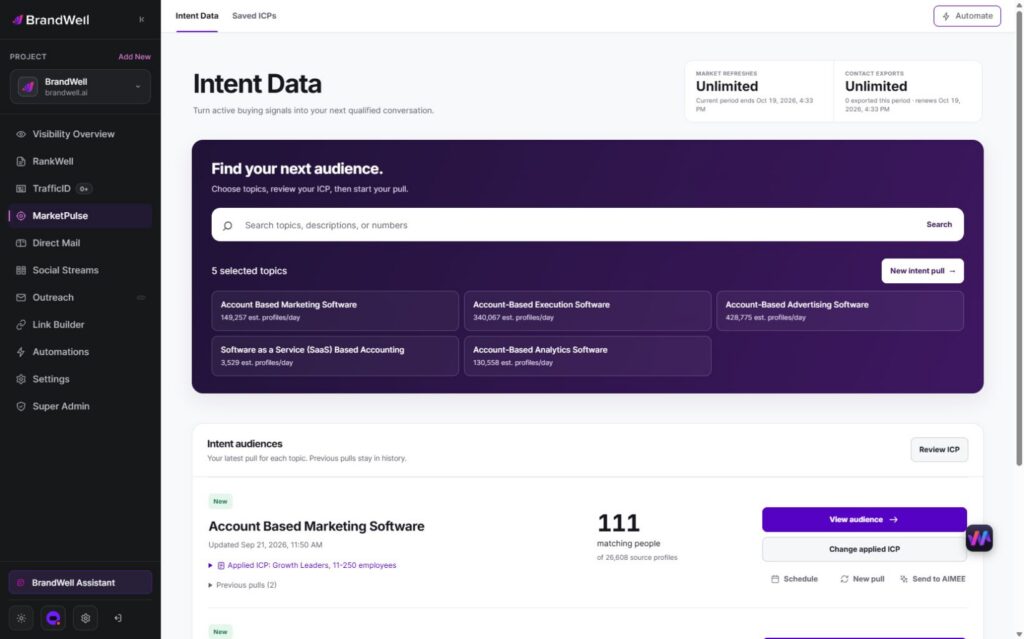
BrandWell MarketPulse: intent data starting at $500/mo. Find people researching topics relevant to what you sell, apply saved ICP filters, and review available contact details before taking action.
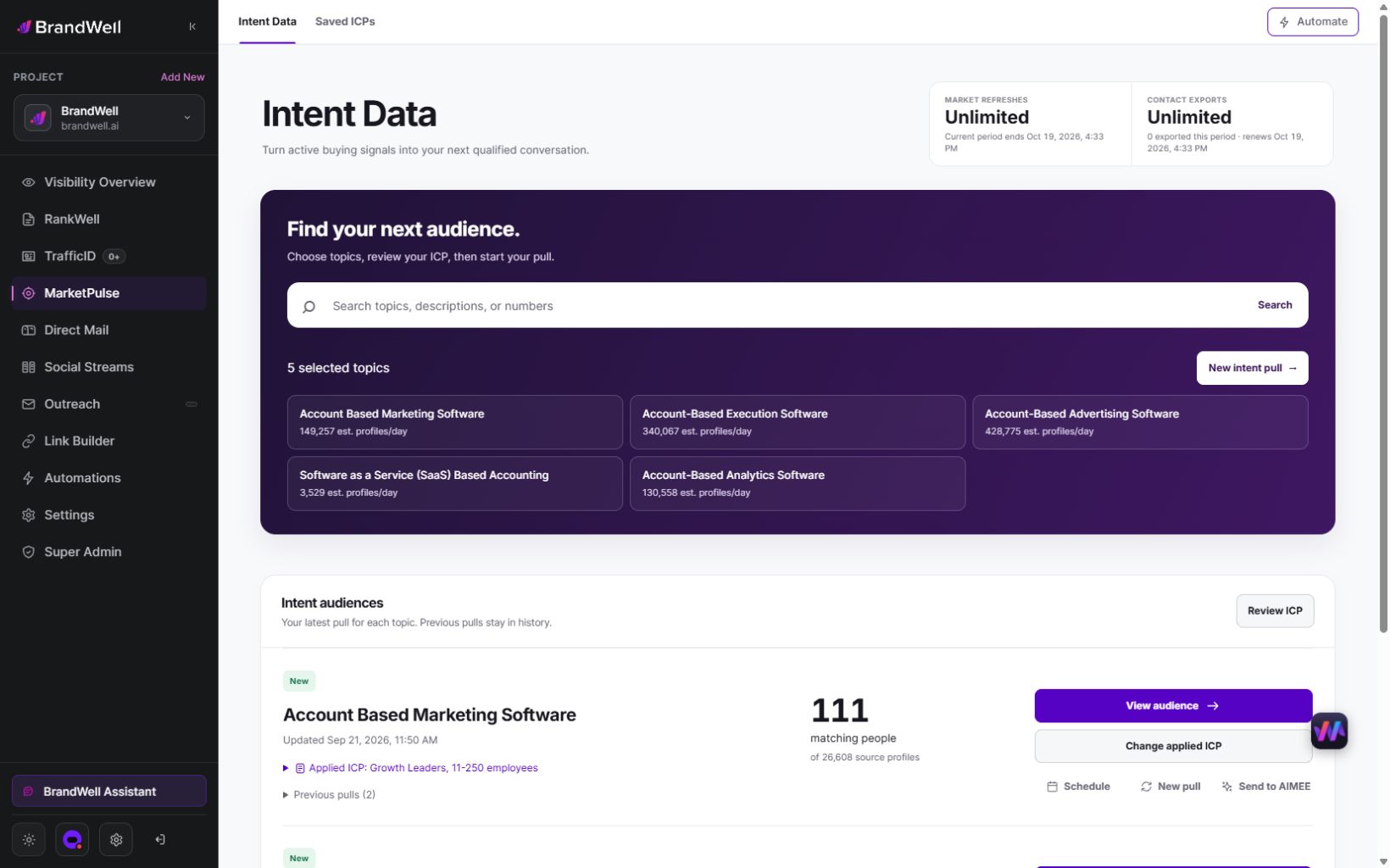
MarketPulse plans are starting at $500/mo. Verify current package scope and offers on the product page.
| Plan | Topics and refreshes | Monthly exports |
|---|---|---|
| Starter | 1 topic, weekly | 25,000 contacts |
| Growth | 3 topics, daily | 100,000 contacts |
| Scale | 10 topics, daily | Unlimited contacts |
Swipe the table to see all columns.
A pull retrieves available data from the previous 24 hours for one topic. Daily use across all included topics provides 90 Growth pulls or 300 Scale pulls in a 30-day month. Weekly Starter pulls vary by calendar month. Available audience size and contact fields vary, and audiences may overlap. Refreshes stop at the plan limit without overage charges.
- Find and qualify: search the topic catalog, save your ICP, and review the people and companies that match.
- Act on the research: export qualified contacts or prepare an Outreach or Direct Mail workflow. Connected products, channel usage, and fulfillment may cost extra.
- Get help from AIMEE: Growth and Scale include AIMEE for the initial user to research accounts and prepare the next step through connected tools.
Agencies and other service businesses can build client deliverables around their available Intent Scans and exports. Keep each client’s scope, permissions, and service fees clear. A subscription is not a promise of a white-label platform or exclusive access to a market.
Explore MarketPulse and watch the demo or compare plans starting at $500/mo. Any early-access discount is a separate, time-limited offer shown to an eligible recipient.
Renew from adoption and delivery evidence
Use the renewal process to expose the next operational constraint. Start with an evidence ladder: contracted delivery, signal relevance, client adoption, activation movement, downstream association, and economic fit. A client may receive every report on time yet fail to assign accounts. Another may act consistently but discover that half the topic set is too broad. Those situations need different changes.
Adoption improves when the renewal standard is visible from kickoff. Name the client owner, expected review behavior, destination, response record, and feedback loop. During delivery, show which dependency is blocking value and assign a correction. Do not wait for a commercial meeting to reveal that the CRM never received the work.
Expansion should follow demonstrated use. Add a topic, module, region, or activation path only when the current scope is adopted and the buyer can describe the decision the addition will support. If evidence is weak, redesign before expanding. This protects trust and keeps extra service from becoming unpriced complexity. For a broader account strategy, pair this contract process with BrandWell’s intent-service renewal strategy.
Assign the renewal clock and decision owners
A renewal clock needs operational checkpoints, not a single last-minute reminder. The delivery lead maintains the exception and acceptance record. The client lead confirms use and decisions. The account director owns the renewal brief. Finance validates the next-period cost model. A privacy or security reviewer approves changed sources, purposes, destinations, access, or retention. The agency owner approves discounts, nonstandard liability, and contract exceptions.
- At onboarding: document the business question, baseline, scope, responsibilities, evidence levels, and change-control path.
- During ordinary delivery: record acceptance, client action, exceptions, and topic feedback while memory is fresh.
- Before commercial negotiation: reconcile the evidence ledger and cost-to-serve record with the client owner.
- At the decision meeting: present the four choices, recommendation, tradeoffs, and unresolved approvals.
- After the decision: update entitlements, owners, service levels, billing instructions, and the next evidence plan.
Client communication should distinguish facts from interpretations. Say, “Twenty accepted accounts reached the CRM” only when the handoff record supports it. Say, “The client associated three opportunities with the program” if that is the attribution method. Do not silently convert association into causation.
Maintain a source-linked decision record
The useful stack is a connected record of contract, delivery, adoption, decisions, and economics. It can be simple. A contract repository owns signed scope and changes. A delivery tracker owns due items and exceptions. The client portal or shared workspace owns accepted signals and next actions. The CRM owns sales-state changes. An evidence ledger connects each statement in the renewal brief to a source record. A cost model remains private to the agency.
Choose tools by control, not feature count. They should support role-based access, timestamps, exports, correction history, retention, and a named system of record for each metric. Avoid copying personal data into presentation tools when a reference or aggregated result is enough. A report platform that cannot show who accepted, rejected, or acted on work is weak renewal infrastructure.
BrandWell’s guide to weekly and monthly intent-data reporting can help separate operational reporting from the commercial renewal packet. The renewal packet should summarize decisions and cite the maintained records rather than recreate every dashboard.
Compare proactive and reactive review
| Approach | Strength | Failure mode | Best use |
|---|---|---|---|
| Proactive | Surfaces adoption and scope problems early | Can become meeting-heavy without a decision record | Strategic accounts or changing workflows |
| Reactive | Low administration when delivery is simple | Leaves little time to fix use, economics, or legal review | Only stable, low-variance services |
| Data-led | Grounds the choice in accepted definitions and source records | Can overvalue activity and ignore client context | All accounts, paired with qualitative review |
Swipe the table to see all columns.
Use proactive checkpoints when adoption, source definitions or scope can change. Preserve a source-linked record and ask why the figures moved. Lower acceptance may reflect broader topics, stricter exclusions, a smaller market or limited client capacity; it does not select a remedy by itself.
Reactive negotiation is sometimes unavoidable, especially after a sponsor change. In that case, do not fabricate a complete history. State what is available, identify missing client records, offer a bounded discovery step, and make a conservative recommendation. The absence of data is itself a design flaw to fix in the next scope.
Model expansion contribution and capacity
Invest enough to maintain the evidence and make the decision, but do not build a bespoke analytics project for every renewal. Cost the contract process in five buckets: routine evidence capture, account review, commercial preparation, legal or security review for changes, and implementation of the new scope. Track actual time so future proposals reflect the real work.
Copyable expansion economics test
Incremental client fee = proposed new recurring fee - current recurring fee
Incremental delivery cost = added wholesale and usage + labor + support + governance + allocated overhead
Expected contribution change = incremental client fee - incremental delivery cost
Capacity test = can the client act on the added scope and can the agency deliver it without displacing higher-priority work?
Decision = expand / redesign / retain current scope / reduce / end
Do not label the result ROI unless the numerator and attribution method are agreed. Expansion economics for the agency and business value for the client are different views. Both matter, and neither is a guaranteed future result.
Define adoption and renewal denominators
Use a compact scorecard. Adoption measures include named active reviewers, review completion, accepted and rejected signals, assigned actions, and destination acceptance. Health measures include unresolved dependencies, response time, scope changes, support load, sponsor continuity, and data-use exceptions. Commercial measures include renewal, contraction, expansion, collection status, and contribution after service cost.
For downstream outcomes, preserve the attribution label. Sourced, influenced, associated, and unknown should not be collapsed. Report pipeline or revenue only when the client’s system and definitions support the statement. A small or incomplete sample should be described as such. Do not use an external benchmark as a substitute for the client’s own baseline.
A composite health score can help triage accounts, but keep the components visible. Otherwise a healthy average can hide zero adoption, a security exception, or unsustainable support. The score supports a human review; it does not renew a contract by itself.
Adapt the decision to client risk and maturity
A new client with limited history needs a learning-based renewal: confirm which topics, identity states, and activation paths worked well enough to continue. A mature client with stable adoption needs an optimization renewal. A client undergoing a sponsor, market, or stack change needs a redesign decision, because historical evidence may not describe the next term.
High-risk profiles need earlier review. Examples include ambiguous data rights, sensitive use cases, new destinations, repeated exports, weak access control, disputed attribution, chronic client delays, unbounded custom work, or a demand for outcome guarantees. Route the issue to the correct owner instead of using a discount to close it.
Use distinct contract treatment for standardized delivery, integration-heavy work, and advisory services. The service level, acceptance test, and remedy should match the work the agency controls. BrandWell’s guide to setting intent-data delivery SLAs provides a companion structure for measurable service obligations.
Reconcile the source-to-outcome chain
Reconstruct the signal chain before renewing: source and permitted purpose, topic or observed behavior, company-level or person-level identity state, validation method, qualification rule, destination, assigned action, client response, and outcome record. Label inferred, matched, validated, unresolved, and suppressed states. An identified company is not proof that a particular person researched or has authority, budget, or purchase intent.
Record client rejection reasons with the same care as acceptance. They reveal topic drift, entity ambiguity, bad timing, missing context, and workflow friction. That learning turns the next scope into a testable operating hypothesis instead of a copied contract.
Ask whether the client used the signal at the appropriate confidence level. Company-level research can prioritize account research or an approved campaign. Verified contact data can support a permitted outreach workflow. Unresolved identity should not be promoted to a named decision maker. The renewal brief should show exceptions and corrections, not just successful rows.
Evidence is strongest when each step has a timestamp, owner, and source system. Downstream commercial evidence still needs attribution limits because many channels and client actions influence an outcome.
Keep limitations beside the renewal claim
Attribution risk appears when the renewal story claims causation from a sequence of associations. Expectation risk appears when sales language implies guaranteed volume or readiness. Data-use risk appears when a new purpose, export, enrichment step, or destination exceeds rights or client instructions. Trust risk grows when the agency hides missing records, duplicates, mistaken identity, exclusions, or delivery cost.
Use a claim-evidence line for every renewal statement
For each proposed claim, record the exact wording, evidence level, source system, population, time window, owner, limitation, and client acceptance. If the claim depends on a CRM field the client does not maintain, downgrade it to unavailable. If a number changed after a topic or scope change, do not compare the periods without explaining the definition break.
Review the line from both sides. The client should be able to trace the business statement to its own source record, while the agency should be able to trace the delivery statement to its operating log. This prevents a persuasive narrative from outrunning the evidence and gives the parties a concrete fix for the next term.
Keep each proposed claim tied to its source record, population, time window, attribution label and limitation. Review the actual contract, purpose, source rights and destinations with authorized owners. A renewal packet is not a legal determination.
Put material limitations next to the result they qualify. A footnote cannot repair an overstated headline. If evidence is unavailable, say unavailable and propose how the next contract will capture it.
Build business reviews into renewal preparation
Make each business review a checkpoint in the renewal file, not a surprise sales presentation. The client-facing packet should contain the business question, scope delivered, adoption, decisions, exceptions, downstream evidence with confidence labels, proposed scope, mutual responsibilities, economics, risks, and the recommended four-way decision. Keep the agency’s detailed margin view private.
AIMEE can help organize an approved renewal evidence packet through configured connected tools. Preserve missing client dispositions, actual cost and attribution limits. Human owners approve the recommendation, contract and billing instructions.
Start with supported MarketPulse research starting at $500/mo and verify actual topic, ICP and plan usage. The agency renewal is a separately scoped service agreement. Do not imply that BrandWell negotiates contracts, grants custom client entitlements or promises the agency renewal outcome.
Copyable contract-renewal review
ROLE: Act as a renewal operations analyst, not a lawyer or autonomous approver.

INPUTS:
- signed scope and change log
- delivery and exception record
- adoption and activation evidence
- outcome records with attribution labels
- actual cost-to-serve ranges
- current data-use, access, and retention rules

TASK:
1. Build the RENEW evidence ladder.
2. Mark every claim as supported, limited, contradicted, or unavailable.
3. Compare renew, redesign, downsize, and end.
4. Draft a client decision brief and a private economics sheet.
5. List open legal, privacy, security, finance, and executive questions.

STOP CONDITIONS:
- Do not infer causation, intent, authority, budget, or identity.
- Do not invent prices, benchmarks, contract terms, or missing results.
- Do not send, publish, sign, change scope, or alter billing.

HUMAN APPROVAL REQUIRED:
The account director approves evidence and recommendation. Finance approves pricing. The authorized privacy, security, and legal reviewers approve applicable risk language. The client and agency sign any contract change.
Claude, ChatGPT, or AIMEE can prepare and check the packet. A responsible human must approve every consequential action.
Make the next decision observable
Choose one account, reconcile its evidence ledger, price the proposed scope, and write all four decision options. If the recommended renewal cannot be explained without an unsupported result claim, revise the package before presenting it.
Worked example: renewed contracts and retained revenue differ
Suppose a fictional period has 10 contracts due for a renewal decision and eight renew. Contract renewal is 80% of the due cohort, not 80% of every active account. Separately, a beginning recurring-revenue cohort has $12,000. It adds $2,000 of expansion, loses $1,000 to contraction and $2,000 to churn. Under those written definitions, net revenue retention is $11,000 / $12,000 = 91.7%. Gross revenue retention excludes expansion: $9,000 / $12,000 = 75%. Neither calculation includes $3,000 from new clients acquired outside the beginning cohort.
SEC metric-disclosure guidance emphasizes defined calculations and material methodology changes in its filing context. This guide applies the general documentation idea to an agency worksheet, not as a declaration of securities-law duties for every agency. Record your cohort, period, exclusions and treatment of pauses before comparison.
For one account, suppose the current fee is $2,400 and defined monthly delivery cost is $2,100, leaving $300 or 12.5% before acquisition, setup recovery, general overhead, tax and financing. A proposed $3,000 scope adds $450 of delivery cost. Its remainder becomes $450, or 15%; incremental fee is $600 and incremental contribution is $150. If transition work costs $900 and that incremental contribution persists, simple transition recovery takes six months. It excludes collection delays, churn and financing. These invented amounts are not typical results or BrandWell contract terms.
Prepare the evidence packet using BrandWell
Review the client’s permitted MarketPulse topics, saved ICP and actual pull windows against the signed scope. Prepare an aggregated delivery summary and preserve unknown client actions. AIMEE can help draft a renewal brief through configured tools, with separate renew, redesign, reduce and end options. Human owners check cost, rights and claims before approving or sending a proposal.
Frequently asked questions
Should every renewal expand the package?
No. Retain, redesign, reduce or end the scope according to evidence and capacity.
Does a contract renewal rate equal revenue retention?
No. Contracts and recurring revenue use different units and denominators.
Do new clients belong in the beginning-cohort retention rate?
No, under the stated example definitions. Keep new-client revenue separate.
Does associated client revenue prove the service caused it?
No. Preserve the agreed attribution label and comparison limitations.
Review the supported research product: explore MarketPulse and current plans.
Reviewed and updated October 3, 2026.

Written by