On this page
- Define the ten-part operating agreement
- Current MarketPulse workflow
- Choose a recurring client decision
- Assign workflow owners and handoff evidence
- Evaluate capabilities against the service scope
- Compare build, resell, refer and avoid
- Price setup and recurring delivery
- Separate delivery, adoption and outcome ledgers
- Choose clients with action and feedback capacity
- Preserve sources and identity states
- Control quality, data use and expectation risks
- Maintain the recurring agency package
- Prove the operating loop before expansion
- Separate recurring delivery from setup recovery
- Worked example: setup recovery changes the remainder
- Frequently asked questions
Direct answer: Productize managed buyer-intent data services as a governed decision-support operation. The agency should promise a repeatable cycle that selects contracted signals, labels identity confidence, qualifies accounts, routes human-approved actions, and preserves evidence. It should never promise a fixed number of buyers, meetings, pipeline, or revenue.
Current MarketPulse offer: intent-data plans start at $500/mo. See the product, demo, and current plans. Updated October 3, 2026.
The managed service earns recurring fees by operating the gap between raw data and client action. Reports alone are not the product. Decisions, exceptions, adoption, and learning are.
Who this is for: Agency owners, GTM consultants, RevOps partners, and demand-generation teams deciding whether to launch a white-label managed intent service.
Define the ten-part operating agreement
- Outcome: define the client decision the service will support.
- Permitted inputs: list contracted signals, rights, entity levels, and exclusions.
- Entity confidence: preserve company, person, contact, conflict, and unresolved states.
- Rules: document topic, fit, freshness, qualification, and suppression.
- Action: map each accepted state to an approved next step.
- Timing: set cadence, service levels, client dependencies, and escalation.
- Integrity: test data quality, permissions, destination, and evidence.
- Ownership: assign agency, client, platform, and reviewer responsibilities.
- Numbers: track delivery cost, adoption, disposition, and qualified outcome evidence.
- Boundaries: label standard, configurable, custom, and out-of-scope work.
This managed buyer intent data services framework is both an agency guide and an implementation plan. It makes the contract operable before tools and automation are selected.
Current MarketPulse workflow
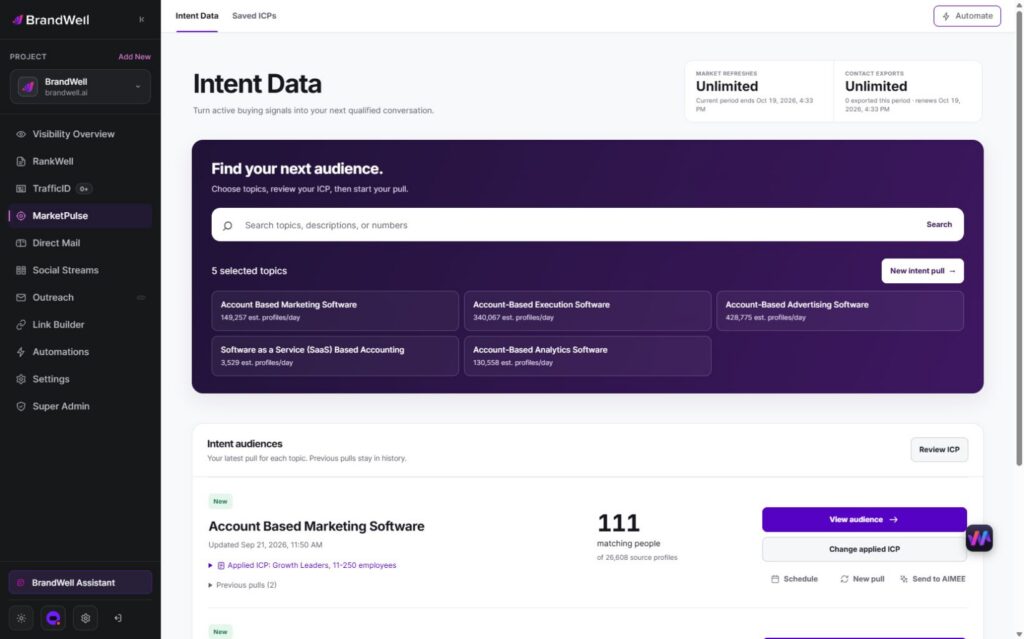
BrandWell MarketPulse: intent data starting at $500/mo. Find people researching topics relevant to what you sell, apply saved ICP filters, and review available contact details before taking action.
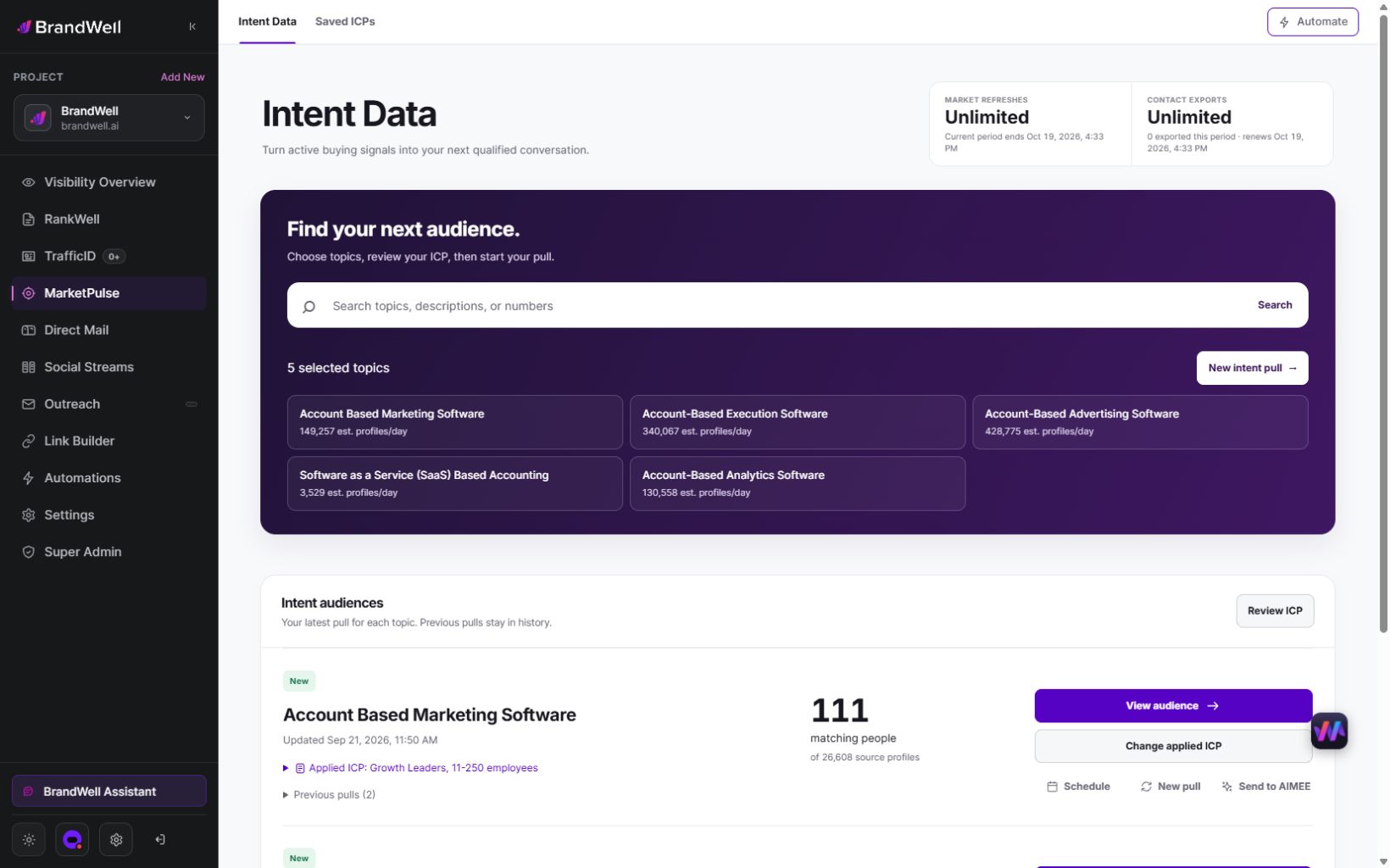
MarketPulse plans are starting at $500/mo. Verify current package scope and offers on the product page.
| Plan | Topics and refreshes | Monthly exports |
|---|---|---|
| Starter | 1 topic, weekly | 25,000 contacts |
| Growth | 3 topics, daily | 100,000 contacts |
| Scale | 10 topics, daily | Unlimited contacts |
Swipe the table to see all columns.
A pull retrieves available data from the previous 24 hours for one topic. Daily use across all included topics provides 90 Growth pulls or 300 Scale pulls in a 30-day month. Weekly Starter pulls vary by calendar month. Available audience size and contact fields vary, and audiences may overlap. Refreshes stop at the plan limit without overage charges.
- Find and qualify: search the topic catalog, save your ICP, and review the people and companies that match.
- Act on the research: export qualified contacts or prepare an Outreach or Direct Mail workflow. Connected products, channel usage, and fulfillment may cost extra.
- Get help from AIMEE: Growth and Scale include AIMEE for the initial user to research accounts and prepare the next step through connected tools.
Agencies and other service businesses can build client deliverables around their available Intent Scans and exports. Keep each client’s scope, permissions, and service fees clear. A subscription is not a promise of a white-label platform or exclusive access to a market.
Explore MarketPulse and watch the demo or compare plans starting at $500/mo. Any early-access discount is a separate, time-limited offer shown to an eligible recipient.
Choose a recurring client decision
Offer the service when a client has a defined market, recurring need to prioritize accounts, an owner for action, and systems capable of recording acceptance and disposition. Promise an agency-branded, controlled flow of qualified signal context into the client’s decision process. A good outcome statement is: the client receives agreed evidence, at an agreed cadence, with confidence, exclusions, next action, and an exception path.
The signal is an input, not a buyer declaration. A company researching a topic may deserve account review, but the signal does not establish which person researched, whether a purchase is active, or whether the account has authority, budget, timing, or fit. The service strategy should help a client make a better next decision under uncertainty.
Avoid the offer when the client wants a one-off list labeled as buyers, demands a guaranteed data volume, has no action capacity, or will not approve purpose and suppression. A software referral, data audit, topic workshop, or standard account-planning engagement may be more appropriate. Managed buyer intent data services for agencies deciding what to sell next should be chosen for recurring operational fit, not novelty.
Assign workflow owners and handoff evidence
The service owner controls scope and commercial decisions. An intent strategist manages topics and qualification. A data operator manages intake, identity states, QA, and destinations. An account manager runs client reviews and change control. The client provides market criteria, system access, named owners, action capacity, and outcome feedback. Privacy, security, legal, and sector reviewers enter based on the actual data and use.
- Write the decision, permitted purpose, sources, destinations, exclusions, and client responsibilities.
- Configure topics, thresholds, fit rules, identity checks, and confidence states.
- Test a minimized sample for relevance, conflicts, suppression, and routing.
- Release approved records on the contracted cadence with evidence and limitations.
- Confirm destination receipt, owner assignment, and client acceptance.
- Collect disposition and exception feedback without rewriting historical evidence.
- Review adoption, data quality, cost, and changes before the next cycle.
The SLA should distinguish acknowledgement, routine delivery, exception response, correction, and service recovery. It should also name client dependencies, planned maintenance, and exclusions. Handoff fields include source, topic, recency, entity level, identity confidence, qualification reason, suppression state, permitted action, destination, owner, and evidence link. BrandWell’s intent-data delivery SOP offers a companion structure for repeatable release and acceptance.
Evaluate capabilities against the service scope
The best toolset supports the service contract. Required capabilities usually include topic and source governance, company and contact identity states, validation, qualification, suppression, client-branded portal or report, CRM or marketing integration, approval gates, exception handling, evidence history, access control, and export. A visually polished dashboard is not enough if it cannot preserve why a record was included.
Evaluate every platform, build path, and white-label option on the same criteria: contracted signal definitions, provenance, recency, identity methods, confidence, permitted uses, correction and suppression, integration, workflow, auditability, security, agency branding, client entitlements, support, and current written price. Mark unavailable facts as unavailable. Do not infer data volume or performance from marketing copy or discovery result order.
AIMEE can prepare a reviewed account brief or proposed operating change through configured connected tools. Preserve the supplied source, uncertainty and client scope. Authorized owners approve pricing, configuration changes and external actions.
Compare build, resell, refer and avoid
| Model | When it wins | Nonnegotiable burden |
|---|---|---|
| Build | The agency has engineering, data governance, differentiated rules, and maintenance capacity. | Sources, security, identity, observability, client access, support, and ongoing change. |
| Resell or white-label | A contracted platform fits the evidence model and lets the agency own the client experience. | The agency still owns qualification, delivery, claims, billing, and client success. |
| Refer | The client needs enterprise procurement, specialized data, or direct platform ownership. | Clear handoff and disclosure of what the agency no longer controls. |
| Avoid | Purpose, rights, client capacity, or a safe outcome promise is missing. | Decline rather than disguise a list or guarantee as a managed service. |
Swipe the table to see all columns.
Also compare a one-off diagnostic and unmanaged software. A diagnostic can establish data readiness and workflows. Software fits a client with an experienced internal operator. The agency service fits when ongoing interpretation, QA, routing, and adoption require ownership. This decision guide should score time to value, control, evidence, client fit, total cost, maintenance, and exit path. Alternatives are not inferior by default.
Price setup and recurring delivery
Separate platform cost from service economics. Setup may include client qualification, purpose and source register, topic design, match rules, integration, sample QA, portal branding, playbooks, and training. Recurring managed buyer intent data services cost includes wholesale and usage, operator time, client meetings, quality review, exceptions, integrations, support, privacy and security work, reporting, and overhead.
Copyable managed-service unit economics
Direct monthly cost = contracted wholesale and usage + delivery labor + QA + support + integration care + governance
Contribution = collected client fee - direct monthly cost
Defined contribution percentage = contribution / collected client fee
Stress test = topic growth + usage variance + exception volume + custom requests + client delays + nonpayment risk
No universal realistic margin can be stated without the agency’s measured inputs. Use scenario planning and actual time records. Keep wholesale, labor, client acquisition, and overhead definitions consistent. Treat customization as a scope change, not invisible service. Managed buyer intent data services benchmarks should be internal and definition-matched before they guide price.
Separate delivery, adoption and outcome ledgers
Use three ledgers. The delivery ledger proves what the agency produced and whether the destination accepted it. The adoption ledger records client review, acceptance, rejection, owner, and action. The outcome ledger preserves the client’s later stage, attribution label, source system, and limitations. Do not merge these into one success count.
Operational KPIs can include on-time accepted delivery, topic relevance feedback, identity conflicts, suppression, destination acceptance, client review, action assignment, and exception resolution. Commercial associations can include meetings, opportunities, pipeline, and revenue only when the client’s records and definitions support them. A missing outcome must remain unavailable.
Managed buyer intent data services ROI requires a documented baseline, full program cost, agreed outcome, evaluation population, and attribution method. A time-series or staged rollout may produce useful evidence, but it does not remove confounding factors. Never convert correlation into causation. Decide in advance which decisions the evidence will inform and use the intent-data SLA guide to keep delivery performance separate from client outcomes.
Choose clients with action and feedback capacity
Best-fit clients have a focused B2B market, recurring account prioritization needs, enough sales or marketing capacity to act, a usable destination system, an accountable owner, and willingness to share disposition. They understand that signals are evidence for prioritization rather than a list of guaranteed buyers. Strong use cases include territory research, account selection, campaign planning, sales prioritization, and client-branded topic reporting.
Exclude clients with no documented purpose, indiscriminate outreach, prohibited or high-stakes uses outside the engagement’s expertise, no suppression, unclear data rights, no destination owner, or a demand for guaranteed volume or commercial results. Also exclude clients whose market is too small, topic set too ambiguous, or action cycle too slow to learn within a reasonable operating cadence.
A fit checklist should cover target definition, topic separability, signal relevance, entity level, identity needs, permitted use, client capacity, integrations, feedback, governance, economics, and exit. If a client fails the action and evidence tests, a workshop or audit may be the better service.
Preserve sources and identity states
Build a traceable record from contracted source to client decision. Include signal type, topic, observation window or recency, company identity, person or contact state if applicable, confidence, qualification rules, suppression, destination, approved action, client acceptance, and outcome evidence. Keep first-party engagement, third-party research, website visitor identity, enrichment, and validation distinct.
Company-level intent can prioritize account research. Website visitor resolution may support a different approved workflow, depending on consent, notices, identity confidence, and contract. Contact validation checks a field under a method; it does not create permission. A qualified account can be routed to human review. An unresolved or suppressed record stops.
Activation workflows should have explicit thresholds, owners, reversible steps, and evidence. Examples include adding an accepted company to an account-review queue, generating an agency-branded topic brief, or asking the client owner to choose a permitted next action. Signal quality and measurement depend on preserving negative evidence, conflicts, and client rejections, not just accepted records.
Control quality, data use and expectation risks
Quality risks include broad topics, stale signals, company ambiguity, false positives, source changes, missing fields, and rule drift. Delivery risks include unstable integrations, duplicates, destination failures, unresolved custom work, and client nonresponse. Privacy and security risks include unclear purpose, excess access, uncontrolled exports, weak suppression, delayed deletion, and vendors outside approved scope. Expectation risk appears when research evidence is called a buyer or when activity is presented as revenue proof.
Maintain a purpose and source register, documented identity states, minimization, access controls, suppression, retention, correction and an incident route. Review actual jurisdiction, data, channel and agreements with qualified owners. These proposed operating controls are not a certification or a universal compliance finding.
Applicability depends on the client, data, jurisdiction, channel, and contract. Authorized legal, privacy, and security reviewers must decide the actual obligations. If a material product, legal, price, or performance fact is unavailable, say unavailable and do not build a claim around it.
Maintain the recurring agency package
The recurring package should specify business decision, contracted signals, topics, identity states, qualification, permitted actions, destinations, owners, cadence, service levels, evidence, exceptions, dependencies, security, privacy, reporting, and change control. Separate standard, configurable, custom, and out-of-scope work. Include a client responsibility matrix, delivery record, exception log, monthly decision brief, and renewal evidence.
MarketPulse supplies topic audiences and saved ICP filtering starting at $500/mo. Agency labor, custom reporting, client access and integrations need separately supported scope, implementation and rights; a subscription is not a turnkey managed-service or white-label portal.
A managed package can use a focused module or broader operating scope, but the agency should add complexity only after the client uses the current delivery. BrandWell’s intent-data service model guide can help separate reporting, activation, and managed operations.
Copyable agent-ready operating review
Use Claude, ChatGPT, or AIMEE with the approved service contract, rulebook, minimized evidence, and client responsibility matrix.

1. Reconcile contracted source, topic, recency, identity state, qualification, suppression, destination, owner, and action.
2. Separate delivery evidence, client adoption, downstream association, and unavailable facts.
3. Flag rule drift, conflicts, stale signals, missing approvals, broken destinations, and out-of-scope requests.
4. Draft an exception queue, evidence-backed client brief, and change proposal.
5. Preserve the original inputs, limitations, and rollback path.

STOP CONDITIONS:
- Do not infer a person, buyer, authority, budget, readiness, permission, or causal outcome.
- Do not invent signals, identities, benchmarks, prices, client actions, or performance.
- Do not change production rules, export data, activate records, post publicly, or contact anyone.

HUMAN APPROVAL REQUIRED:
The client owner approves purpose, market, actions, and disposition. Authorized privacy, security, legal, and sector reviewers approve applicable use. The agency owner approves scope and price. A human approves each rule change, release, and activation.
The agent should make the service easier to inspect, not more autonomous. Human owners remain accountable for context, rights, exceptions, and the decision to act.
Prove the operating loop before expansion
Start with one client decision and prove that the team can receive, review, route, correct, and learn from the evidence. Expand only when adoption and unit economics support the next scope.
Separate recurring delivery from setup recovery
SBA’s business-finance guidance recommends tracking revenue and expenses and distinguishing recurring from nonrecurring costs. Apply that bookkeeping discipline to the agency package. Use consistent accounting definitions and qualified financial review before calling an estimate gross margin or profit.
Keep the software subscription, monthly labor, setup recovery, support reserve, client acquisition and general overhead visible. A client payment and a recorded sale can occur in different periods; choose a consistent basis for the estimate and do not confuse available cash with profitability.
Worked example: setup recovery changes the remainder
Suppose a fictional package charges $2,000 monthly. Defined recurring cost includes $500 in software, $600 in operations and $150 in reporting and support: $1,250 total. The $750 remainder is 37.5% of fees before excluded costs.
Setup requires 12 hours at $100 plus $300 in configuration and testing: $1,500. If the agency recovers this over six service months in its planning model, add $250 monthly. Defined cost becomes $1,500 and the remaining $500 is 25% of fees before acquisition, general overhead, tax and financing. If eight unpriced support hours at $75 occur in one month, that month’s defined cost becomes $2,100, leaving negative $100.
These invented inputs are not typical results or BrandWell agency terms. A six-month recovery assumption does not guarantee six months of payment or a minimum contract; model early cancellation and the actual agreement separately. If the agency instead charges a setup fee, show it separately rather than recovering the same cost twice.
Build a scoped brief with BrandWell
Review an available MarketPulse topic and audience, apply the saved client ICP and preserve the actual preceding-24-hour data window. AIMEE can help draft account context through configured tools. The designated owner reviews fit, source meaning, uncertainty and permitted action before the handoff. Weekly pulls do not automatically retrieve a week’s history.
Frequently asked questions
Does the software price include managed delivery?
No. Agency operations, reporting, custom integrations and client support require their own scope and cost model.
Is the fee minus selected costs net profit?
No. Name the included costs and show acquisition, overhead, tax and other exclusions separately.
Should setup be recovered twice?
No. Distinguish a separate setup fee from an explicit amortization assumption and reconcile both with the actual agreement.
Does a topic observation identify a ready buyer?
Not by itself. Preserve available evidence, uncertainty and a separate review of fit and next action.
Evaluate the topic-data input: explore MarketPulse and current plans.
Reviewed and updated October 3, 2026.

Written by