On this page
- How a language model produces text
- What AI can help a writer do
- What a generated draft does not establish
- Give the model a brief it can work from
- Use a review workflow in RankWell
- Measure the whole writing process
- Copyright requires a separate assessment
- Will AI replace content creators?
- Frequently asked questions
AI writing systems generate text by using learned language patterns and the context you provide to predict and produce sequences of tokens. A fluent answer is not necessarily a verified answer. For business content, the practical task is to combine generation with reliable sources, original expertise and editorial review.
This guide explains the basic mechanism, useful writing tasks and the checks needed before publication. It also separates copyright questions and occupational exposure research from blanket claims about ownership or jobs disappearing.
How a language model produces text
Google’s language-model introduction describes models that estimate the probability of tokens or token sequences in context. Tokens can be words, parts of words or characters. Modern large language models use learned parameters and context to generate output.
Training and generation are different stages. Training develops the model’s learned patterns; generation uses those patterns with the supplied context. A prompt can specify the topic, audience, tone and structure, but it does not certify the truth of the response.
Some writing systems can also use configured sources or connected tools. That is a feature of the system and its settings, not something every generated sentence automatically does. Confirm which sources were actually used and check that they support the statements in the draft.
What AI can help a writer do
- Develop alternative outlines for a defined reader question.
- Draft an explanation from supplied source material.
- Suggest shorter or clearer versions of a passage.
- Adapt an approved idea into another format.
- Identify questions an editor should investigate.
- Generate possible headings or calls to action for review.
Evaluate each task by the finished result. Generating several headline options may be useful even when none should be published unchanged. A summary needs comparison with its source; a product guide needs verification against the current interface.
What a generated draft does not establish
Confident wording does not establish accuracy. A model can produce an incorrect number, a nonexistent reference or instructions that combine old and new product versions. It can also repeat assumptions from the supplied material.
A draft does not establish permission to reuse a quotation, image or customer story. Nor does it prove that a page will rank, that a message will convert, or that a connected action is authorized. Keep source checking and approval as explicit parts of the workflow.
Give the model a brief it can work from
Specify the reader, task, allowed facts, source material, scope and desired output. State what is unknown and ask for gaps to be flagged rather than filled with invented detail.
Hypothetical brief: “Draft a checklist for a small IT services company’s first client onboarding call. Use the approved service scope and notes below. Separate preparation, questions and follow-up. Do not invent prices, response-time guarantees, customer results or integrations. Flag missing information for the account manager.”
The brief makes the intended task concrete. It still requires a reviewer to check that the draft followed it. Compare the output with the service scope, remove unsupported additions and confirm the actual next step.
Use a review workflow in RankWell
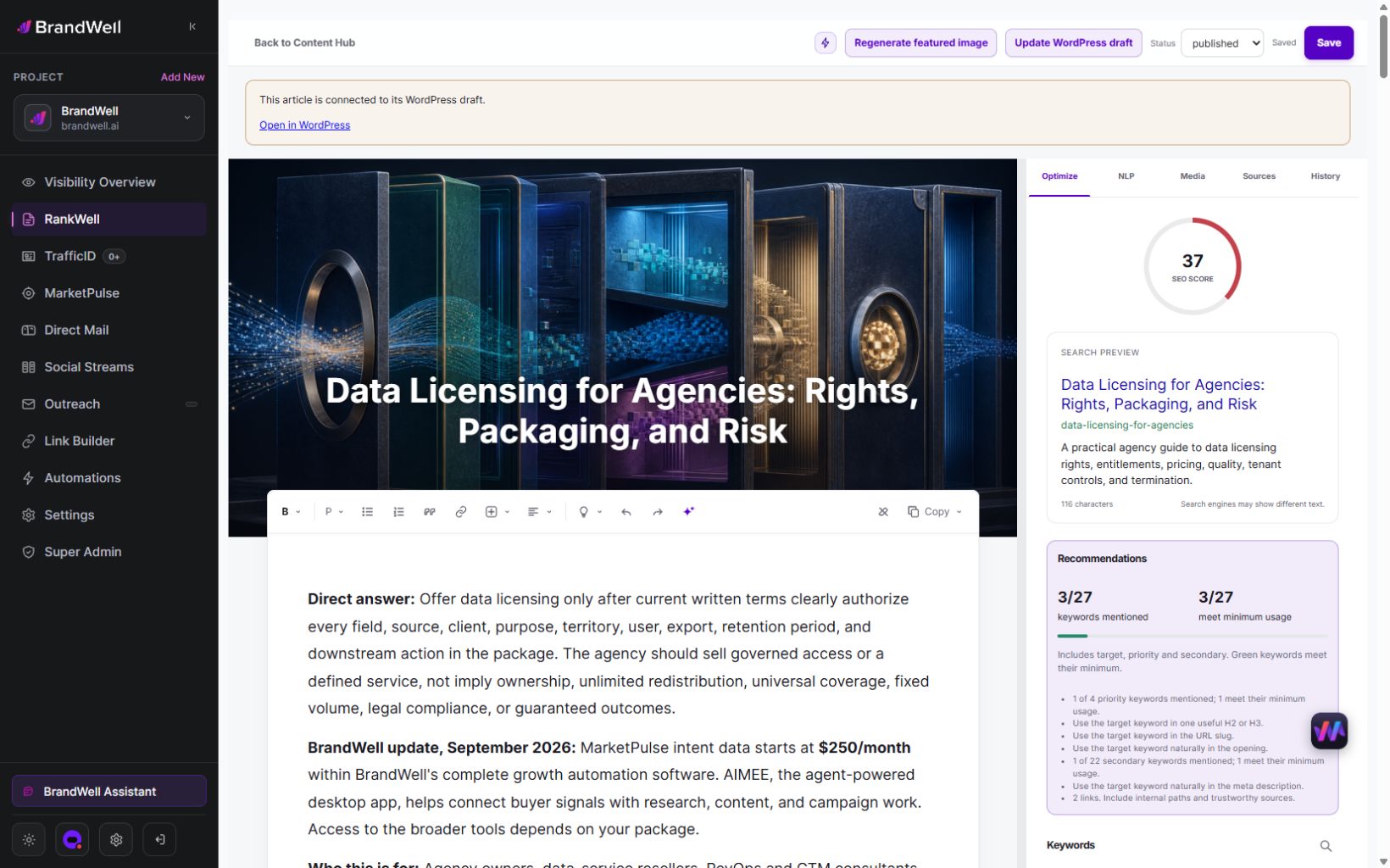
RankWell is the content workflow in BrandWell’s current portal. The Content Hub supports article, strategy, queue and calendar work. Its editor brings together content, search preview, recommendations, NLP, media, sources and history.
- Define a reader question and gather reliable evidence.
- Develop the draft from the approved brief and sources.
- Check factual statements, quotations, dates and product instructions.
- Add a useful original example or current screenshot.
- Review structure, readability, links and mobile formatting.
- Approve publication through the connection configured in your workspace.
Use Visibility for keyword research. Use configured Automations to coordinate tools, owners and approval steps where appropriate. Available actions depend on your connections and permissions.
Measure the whole writing process
Do not compare generation time with the full time needed to research, write and publish manually. Include briefing, factual review, editing and publication checks in both workflows.
Hypothetical calculation: A manual process takes 240 minutes. An AI-assisted process takes 30 minutes to brief, 25 to draft, 90 to check facts, 60 to edit and 20 to publish: 225 minutes total. That is 15 minutes less, or 6.25% of the manual baseline. It is an illustration, not a BrandWell result or expected saving.
Also record corrections, usefulness and downstream outcomes. A fast draft that takes longer to verify may not save time. A process should be judged against comparable work with comparable acceptance standards.
Copyright requires a separate assessment
The U.S. Copyright Office’s January 2025 report announcement explains that protection can apply where a human determines sufficient expressive elements, including creative arrangements or modifications. Merely supplying prompts is not enough. Using AI as assistance does not itself bar copyrightability.
That is U.S. guidance, not a global ownership rule or clearance for a particular asset. Separate the copyrightability of your contribution from permission to use other people’s material. Check applicable terms and obtain advice for a specific commercial rights question.
Will AI replace content creators?
The ILO’s 2025 research brief estimates that one in four workers globally is in an occupation with some generative-AI exposure. Exposure measures potential effects on tasks; it is not a count of jobs already lost. The brief emphasizes transformation and continued human input.
A list of “safe” or “doomed” occupations would oversimplify that evidence. For a content team, examine specific tasks, quality requirements, accountability and the skills needed to review outputs. Set owners for factual approval, product accuracy and publication rather than predicting an entire profession’s future from a drafting demonstration.
Frequently asked questions
Does AI automatically look up every fact?
No. Source retrieval depends on the system and configuration. Check the material actually used and verify important claims.
Can I publish the first draft?
Review it against the brief, evidence and current product information first. A coherent response can still be wrong.
Does AI assistance guarantee originality or rankings?
No. Check attribution, rights, usefulness and the finished page. Measure actual performance separately.
Reviewed and updated October 3, 2026.

Written by
Julia McCoy has contributed articles to BrandWell on content marketing, writing, and search engine optimization. This archive retains her original bylines; individual articles may be updated by the BrandWell editorial team.