On this page
- Current MarketPulse workflow
- Separate shared methods from client decisions
- Assign owners and client-specific gates
- Choose tools that preserve client context
- Compare manual, assisted and branded delivery
- Price setup, recurring work and exceptions
- Measure delivery, adoption and workload
- Match complexity to client readiness
- Preserve evidence through activation
- Control cross-client and delivery risks
- Maintain the agency service package
- Test the resource boundary, not just the client label
- Worked example: add clients within review capacity
- Frequently asked questions
Direct answer: Run multi-client intent operations as isolated client control planes on one governed service backbone. Standardize the signal states, delivery method, evidence, and change process, while keeping every client’s topics, rules, users, destinations, retention, and approvals separate. Add clients only when exception capacity and quality remain within the limits you have defined.
Current MarketPulse offer: intent-data plans start at $500/mo. See the product, demo, and current plans. Updated October 3, 2026.
A larger shared spreadsheet is not a multi-client operating model. The useful test is whether your team can trace any delivered record back to the correct client configuration, explain why it qualified, prove where it went, and reverse a bad change without touching another tenant.
Who this is for: Agency owners, delivery leaders, RevOps consultants, and demand generation teams operating intent services for more than one client. Start with a single-client process first if you cannot yet document signal meaning, ownership, acceptance, and correction.
Current MarketPulse workflow
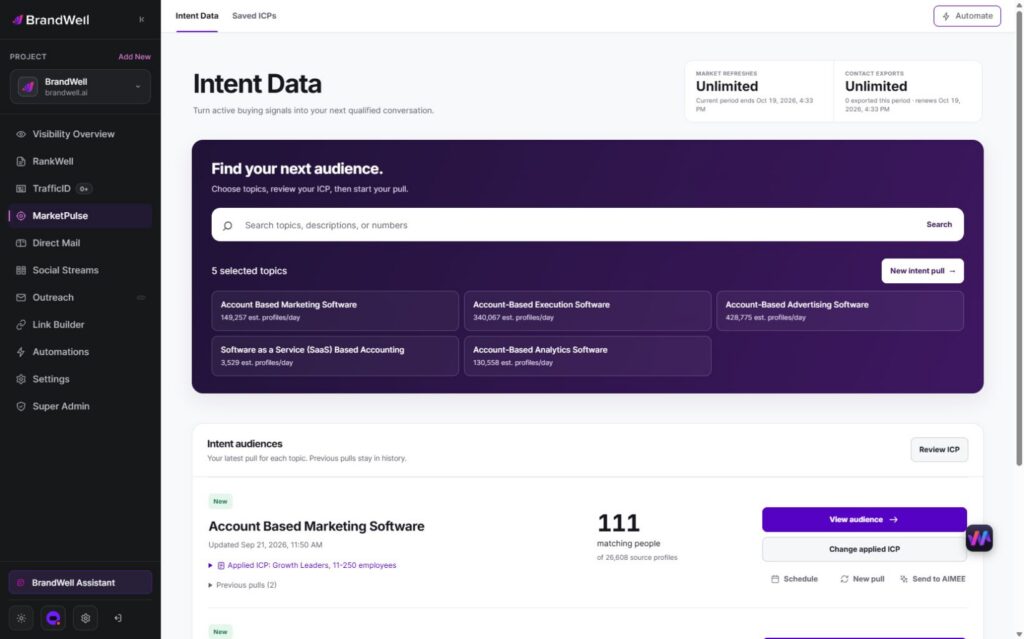
BrandWell MarketPulse: intent data starting at $500/mo. Find people researching topics relevant to what you sell, apply saved ICP filters, and review available contact details before taking action.
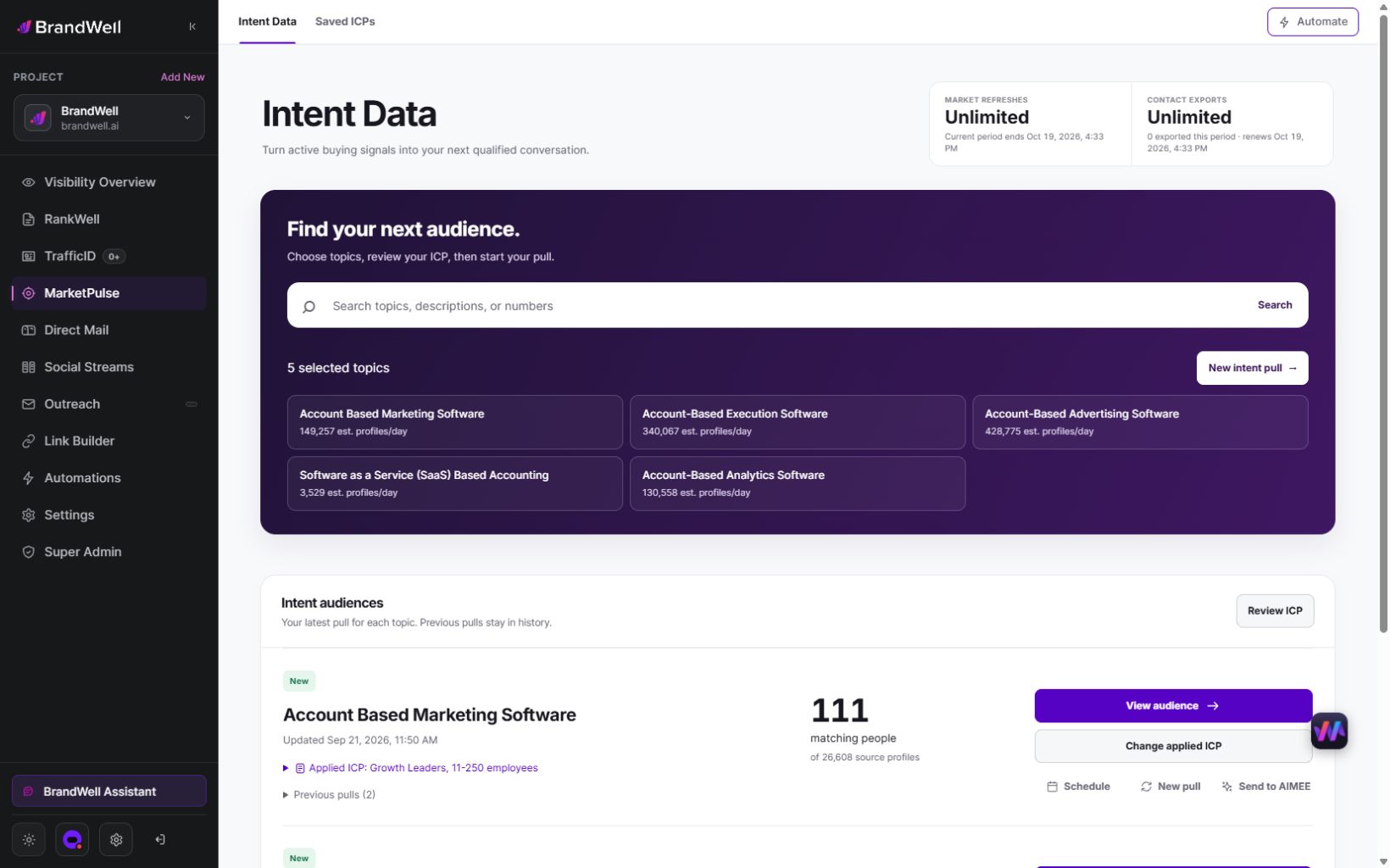
MarketPulse plans are starting at $500/mo. Verify current package scope and offers on the product page.
| Plan | Topics and refreshes | Monthly exports |
|---|---|---|
| Starter | 1 topic, weekly | 25,000 contacts |
| Growth | 3 topics, daily | 100,000 contacts |
| Scale | 10 topics, daily | Unlimited contacts |
Swipe the table to see all columns.
A pull retrieves available data from the previous 24 hours for one topic. Daily use across all included topics provides 90 Growth pulls or 300 Scale pulls in a 30-day month. Weekly Starter pulls vary by calendar month. Available audience size and contact fields vary, and audiences may overlap. Refreshes stop at the plan limit without overage charges.
- Find and qualify: search the topic catalog, save your ICP, and review the people and companies that match.
- Act on the research: export qualified contacts or prepare an Outreach or Direct Mail workflow. Connected products, channel usage, and fulfillment may cost extra.
- Get help from AIMEE: Growth and Scale include AIMEE for the initial user to research accounts and prepare the next step through connected tools.
Agencies and other service businesses can build client deliverables around their available Intent Scans and exports. Keep each client’s scope, permissions, and service fees clear. A subscription is not a promise of a white-label platform or exclusive access to a market.
Explore MarketPulse and watch the demo or compare plans starting at $500/mo. Any early-access discount is a separate, time-limited offer shown to an eligible recipient.
Separate shared methods from client decisions
Begin with a narrow accepted-delivery outcome. For one client, that might be a reviewed weekly topic-intent report with an accountable sales owner. For another, it might be a qualified company record routed into a defined CRM queue. Neither outcome is a promised meeting or sale. It is a delivery the client understands, accepts, and can act on.
Put common mechanics in the backbone: intake fields, identity states, qualification vocabulary, review evidence, delivery receipts, correction handling, and incident escalation. Put client decisions in the control plane: approved purpose, selected topics, audience, exclusions, users, destinations, retention, cadence, and activation authority. This distinction lets you reuse a method without mixing the decisions that make each service appropriate.
Create a tenant charter before configuration. Give it a client ID and version. Record the commercial package, modules, signal sources, allowed identity states, service clock, downstream owner, and stop conditions. A charter makes time to value repeatable because the team is not rediscovering scope in email threads. It also gives an operator a single source for deciding whether a request belongs in the standard service or needs a priced change.
Design the first accepted delivery backward from a client decision. If an account owner will review five relevant companies every Monday, the service must produce a short, explained queue before that meeting. If the client wants a monthly market narrative, the service must preserve topic changes and supporting records across the month. This prevents an impressive volume of signals from becoming an unowned backlog.
Write a repeatability test for the service. A different trained operator should be able to use the same charter, run the same checks, produce the same qualification state, and identify the same exception. If the result depends on private knowledge held by one strategist, capture that decision rule before adding volume. The broader multi-client intent service scaling guide can then be used to set admission and capacity gates.
Keep client value and operating reuse in balance. Reuse the data model, state names, checklist, and evidence format. Customize the topics, fit logic, action play, schedule, branding, and service level. Too little reuse creates an agency full of bespoke projects. Too little client context creates a generic feed that buyers struggle to use.
Assign owners and client-specific gates
Use a control sequence in which every gate creates evidence. The workflow should live inside an intent-data delivery SOP, but the client charter supplies the tenant-specific values. Assign one accountable owner at each gate, even when software performs the first pass.
The eight-gate tenant control plane
- Charter: approve purpose, package, topics, identity states, cadence, destinations, and prohibited actions.
- Isolate: create client-scoped credentials, rules, storage, prompts, exports, and evidence logs.
- Configure: map inputs to the client’s audience, exclusions, qualification logic, and owner fields.
- Validate: test representative, edge, suppressed, stale, and deliberately invalid records.
- Review: sample eligible output and route ambiguous items into the correct tenant exception queue.
- Deliver: send only through approved destinations and capture a receipt or named acceptance.
- Reconcile: compare source, reviewed, delivered, rejected, corrected, and actioned states.
- Change safely: test a proposed change, obtain approval, deploy by tenant, and retain rollback evidence.
Define SLAs around events the agency controls. Examples include time from an eligible record entering review to an accepted delivery, time to acknowledge a severity-one data mix-up, or time to correct a rejected mapping. Document business hours, paused states, client dependencies, severity definitions, and remedies through a separate intent-data SLA design process. Do not turn an operational SLA into a promise of response, pipeline, or revenue.
Choose tools that preserve client context
The best stack is the one that preserves tenant context across six capabilities. You need a client registry, isolated configuration, controlled ingestion, review queues, destination connectors, and an evidence ledger. A white-label portal can improve the client experience, but it does not replace access control, scoped credentials, or delivery reconciliation underneath.
- Client registry: stores the current charter, package, data-use purpose, users, owners, and contract-scoped entitlements.
- Configuration layer: versions topics, filters, qualification rules, suppression, branding, schedules, and destinations by tenant.
- Signal and identity layer: preserves source, timestamp, identity state, validation result, and uncertainty instead of flattening everything into a lead.
- Operations console: separates normal review, exceptions, incidents, changes, and approvals.
- Client delivery surface: presents branded reports or portal views without exposing another client’s data or the agency’s wholesale controls.
- Evidence ledger: connects input, decision, delivery, correction, and client feedback under immutable IDs.
Evaluate integrations with negative tests, not just a successful demo. Try a wrong tenant credential, a revoked user, a duplicate record, a missing required field, a stale event, and an unavailable destination. The tool should stop safely and show an operator what happened. If it silently falls back to a shared default, it is not ready for multi-client use.
Compare manual, assisted and branded delivery
A manual desk is flexible and useful while discovering the service, but control depends heavily on operator attention. Rules-assisted operations reduce recurring work while preserving human review for ambiguity. A white-label operating system adds a consistent client experience and reseller controls. It is valuable when it also preserves the underlying tenant boundaries, not when it merely changes colors on a shared feed.
| Approach | Best fit | Primary strength | Main constraint |
|---|---|---|---|
| Manual desk | One or two discovery clients | Fast learning and flexible judgment | High operator variance and weak capacity visibility |
| Rules-assisted | Stable service with known exceptions | Repeatable handoffs with review where needed | Requires disciplined versioning and monitoring |
| White-label system | Agencies selling recurring service across clients | Branded delivery, entitlements, reusable modules | Needs clear support, billing, and configuration boundaries |
Swipe the table to see all columns.
Do not select one approach for every stage. An agency can discover a new topic package manually, automate stable qualification and reporting, and deliver it through a white-label portal. The right progression moves repeated work into controls while leaving judgment, exceptions, client promises, and public actions with people.
Price setup, recurring work and exceptions
Model cost by work driver rather than by record count alone. Separate the one-time effort to charter, configure, integrate, test, brand, and train from the recurring effort to review, handle exceptions, report, support users, maintain topics, and reconcile outcomes. Add a reserve for incidents and change requests, because those are capacity consumers even when the regular feed is quiet.
Copyable tenant economics worksheet
Setup cost = charter hours + configuration hours + integration hours + validation hours + training hours + allocated platform onboarding.
Monthly delivery cost = routine review + exception handling + reporting + client support + maintenance + allocated platform cost + risk reserve.
Contribution estimate = collected client fee – monthly delivery cost – amortized setup recovery – expected credits or rework.
Measure delivery, adoption and workload
Use a metric ladder so operational proof is not confused with commercial attribution. Time to value can be measured from approved charter to first accepted delivery. Quality can include required-field completeness, validation pass rate, correct tenant routing, duplicate rate, correction rate, and exception aging. Adoption can include report views, accepted deliveries, assigned owners, and completed approved actions.
Outcome evidence belongs in a separate layer: replies, meetings, qualified opportunities, influenced pipeline, or revenue recorded by the client’s systems. Preserve denominators, comparison windows, source limitations, and the client’s contribution. Do not credit the intent service for an outcome simply because a record appeared earlier in the timeline.
For capacity, track recurring minutes, exception minutes, incidents, overdue reviews, and work in progress by tenant. A service can look successful at the client level while consuming more unpriced effort than the agency can support. The scale decision should consider both accepted client value and a realistic cost-to-serve trend.
Match complexity to client readiness
A low-maturity client needs a smaller action surface. Start with a reviewed branded report, a named owner, and one follow-up play. A client with reliable CRM ownership can accept structured routing, qualification states, and feedback fields. A mature RevOps team may be ready for multiple sources, account scoring, workflow automation, and outcome reconciliation across systems.
Vary complexity, not control quality. Every package still needs a purpose, tenant boundary, identity labels, suppression, owners, delivery receipt, correction path, and approval rules. What changes is the number of modules, frequency, destinations, custom rules, reporting depth, and support commitment.
Use a maturity gate before each expansion. Confirm the current delivery is understood, owners are acting on it, rejected records are being explained, and the next integration has a defined business use. Adding another signal source to an ignored queue does not improve the service. It expands cost and failure surface.
Preserve evidence through activation
Preserve four distinctions: third-party topic activity, first-party site activity, company identity, and possible person or contact identity. Each can have different freshness, confidence, permissible uses, and actions. Record the source event and identity state separately so a client does not interpret an account-level signal as proof that a named individual performed an action.
Qualification should combine the client’s account fit, signal relevance, timing, exclusions, and action capacity. Activation should follow an approved play such as research, ad audience review, personalized outreach draft, account-owner alert, or branded report. The delivery record should show what was approved, by whom, where it went, and whether the client accepted or corrected it.
Outcome evidence needs durable identifiers across signal, account, contact, action, and CRM outcome. When a join is uncertain, label it uncertain. When the client changes a stage definition, version the metric. Evidence discipline matters more than producing a flattering dashboard.
Control cross-client and delivery risks
Cross-client exposure is a serious operational risk. Use appropriately scoped access, storage, prompts, exports, caches, test records, destinations and support permissions. Verify the actual authorization boundary; a configuration label alone does not establish isolation. Missing client context or ambiguous routing should stop delivery.
Other risks include scope drift, unsupported identity claims, stale topics, duplicate delivery, inappropriate use, excessive retention, client-side forwarding, broken integrations, and outcome overclaiming. Maintain an incident path that can suspend a tenant, preserve evidence, notify the correct owner, correct downstream records, and document recurrence prevention.
Agent-ready tenant change review
Role: Review one proposed change for one named client tenant.
Inputs: approved tenant charter, current version, requested change, test cases, destinations, retention, and owner.
Tasks: identify affected rules and data; draft tenant-scoped tests; list possible cross-client effects; propose rollback; summarize evidence needed for approval.
Never: load another tenant's records, infer permission, publish, contact a person, change pricing, deploy, or send data.
Stop when: tenant ID is missing, authorization is unclear, test evidence fails, identity meaning changes, or any shared default could be invoked.
Output: draft change record for human review only.
Human approval: required before configuration, deployment, outreach, export, or client communication.
Maintain the agency service package
A recurring white-label package needs more than recurring data. Include an agency-defined promise, client-specific charter, branded delivery, module entitlements, topic and filter maintenance, documented identity states, QA, service cadence, support boundaries, change allowances, evidence reporting, billing ownership, renewal criteria, and an exit or export process.
Define the boundary between wholesale platform support, agency operations, and client action. The platform should not silently make the agency’s client promise. The agency should not promise a source capability it has not contracted. The client should know which decisions remain theirs, including outreach approval, account ownership, and treatment of downstream outcomes.
AIMEE can help prepare a client-scoped brief or proposed change through configured connected tools. Preserve client context, source timing and uncertainty, and retain the designated approval for external delivery or configuration changes.
MarketPulse supplies topic audiences and saved ICP filtering starting at $500/mo. Build appropriately scoped client deliverables around available pulls and exports. Separate client access, custom portals, routing, evidence ledgers and agency operations need separately supported implementation and confirmed rights.
Make the next client an operational test, not a capacity surprise
Complete one tenant charter, run the negative tests, calculate actual setup and recurring minutes, and prove that every delivery can be traced and corrected. Only then admit the next client or expand the package.
Test the resource boundary, not just the client label
OWASP’s direct-object-reference guidance explains that complex identifiers do not replace authorization checks. A difficult-to-guess report URL is not evidence that another client’s report is protected.
For an authorized test of a proposed custom service, use synthetic records for Clients A and B. As A, attempt to open or export B’s test report through its resource reference; verify denial. Repeat after revoking access and test shared download links. Record the scope, expected result, actual result and remediation. This is an agency implementation test, not a security certification of BrandWell or proof that a custom portal is included.
Worked example: add clients within review capacity
A fictional team has 40 monthly delivery hours and reserves eight for incidents and changes, leaving 32 for routine work. Each of four clients requires six routine hours and two expected exception hours. Four clients therefore consume 32 hours. A fifth adds eight hours and would use the full 40, eliminating the planned reserve. Do not count the reserve as spare routine capacity.
Assume four clients each pay $1,200 monthly, shared software and infrastructure cost $1,000, and the 32 delivery hours cost $75/hour. Fees are $4,800 and defined cost is $1,000 + $2,400 = $3,400. The $1,400 remainder is 29.2% before acquisition, general overhead, setup recovery, tax and financing costs. An additional unpriced eight-hour incident adds $600, reducing the remainder to $800, or 16.7%. These numbers are invented, not typical results or a BrandWell agency quote.
Evaluate both financial and workload constraints before expansion. A nominally positive margin does not create operator hours, and a software allowance does not automatically authorize client sharing or separate access. Confirm the actual use and agreement.
Prepare a separate reviewed brief for each client
Review an available MarketPulse topic, apply the saved client ICP and preserve its actual preceding-24-hour pull window. Keep each client’s brief and destination distinct. AIMEE can draft context through configured tools; the responsible owner verifies scope and approves the handoff. Weekly pulls do not provide a full previous week’s historical catch-up.
Frequently asked questions
Does MarketPulse include a multi-client portal?
The topic subscription supplies its stated audiences and export allowances. Custom client access, branding and delivery require separate confirmation.
Does a random report URL prove isolation?
No. Authorization must protect access to the actual resource and export operation.
When should another client be added?
When supported rights, tested delivery controls, routine workload and a realistic exception reserve support the expansion.
Can all clients use one qualification rule?
Shared methods can be reused, but approved fit, exclusions, source meaning and destinations must retain the correct client context.
Evaluate the topic-data input: explore MarketPulse and current plans.
Reviewed and updated October 3, 2026.

Written by